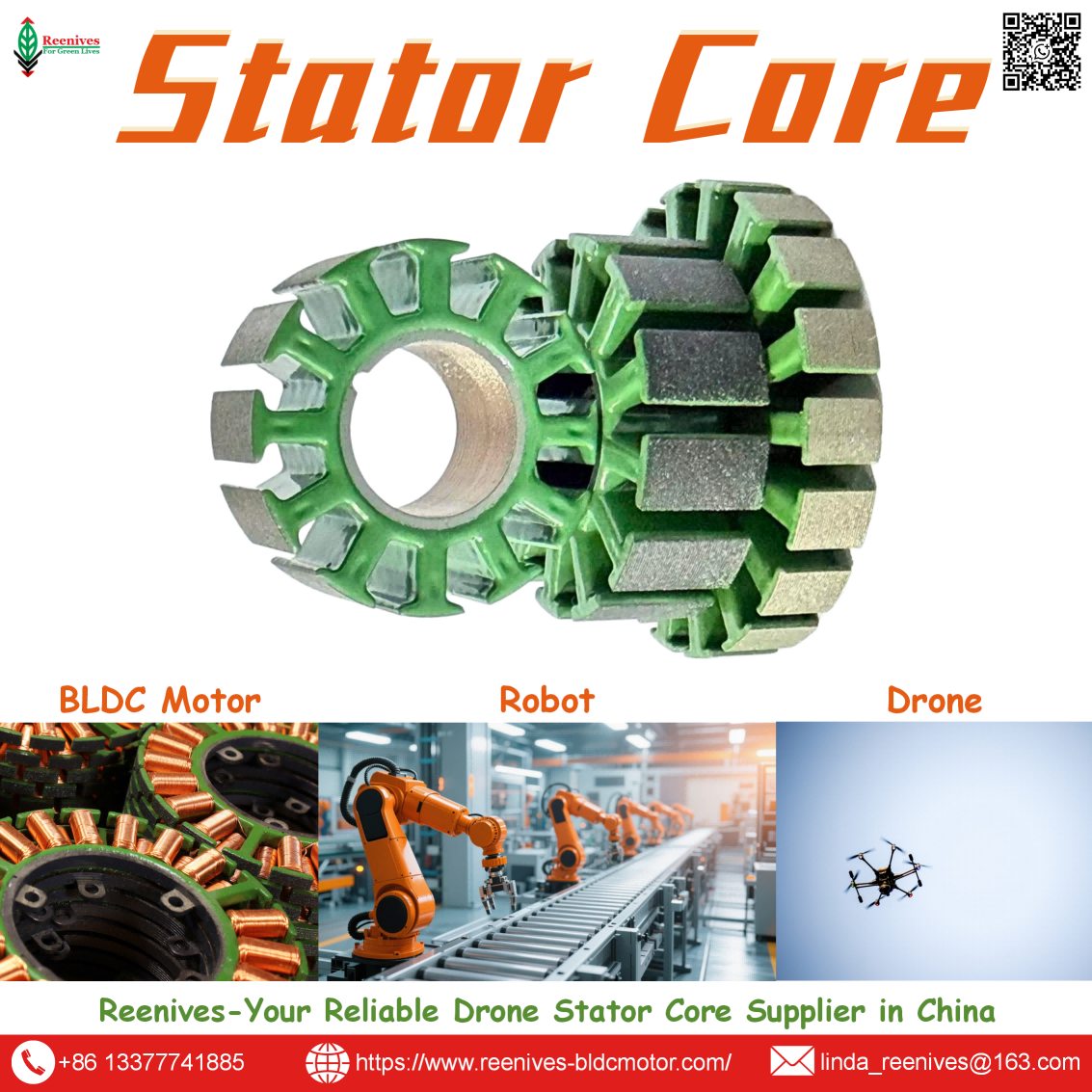
What is Electric Motor Stator?

Electric Motor Stator — The Laminated Core That Decides Whether a Drone Motor Holds Hover or Enters Thermal Runaway
A drone motor does not fail because the propeller demanded too much torque. It fails because the electric motor stator — the stationary laminated core inside the motor — reached a temperature the winding insulation could not survive, and the resulting phase-to-phase short took the propulsion system down with it. The stator is the heaviest single component in most UAV outrunner motors, the primary path for magnetic flux, and the component where the dominant loss (copper loss in the windings it carries, plus iron loss in the steel itself) is generated. Yet it is routinely specified by outer diameter and stack height alone, as if it were a structural spacer rather than a thermal and electromagnetic component. This guide is written for drone motor engineers and B2B buyers who need to specify, compare, or troubleshoot electric motor stators against real thermal duty cycles — not catalogue dimensions.
Table of Contents
- What Is an Electric Motor Stator?
- Slotted vs. Slotless: Which Stator Core Architecture Suits UAV Propulsion?
- Parameters That Separate a Usable Stator Core from a Thermal Liability
- Where Electric Motor Stator Performance Shows Up in UAV Propulsion
- Selection Checklist: Five Steps Before You Approve a Stator Core Spec
- FAQ: Electric Motor Stator Procurement Questions
- Summary & CTA
What Is an Electric Motor Stator?
An electric motor stator is the stationary electromagnetic assembly of a rotating electrical machine. It consists of a laminated steel core — thin electrical steel sheets stacked and bonded together — arranged either as a ring with inward- or outward-projecting teeth and slots, or as a smooth cylindrical bore in slotless designs. The laminations are individually insulated to interrupt eddy-current paths through the core thickness, which is why the stack is laminated rather than machined from solid steel. Windings are placed in the slots (slotted designs) or formed as a self-supporting cylinder in the air gap (slotless designs).
In a drone brushless DC (BLDC) motor, the stator performs two jobs simultaneously that cannot be optimized in isolation:
| Stator Function | What It Means Physically | Drone-Specific Consequence |
|---|---|---|
| Magnetic flux path | Provides a low-reluctance path for the rotating field that interacts with the rotor’s permanent magnets | Determines torque per amp and therefore the thrust available at a given current |
| Primary heat exchanger | Receives copper loss from the windings and iron loss from its own laminations, and conducts that heat toward the housing and airflow | Sets the continuous current rating — the number that actually constrains payload and flight time |
A stator sized only to “max current” is not sized for a drone. The maximum current label on a UAV motor is usually a burst rating; the true limit is the winding insulation temperature class after thermal steady state, and the stator core is the component that decides how quickly that limit is reached.
Slotted vs. Slotless: Which Stator Core Architecture Suits UAV Propulsion?
Electric motor stators for UAV motors divide into two architectural families, and the choice is dictated by whether the thermal and performance bottleneck is torque density at hover or iron loss at high rotational speed.
Slotted stator cores use teeth and slots to carry concentrated windings. The teeth increase magnetic loading and torque density — a slotted motor of a given outer diameter can typically fit more copper into the available slot area — and the teeth create a direct conduction path from the hot winding bundle into the stator core and onward to the housing. This makes slotted stators the practical default for multirotor hover and climb, where copper loss dominates and the duty cycle includes sustained current. The trade-off is cogging torque and tooth-tip iron loss at high electrical frequency.
Slotless stator cores eliminate teeth entirely. The winding is a self-supporting cylinder in the air gap, and the absence of tooth tips means iron loss is dramatically reduced at high speed and cogging torque is virtually eliminated. A 4 kW-class drone propulsion study comparing slotless and slotted stators concluded that a slotless stator with Halbach magnet configuration achieves high power density, very low cogging torque and torque ripple, and sinusoidal back EMF — attributes that matter when the mission profile is dominated by high-speed cruise rather than hover. The trade-off is lower torque density and a winding that relies more heavily on potting and the stator body to extract heat, because there is no tooth conduction path.
| Selection Signal | Slotted Stator Core | Slotless Stator Core |
|---|---|---|
| Dominant UAV requirement | High torque density; sustained hover and climb | High-speed cruise efficiency; minimal vibration and cogging |
| Primary loss mechanism | Winding copper loss (I²R) | Iron loss at high electrical frequency |
| Thermal advantage | Conduction path through teeth to core and housing | Low core loss reduces heat generation at source |
| Thermal risk | Tooth-body hot spot; slot liner degradation | End-winding heat trapped without tooth conduction |
| Typical drone use | Heavy-lift, agricultural, cargo multirotors | High-speed fixed-wing / VTOL cruise, precision inspection, gimbal systems |
For most 5-inch to heavy-lift multirotor platforms, slotted is the baseline. Slotless enters the specification when continuous RPM is high enough that iron loss becomes the thermal constraint, or when cogging torque and torque ripple are incompatible with the payload’s precision requirements.
Parameters That Separate a Usable Stator Core from a Thermal Liability
Specifying an electric motor stator for a drone requires four parameters that directly control iron loss, copper loss coupling, and air-gap magnetic performance. The values below are drawn from published motor design research, supplier manufacturing data, and UAV-specific thermal analysis — use them as a review baseline, not a substitute for prototype validation on your duty cycle.
| Parameter | Practical UAV Baseline | What Happens If You Ignore It |
|---|---|---|
| Lamination thickness | 0.2 mm thin silicon steel for high-speed drone motors | Thicker steel → higher eddy-current loss → core heats continuously at cruise |
| Stacking factor | 95–97% for well-controlled thin laminations | Low factor → reduced effective steel → higher current for same torque |
| Bore / air-gap tolerance | ±0.05 mm critical dimensions; 0.2–1.0 mm air gap | Loose gap → flux loss, higher copper loss, vibration |
| Slot/pole electrical frequency | Evaluate iron loss at max continuous RPM frequency | 50/60 Hz data misleads; core is lossy at UAV frequencies |
Where Electric Motor Stator Performance Shows Up in UAV Propulsion
The stator is not a passive structural component. It determines whether the propulsion system can sustain a hover, complete a transition, or survive a hot-day sortie. The market context reinforces why this matters: the global drone motor market was estimated at $3.8 billion in 2024 and is projected to reach $8.8 billion by 2030, with brushless motors growing at a 16.2% CAGR. As payloads and endurance requirements climb, the continuous current rating — which is a stator thermal limit — becomes the constraint that payload calculations must respect.
Sustained hover and thermal steady state. In hover, current is roughly constant and the stator reaches thermal steady state within minutes. A stator with high iron loss at hover electrical frequency heats continuously, even before copper loss is considered. The flight controller may not see a fault until winding insulation has already begun to degrade. Thin laminations and a high stacking factor preserve the thermal margin that determines usable hover time.
Throttle transients and burst ratings. A drone motor’s “max current” specification is usually a burst rating. Copper loss is quadratic in current; a 30-second burst at twice hover current generates roughly four times the copper loss. The stator core’s thermal mass and conduction path determine how quickly that heat reaches the windings and whether the next burst begins from an already-elevated baseline. Repeated burst duty cycles accumulate thermal cycling that accelerates insulation aging.
High-ambient and agricultural UAV duty. Agricultural spraying drones and inspection platforms often operate above 35°C ambient, where the stator-to-ambient delta is reduced. The same stator that holds insulation class limits in a 25°C lab can exceed them in the field. Stator selection must use worst-case ambient, not nominal test conditions — and the stator’s iron loss at that operating point is part of the heat load.
Selection Checklist: Five Steps Before You Approve a Stator Core Spec
- Define continuous current, duty cycle, and worst-case ambient — not just stator diameter and Kv. The familiar four-digit motor size (e.g., 2812) describes stator diameter and height, and taller stators favor top speed while wider stators favor low-speed handling. But thermal survival is set by continuous current, burst duration, ambient temperature, and airflow. Specify these first; dimensions follow.
- Calculate electrical frequency at maximum continuous RPM and require iron-loss data at that frequency. Use fe = RPM × (poles/2) / 60. For a 36-slot/40-pole stator at 10,000 rpm, that is approximately 3,333 Hz. If a supplier can only provide 50/60 Hz loss data, the stator is not specified for high-speed UAV duty. Ask for W/kg iron-loss curves at the actual operating frequency.
- Choose lamination thickness against the dominant loss mode. For high-speed drone stators, evaluate 0.2 mm thin silicon steel as the baseline; step to thicker gauges only if loss modeling confirms thermal margin. Pair thickness with stacking factor — a thin lamination with a poor stacking factor gives back much of the loss benefit through reduced effective steel.
- Specify bore diameter, air gap, and concentricity as a matched set with the rotor. Require ±0.05 mm on critical stator dimensions and a defined air-gap budget (typically 0.2–1.0 mm for drone motors). Confirm the measurement method (CMM vs. air gauge) and require air-gap concentricity data (TIR) in the PPAP documentation. An air gap that is correct on average but eccentric will produce unbalanced magnetic pull, vibration, and localized heating.
- Validate with hot-spot measurement in the actual mounting and airflow condition. A thermistor on the core or a thermal camera reading on the bell does not give the winding hot-spot temperature. Require winding resistance-based hot-spot estimation or embedded thermocouple data at continuous current in the worst-case ambient. The acceptance criterion is hot-spot temperature within the insulation class after thermal steady state — not a calculated efficiency or an averaged case temperature.
FAQ: Electric Motor Stator Procurement Questions
Q1: Is 0.2 mm lamination thickness always better than 0.35 mm for a drone stator?
For high-speed drone motors, 0.2 mm is the practical baseline because thinner laminations limit eddy-current circulation and can cut core loss by up to 40% compared with 0.35 mm at high electrical frequency. However, thinner steel requires more laminations for the same stack height, increasing stamping and handling cost, and the benefit depends on the stacking factor actually achieved. For low-speed, cost-constrained designs, 0.35 mm may remain acceptable. The decision should be made against measured iron loss at your maximum continuous RPM, not against a generic material grade.
Q2: What air gap should I specify between the stator bore and the rotor for a drone BLDC motor?
Reenives manufacturing data for drone brushless motors specifies a typical air gap of 0.2 mm to 1.0 mm, depending on motor size and rotor design, with ±0.05 mm tolerance on critical stator bore and rotor outer diameter dimensions. A smaller gap increases flux and torque density but demands tighter concentricity and bearing stiffness; a larger gap is more tolerant of manufacturing variation but reduces flux and forces higher current for the same torque. Specify the gap and the concentricity (TIR) together, and confirm that the rotor design uses the same air-gap budget.
Q3: Does a slotless stator always run cooler than a slotted stator in a drone motor?
No. Slotless stators reduce iron loss because the absence of teeth eliminates flux concentration at tooth tips, and they eliminate cogging torque. But slotted stators provide a direct conduction path from the winding through the teeth into the core and housing. A slotless motor with poor winding potting can run hotter at high continuous current because the end-winding heat has no tooth conduction path out of the winding cylinder. “Cooler” depends on which loss mechanism dominates the duty cycle — iron loss at high speed or copper loss at sustained hover.
Q4: How do I know a stator supplier’s iron-loss claim is relevant to my drone motor’s operating point?
Ask for iron-loss data in W/kg at the electrical frequency corresponding to your maximum continuous RPM, not at 50/60 Hz. A 14-pole motor at 10,000 rpm runs at approximately 1,167 Hz; a 40-pole motor at the same speed runs at approximately 3,333 Hz. A supplier who can provide loss curves at UAV frequencies has the test capability and engineering depth to support a cooler stator design. If the data is only available at power frequency, the claim does not cover your operating condition.
Q5: What tolerance on stack height and bore diameter actually matters for thermal performance?
Stack height tolerance affects the effective magnetic circuit length and therefore the flux density and iron loss for a given torque. Bore diameter and concentricity affect the air gap; an eccentric or oversized gap reduces flux and forces higher current, increasing copper loss in the windings. For drone stators, critical dimensions should be controlled to ±0.05 mm, and air-gap concentricity should be specified as TIR (typically 0.03–0.08 mm depending on size). These are electromagnetic and thermal tolerances, not cosmetic ones. Confirm the measurement method and include the data in PPAP documentation.
Summary & CTA
An electric motor stator is the component where a drone motor’s thermal fate is decided. Lamination thickness, stacking factor, slot architecture, and air-gap tolerance determine whether the core generates manageable iron loss at UAV electrical frequencies and whether the heat from the windings it carries can reach the housing before the insulation class ceiling is crossed. The stator is also the component most sensitive to manufacturing variation — bore concentricity, stacking factor, and inter-lamination insulation integrity cannot be inspected into a finished motor. If you are specifying a stator core for a new UAV platform or qualifying a second source, bring us your continuous current, maximum RPM, slot/pole combination, ambient condition, and air-gap budget.
Reenives — Drone Motor Stator Core One-Stop Solution Supplier
🌐 Website: www.reenives-bldcmotor.com
📱 WhatsApp: +86-13377741885
✉️ Email: linda_reenives@163.com
Send your stator dimensions, continuous current, maximum RPM, and air-gap target — we will return a stator core proposal with lamination thickness, stacking factor, bore tolerance, and a thermal validation plan aligned with your duty cycle.
Dongguan Runlu Motor Technology Co., Ltd.
About Reenives
Reenives is a professional drone stator core manufacturer, founded in 2022. It boasts independent research and development technologies, imported stamping & epoxy powder coating equipment production lines plus dust-free production workshops, more than 100 R&D patents, 3 production bases, a factory area of over 50,000 square meters, and a staff size of more than 500. From production to sales, we support bulk purchasing, private mould develop, and samples making, and can provide tailor-made perfect solutions for your production and usage scenarios. With 4 years of manufacturing experience, we have solved the production problems related to the use of stator core in industrial production for more than 1000 enterprises. We can ship globally (with complete export qualifications). Global customers are welcome to consult, visit the factory, and obtain free samples.
Social & Discoverability: Reenives / Dongguan Runlu Motor Technology Co., Ltd. — search for “Reenives drone stator core” and “Reenives electric motor stator” on LinkedIn and Google to verify our manufacturing footprint, thin-lamination capability, and UAV stator core case references.
What is Motor and Stator?
What is Alternator Stator Winding?
Related Article