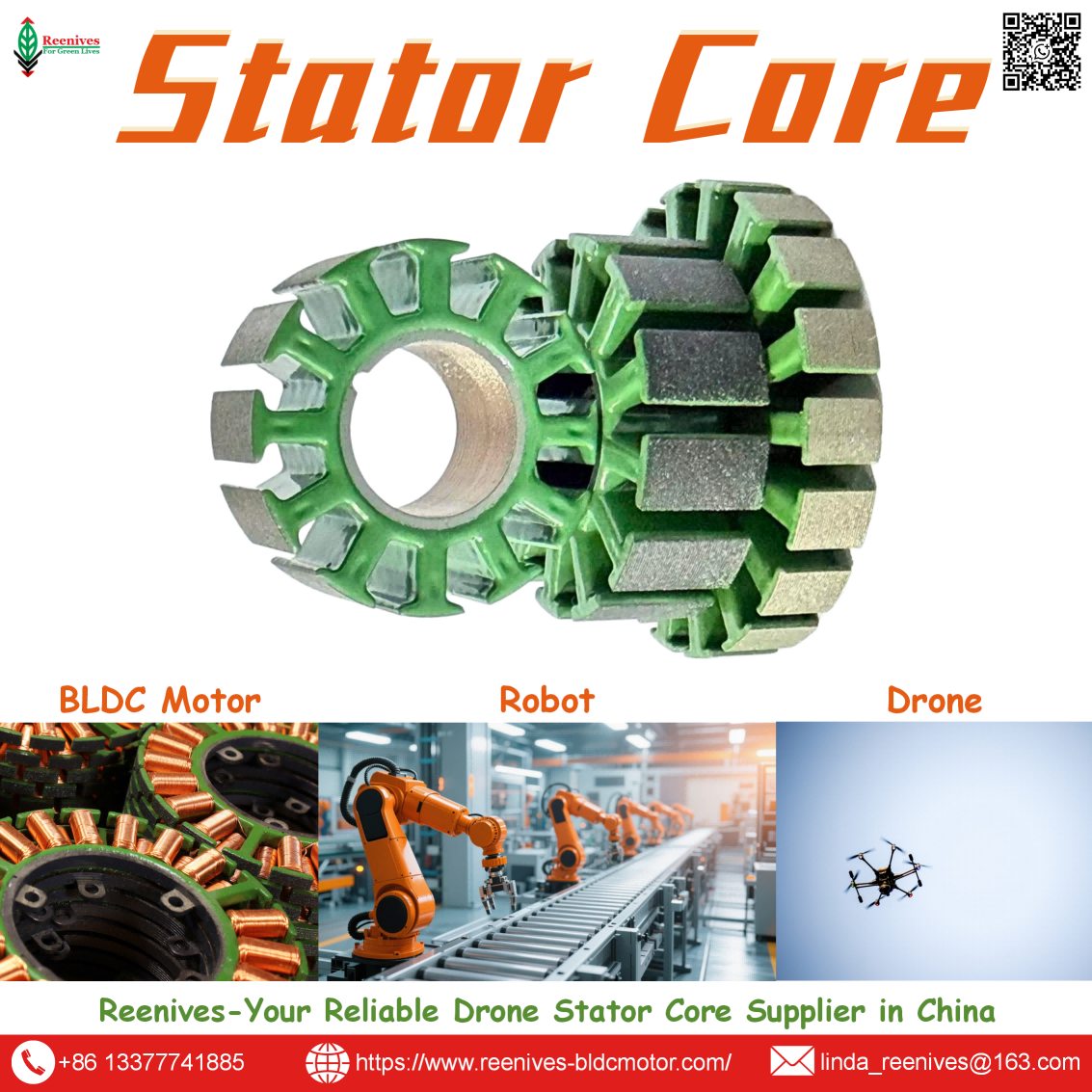
What is Cooler Motor Stator?

Cooler Motor Stator — What It Is and How It Determines Drone Motor Continuous Performance
Drone engineers rarely lose a motor to a single high-current burst. The failure mode is thermal: winding insulation degrades, magnets demagnetize, and efficiency collapses—not because the stator was too small for peak torque, but because it could not move heat out of the core fast enough. A cooler motor stator is not a marketing label. It is a stator core engineered with heat path, iron loss, and duty cycle as first-order design variables, not afterthoughts. For UAV propulsion buyers and motor designers, understanding this distinction is the difference between a 3-minute burst rating and a propulsion system that holds continuous thrust through a full mission profile. This article breaks down the definition, classification, parameters, selection logic, and procurement FAQs—built around what actually matters when you specify a stator core for a drone BLDC motor.
Table of Contents
- What Is a Cooler Motor Stator?
- Slotted vs. Slotless: Which Stator Architecture Runs Cooler?
- Parameters That Separate a Cool Stator from a Hot One
- Where Cooler Motor Stators Matter in UAV Propulsion
- Selection Checklist: Five Steps Before You Issue a PO
- FAQ: Cooler Motor Stator Procurement Questions
- Summary & CTA
What Is a Cooler Motor Stator?
A cooler motor stator is a laminated stator core whose electromagnetic and thermal design is optimized to reduce heat generation at the source and improve heat rejection from the winding and core body under sustained drone motor operation. The term does not refer to an add-on heat sink. It describes a stator core where three variables are managed together:
| Thermal Lever | What It Controls | Why It Matters for Drone Motors |
|---|---|---|
| Iron loss (core loss) | Eddy-current + hysteresis heat generated inside the laminations | The stator iron loss is the predominant loss component across the full speed range in high-speed UAV motors |
| Winding-to-core thermal coupling | How efficiently \( I^2R \) heat in the copper reaches the lamination stack | Slotted designs create a direct thermal path from windings through teeth to the core; poor coupling traps heat in the winding |
| Heat rejection surface & geometry | Ability of the stator body and adjacent structures to shed heat to airflow | UAV motors rely on passive or forced air cooling; stator geometry affects the effective cooling area |
In a drone BLDC motor, the stator does two jobs simultaneously: it carries the magnetic flux that produces torque, and it acts as the primary heat exchanger for the winding losses. A cooler motor stator is the result of accepting that these two jobs cannot be optimized in isolation.
Slotted vs. Slotless: Which Stator Architecture Runs Cooler?
There is no universal “cooler” architecture. The right choice depends on whether your thermal bottleneck is peak torque density or high-speed continuous efficiency.
Slotted stator cores place windings in discrete slots between stator teeth. The teeth increase magnetic loading and torque density—a slotted motor of the same outer dimensions can typically fit more copper into the available space. From a thermal standpoint, the teeth and slot walls create a direct conduction path from the hot winding bundle into the stator core and onward to the housing. This makes slotted stators well-suited to high-torque, moderate-speed UAV platforms where copper loss dominates and the duty cycle includes sustained hover or climb.
Slotless stator cores eliminate teeth entirely. The winding is a self-supporting cylinder bonded with resin, positioned in the air gap. Because there are no tooth tips concentrating flux, iron loss is dramatically reduced, especially at high rotational speeds. Cogging torque is virtually eliminated, and efficiency at high speed is typically higher than an equivalent slotted design. The trade-off: slotless stators generally have lower torque density and require more sophisticated winding and bonding processes.
| Selection Signal | Slotted Stator | Slotless Stator |
|---|---|---|
| Dominant requirement | High torque density, sustained hover/climb | High-speed cruise efficiency, low vibration |
| Primary heat source | Winding \( I^2R \) loss | Iron loss at high frequency |
| Thermal advantage | Conduction path through teeth | Low core loss reduces heat at source |
| Typical drone use | Heavy-lift, agricultural, cargo multirotors | High-speed fixed-wing / VTOL cruise, precision inspection |
A 4 kW-class drone propulsion study comparing slotless and slotted stators concluded that a slotless stator with Halbach magnet configuration can achieve high efficiency for drone applications where high-speed operation dominates the mission profile. Conversely, for platforms that spend most of their flight time in hover, the slotted stator’s torque density and conduction-based cooling remain the practical default.
Parameters That Separate a Cool Stator from a Hot One
Specifying a cooler motor stator starts with four parameters that directly control heat generation and thermal margin. The data below are drawn from published motor design research and industry technical references—use them as a baseline for engineering review, not as a substitute for application-specific validation.
Where Cooler Motor Stators Matter in UAV Propulsion
The drone motor market is expanding from roughly $3.95 billion in 2025 toward an estimated $7.64 billion by 2030, with brushless outrunner motors for multirotor drones driving a substantial share of demand. As payloads increase and mission durations stretch, the thermal margin of the stator core becomes a direct constraint on usable thrust—not a secondary refinement.
Multirotor hover and climb. In hover, the motor operates at a relatively fixed current; thermal steady state is reached within minutes. A stator with high iron loss at hover electrical frequency will heat continuously, forcing the flight controller to limit current or the operator to shorten sorties. A cooler stator core preserves the continuous current rating that determines actual payload capacity.
High-speed cruise and VTOL transition. During transition from hover to forward flight, motor RPM and electrical frequency climb sharply. Iron loss scales with frequency and flux density; slotless or thin-lamination stators reduce this loss at the operating point where thermal margin is already thin.
Agricultural and inspection drones in high-ambient conditions. Pesticide-spraying UAVs and inspection platforms often operate in ambient temperatures above 35°C, where the stator-to-ambient delta is reduced. The same motor that performs acceptably in a lab at 25°C can enter thermal derating in the field. Stator selection must account for the worst-case ambient, not the nominal test condition.
Selection Checklist: Five Steps Before You Issue a PO
- Define the thermal duty cycle, not just the peak current. Specify continuous current, burst current and duration, ambient temperature, and airflow condition (static hover vs. forward flight). A stator sized only to “max current” will overheat in sustained operation.
- Calculate electrical frequency at maximum continuous RPM. Use fe = RPM × (poles/2) / 60. Require iron-loss data at that frequency. If the supplier cannot provide loss curves above 400 Hz, the stator is not specified for high-speed UAV duty.
- Choose architecture against the dominant loss mode. Slotted when winding \( I^2R \) dominates and torque density is the constraint; slotless when high-speed iron loss and vibration are the constraints.
- Set lamination thickness and material grade together. For high-speed drone stators, evaluate 0.2 mm thin-gauge silicon steel as the baseline; step to thicker gauges only if loss modeling confirms thermal margin. Specify the insulation coating class and stack factor, not just “silicon steel.”
- Validate with a thermal prototype, not a datasheet alone. Measure winding temperature rise at continuous current in the actual mounting and airflow condition. The final acceptance criterion is hot-spot temperature within the insulation class after thermal steady state, not a calculated efficiency number.
FAQ: Cooler Motor Stator Procurement Questions
Q1: What lamination thickness should I specify for a drone stator operating above 5,000 rpm?
For high-speed drone stators, the practical starting point is 0.2 mm thin-gauge silicon steel, which research identifies as the best compromise between iron loss and cost at high operating frequency. Thicker gauges (0.35 mm and above) are appropriate for lower-speed or cost-constrained designs but will generate higher eddy-current loss at UAV electrical frequencies. Final thickness should be confirmed against a loss model at your maximum continuous RPM and slot/pole combination.
Q2: Does a slotless stator always run cooler than a slotted stator?
No. Slotless stators reduce iron loss because the absence of teeth eliminates flux concentration at tooth tips. However, slotted stators provide a more direct conduction path from the winding to the core through the teeth. A slotless motor with poor winding potting can run hotter at high continuous current because the heat has no conduction path out of the winding cylinder. “Cooler” depends on which loss mechanism dominates your duty cycle.
Q3: What is a realistic cogging torque target for a drone motor stator?
In well-designed precision BLDC motors, cogging torque in the range of 1–3% peak-to-peak of rated torque is achievable. For drone propulsion, lower cogging torque correlates with smoother hover control and reduced vibration-induced thermal cycling, but it should be balanced against torque density. If a quotation claims “zero cogging” without measurement data, request peak-to-peak cogging torque values at the specified air gap.
Q4: How do I verify that a stator supplier’s iron-loss claim is relevant to my drone motor?
Ask for iron-loss data in W/kg at the electrical frequency corresponding to your maximum continuous RPM, not at 50/60 Hz. The electrical frequency for a 14-pole motor at 10,000 rpm is approximately 1,167 Hz—more than 20 times the frequency at which standard electrical steel loss data is typically reported. A supplier who can provide loss curves at UAV frequencies has the test capability and engineering depth to support a cooler stator design.
Q5: What tolerance on stator stack height and bore diameter actually affects thermal performance?
Stack height tolerance affects the effective magnetic circuit length and therefore the flux density and iron loss for a given torque output. Bore diameter tolerance affects the air gap; an oversized air gap reduces flux and may force the motor to draw more current to produce the same torque, increasing copper loss. For drone stators, stack height should be controlled to ±0.05 mm and bore diameter to the air-gap budget defined by your rotor design; these are not cosmetic tolerances. Confirm measurement method (CMM vs. air gauge) in the PPAP documentation.
Summary & CTA
A cooler motor stator is a stator core where iron loss, winding thermal coupling, and heat rejection are designed as a system—not selected from a catalog and hoped for. For drone propulsion, the difference shows up as sustained thrust, stable hover, and longer flight time rather than a burst rating that cannot be used in the field. If you are specifying a stator for a new UAV motor platform or qualifying a second source, bring us your duty cycle, RPM, and thermal constraints.
Reenives — Drone Motor Stator Core One-Stop Solution Supplier
🌐 Website: www.reenives-bldcmotor.com
📱 WhatsApp: +86-13377741885
✉️ Email: linda_reenives@163.com
Send your operating RPM, continuous current, and ambient temperature—we will return a stator core specification and lamination recommendation aligned with your thermal duty cycle.
Dongguan Runlu Motor Technology Co., Ltd.
About Reenives
Reenives is a professional drone stator core manufacturer, founded in 2022. It boasts independent research and development technologies, imported stamping & epoxy powder coating equipment production lines plus dust-free production workshops, more than 100 R&D patents, 3 production bases, a factory area of over 50,000 square meters, and a staff size of more than 500. From production to sales, we support bulk purchasing, private mould develop, and samples making, and can provide tailor-made perfect solutions for your production and usage scenarios. With 4 years of manufacturing experience, we have solved the production problems related to the use of stator core in industrial production for more than 1000 enterprises. We can ship globally (with complete export qualifications). Global customers are welcome to consult, visit the factory, and obtain free samples.
Social & Discoverability: Reenives / Dongguan Runlu Motor Technology Co., Ltd. — search for “Reenives drone stator core” on LinkedIn and Google to verify our manufacturing footprint, product updates, and UAV stator core case references.
What is Alternator Stator Winding?
What is DC Machine Stator?
Related Article