
What is Alternator Stator Winding?
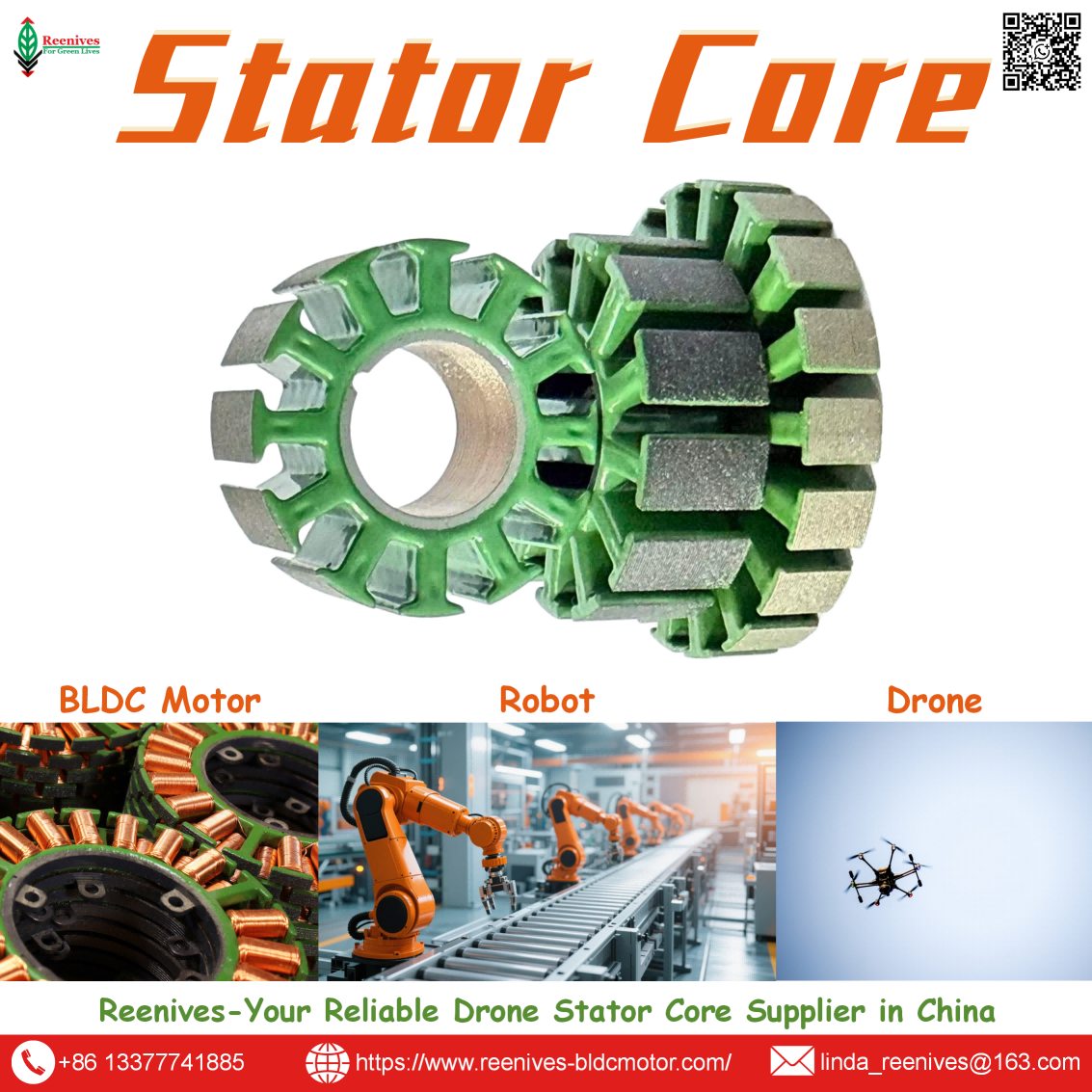
Alternator Stator Winding — How the Copper on the Core Decides Whether a Drone Motor Holds Thrust or Cooks Its Insulation
A drone motor rarely dies from too much torque command. It dies because the alternator stator winding — the copper coils seated in the stator core — reaches a temperature the insulation cannot survive, and the resulting short or open phase takes the propulsion system down with it. In UAV BLDC motors, more than 70% of total heat is generated in the stator windings, and copper loss rises with the square of current, not linearly. That means a motor that looks comfortable at 20 A can be thermally unrecognizable at 40 A, and the difference between a usable continuous rating and a burst-only spec is decided largely at the winding level: wire gauge, turns, fill factor, insulation system, and how the copper is arranged around the teeth. This guide is written for drone motor engineers and B2B buyers who need to specify, compare, or troubleshoot alternator stator windings against real thermal duty cycles — not datasheet fantasy.
Table of Contents
- What Is Alternator Stator Winding?
- Concentrated vs. Distributed: Which Winding Architecture Suits Drone Motors?
- Parameters That Separate a Usable Winding from a Thermal Liability
- Where Alternator Stator Winding Performance Shows Up in UAV Propulsion
- Selection Checklist: Five Steps Before You Approve a Winding Spec
- FAQ: Alternator Stator Winding Procurement Questions
- Summary & CTA
What Is Alternator Stator Winding?
Alternator stator winding refers to the copper conductors — wound as coils, inserted into stator slots or formed as a self-supporting cylinder — that carry alternating current in the stationary portion of a rotating electrical machine. The term is inherited from alternator practice, where the stator carries the armature winding and the rotor carries the field; in a three-phase alternator, the windings are arranged in three sets spaced 120 electrical degrees apart around the stator. In a brushless DC motor for a drone, the same physical structure performs the motoring function in reverse: current from the ESC flows through the stator windings, produces a magnetic field that interacts with the permanent magnets on the rotating bell, and generates torque.
The practical consequence is that alternator stator winding is not a passive bundle of wire. It is the component that converts electrical input into magnetic flux and the component where the dominant loss — copper loss I²R — is generated. Every winding decision carries a thermal consequence:
| Winding Decision | Electromagnetic Effect | Thermal Consequence in a Drone Motor |
|---|---|---|
| Number of turns | Sets Kv (fewer turns = higher Kv) and flux linkage | More turns add wire length and resistance; higher R means more I²R heat for the same current |
| Wire gauge (AWG) | Sets current density for a given slot area | Thicker wire reduces resistance but consumes slot space; thinner wire raises current density and hot-spot risk |
| Fill factor | Determines how much copper fits in the slot | Higher fill means lower resistance and better thermal conduction through the winding body; typical practical fill is 0.3–0.6 |
| Insulation system | Dielectric separation between turns, phases, and core | Insulation class (B/F/H) sets the absolute temperature ceiling; every 10°C rise roughly halves insulation life |
Concentrated vs. Distributed: Which Winding Architecture Suits Drone Motors?
Alternator stator windings are classified first by how the coils are distributed around the stator circumference. The two families behave very differently in a UAV motor, and the choice is not a matter of preference — it is dictated by pole count, slot count, and whether the thermal bottleneck is end-winding volume or heat concentration.
Concentrated windings place each coil around a single stator tooth. The coils do not overlap, the end-winding volume is minimized, and the winding factor can be high — a theoretical winding factor of 0.984 has been reported for a concentrated configuration in a BLDC machine patent. For drone motors, this is the practical default: concentrated windings allow compact end turns, shorter copper length, and easier automation. However, the heat is concentrated on the teeth, and the absence of overlap means there is less copper mass to spread the loss. Single-layer concentrated windings offer physical separation between phases and fault tolerance, but can produce subharmonic field content that induces rotor loss and vibration.
Distributed windings spread each phase across multiple slots per pole, with coil pitch greater than one slot. The copper is distributed more evenly around the armature surface, which produces more uniform heating and easier cooling — a classical advantage of distributed AC windings. The trade-off is longer end windings, higher copper mass, and greater end-winding losses. Distributed windings are generally used when the slot count is more than 1.5 times the pole count; machines with similar slot and pole counts are built with concentrated windings.
| Selection Signal | Concentrated Winding | Distributed Winding |
|---|---|---|
| Typical drone slot/pole ratio | Slots ≈ poles (e.g., 12N14P, 24N28P) | Slots > 1.5 × poles (e.g., high slot-count designs) |
| End-winding volume | Compact; shorter copper length | Longer; more copper and higher end-winding loss |
| Heat distribution | Concentrated on teeth; hot-spot risk at tooth body | More uniform; easier to cool |
| Winding factor | Can approach 0.984 in optimized designs | Typically lower than concentrated; depends on pitch and distribution |
| Manufacturing | Premade coils, easier insertion, lower cost at volume | More complex coil shaping; higher production cost |
| Best-fit drone duty | Multirotor hover/climb where compactness and torque density dominate | High-continuous-duty platforms where uniform heat spreading is worth the mass penalty |
For most UAV outrunner motors in the 5-inch to heavy-lift class, concentrated windings are the baseline. Distributed windings enter the conversation when continuous current is high enough that end-winding hot spots become the limiting factor, or when a low-Kv, high-torque design needs the smoother MMF waveform that distribution provides.
Parameters That Separate a Usable Winding from a Thermal Liability
Specifying an alternator stator winding for a drone motor requires four parameters that directly control copper loss and hot-spot temperature. The values below are drawn from published machine design literature, motor manufacturer data, and UAV-specific thermal references — use them as a review baseline, not a substitute for prototype validation on your duty cycle.
| Parameter | Practical UAV Baseline | What Happens If You Ignore It |
|---|---|---|
| Fill factor | 0.3–0.6 | Low fill → higher R and poor lateral heat conduction |
| Continuous current density | ≤ 7.5 A/mm² (validate against insulation class) | High Jcu → localized hot spot, insulation aging |
| Insulation class ceiling | B (130°C) / F (155°C) / H (180°C) | Operating above class halves life per 10°C |
| Winding thermal conductivity | 100–200 W/(m·K) along; 0.4–3.0 W/(m·K) across | End-winding hot spots despite acceptable average temperature |
| Wire enamel rating | Up to 220°C class available | Enamel alone does not raise the system insulation class |
Where Alternator Stator Winding Performance Shows Up in UAV Propulsion
The winding is not an abstract design variable. In a drone motor, it determines whether the propulsion system can hold a hover, complete a transition, or survive a hot-day sortie. The market context reinforces this: brushless outrunner motors are the default for multirotor UAVs, and as payloads and endurance requirements climb, the continuous current rating — which is a winding thermal limit — becomes the constraint that payload calculations must respect.
Sustained hover and thermal steady state. In hover, current is roughly constant and the winding reaches thermal steady state within minutes. If the fill factor is low or the end-winding hot spot is poorly coupled to the core, the winding temperature will stabilize above the insulation class even though the average motor temperature looks acceptable. The flight controller may not see a fault until insulation degradation has already begun.
Throttle transients and burst ratings. A drone motor’s “max current” specification is usually a burst rating, not a continuous one. Because copper loss is quadratic in current, a 30-second burst at twice the hover current generates roughly four times the copper loss in the winding — heat that the end turns may not shed before the next burst begins. Repeated burst duty cycles accumulate thermal cycling that accelerates enamel cracking and turn-to-turn insulation failure.
High-ambient and agricultural UAV duty. Agricultural spraying drones and inspection platforms often operate in ambient temperatures above 35°C, where the stator-to-ambient delta is reduced. The same alternator stator winding that holds Class F limits in a 25°C lab can exceed Class H territory in the field. Winding selection must use worst-case ambient, not nominal test conditions.
Selection Checklist: Five Steps Before You Approve a Winding Spec
- Define the continuous current and duty cycle, not just Kv. Kv is an electromagnetic parameter; the winding’s thermal survival is determined by continuous current, burst current and duration, ambient temperature, and airflow. Two motors with the same Kv and turn count can have very different thermal margins depending on wire gauge and fill factor.
- Calculate current density against the insulation class, not a generic number. Take the required continuous current, divide by the copper cross-section (wire gauge × parallel strands), and compare the result to the 7.5 A/mm² continuous baseline — then apply a margin for your ambient and duty cycle. If the calculated hot-spot temperature approaches the insulation class ceiling, the winding is undersized regardless of what the peak current label says.
- Specify fill factor and impregnation together. Fill factor alone does not guarantee thermal performance. Require the winding to be epoxy or resin impregnated and ask for the impregnation coverage of the end turns. The perpendicular thermal conductivity of an impregnated winding is several times that of a dry winding, and the end-winding hot spot is where the difference matters most.
- Set insulation class and wire enamel rating as a system. A 220°C enamel wire does not make a Class H winding if the slot liner, phase separator, or impregnation resin is rated lower. Specify the complete insulation system — enamel, slot liner, phase insulation, impregnation — to a single class, and require a 1000 V dielectric withstand test on production windings as a baseline quality gate.
- Validate with hot-spot measurement, not average temperature. A thermal camera reading on the motor bell or a thermistor on the core does not tell you the end-winding temperature. Require winding resistance-based hot-spot estimation or embedded thermocouple data under continuous current at your worst-case ambient. The acceptance criterion is hot-spot temperature within the specified insulation class after thermal steady state — not a calculated efficiency or an averaged case temperature.
FAQ: Alternator Stator Winding Procurement Questions
Q1: Does a higher fill factor always mean a cooler-running alternator stator winding?
Not automatically. A higher fill factor reduces resistance for a given turn count and improves lateral thermal conduction through the winding body, which is favorable. But fill factor is achieved within the constraints of wire insulation thickness and winding process — practical fill is 0.3–0.6. If a supplier claims an unusually high fill factor without specifying the insulation system or impregnation quality, the thermal benefit may be offset by reduced insulation clearance or incomplete resin penetration. Require fill factor and impregnation data together.
Q2: What continuous current density should I specify for a drone BLDC stator winding?
Published continuous-operation guidance places the practical ceiling around 7.5 A/mm², with the actual limit set by the insulation temperature class and the cooling condition. For UAV stators with limited airflow and high ambient, a lower design value — often 4–6 A/mm² — provides thermal margin. The number should be calculated from your continuous current and copper cross-section, then validated against hot-spot measurement, not adopted as a universal constant.
Q3: My motor uses 220°C-rated enamel wire. Does that make it a Class H winding?
No. Insulation class is a system property, not a wire property. A Class H (180°C) winding requires the slot liner, phase insulation, impregnation resin, and lead wire insulation to be compatible with 180°C operation. A 220°C enamel wire inside a Class F (155°C) slot system is still a Class F winding. Specify the complete insulation system to the target class and confirm with a dielectric withstand test and thermal endurance data.
Q4: Why does my drone motor’s efficiency drop sharply at high throttle even though the winding resistance is within specification?
Because copper loss is quadratic in current and resistance rises with temperature. At 40 A, copper loss can be roughly four times the 20 A value for the same cold resistance, and at elevated winding temperature the resistance itself can be 51% higher than at 25°C. The efficiency curve falls faster on the high-current side because the I²R term dominates. A winding that measures “in spec” cold can be thermally undersized at the current the motor actually sees in flight.
Q5: What production test actually catches a bad alternator stator winding before it reaches my assembly line?
A 1000 V dielectric withstand (hipot) test between winding and core, and between phases, catches gross insulation faults and phase-to-ground shorts. It does not catch turn-to-turn insulation weaknesses or partial discharge risk at high altitude. For drone motors, pair the hipot test with winding resistance measurement per phase (phase imbalance indicates turn-count or termination errors) and surge comparison testing if the application demands high reliability. Confirm that the test voltage and duration are specified in the PPAP documentation, not left to operator discretion.
Summary & CTA
Alternator stator winding is where the drone motor’s thermal fate is decided. Fill factor, current density, insulation class, and impregnation quality determine whether the winding holds continuous thrust through a hover or enters a resistance-heating feedback loop at the first sustained climb. The winding is also the component most sensitive to manufacturing variation — turn count, phase balance, and insulation integrity cannot be inspected into a finished motor. If you are qualifying a stator winding for a new UAV platform or resolving a field overheating issue, bring us the continuous current, duty cycle, ambient condition, and target insulation class.
Reenives — Drone Motor Stator Core & Winding One-Stop Solution Supplier
🌐 Website: www.reenives-bldcmotor.com
📱 WhatsApp: +86-13377741885
✉️ Email: linda_reenives@163.com
Send your winding specification, target Kv, continuous current, and insulation class — we will return a stator winding proposal with fill factor, wire gauge, impregnation, and test plan aligned with your thermal duty cycle.
Dongguan Runlu Motor Technology Co., Ltd.
About Reenives
Reenives is a professional drone stator core manufacturer, founded in 2022. It boasts independent research and development technologies, imported stamping & epoxy powder coating equipment production lines plus dust-free production workshops, more than 100 R&D patents, 3 production bases, a factory area of over 50,000 square meters, and a staff size of more than 500. From production to sales, we support bulk purchasing, private mould develop, and samples making, and can provide tailor-made perfect solutions for your production and usage scenarios. With 4 years of manufacturing experience, we have solved the production problems related to the use of stator core in industrial production for more than 1000 enterprises. We can ship globally (with complete export qualifications). Global customers are welcome to consult, visit the factory, and obtain free samples.
Social & Discoverability: Reenives / Dongguan Runlu Motor Technology Co., Ltd. — search for “Reenives drone stator core” and “Reenives alternator stator winding” on LinkedIn and Google to verify our manufacturing footprint, winding capability, and UAV stator case references.
What is Electric Motor Stator?
What is Cooler Motor Stator?
Related Article


