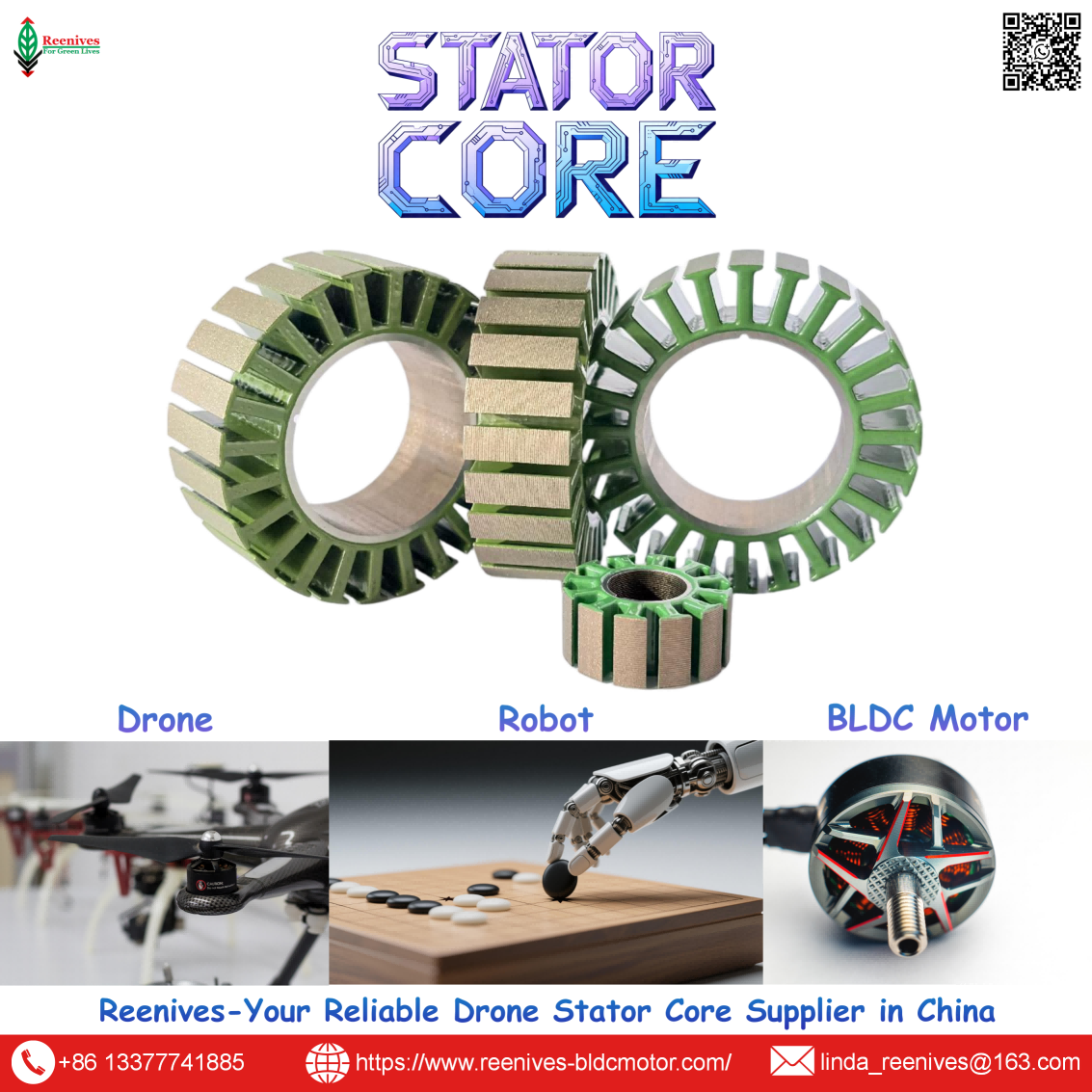
Reenives: Global Leading Drone Motor Parts Supplier

Drone Motor Parts: Why Sourcing Them Separately Breaks the Tolerance Chain — and What a One-Stop Parts Supplier Actually Controls
Five vendors, five lead times, five quality definitions, and nobody accountable for the air gap. That is the standard procurement pattern for drone motor parts: the stator core from one supplier, the rotor bell and magnets from a second, the bearings from a third, the shaft from a fourth, and the housing from a fifth. Each part passes its own inspection. Each supplier ships within its own tolerance band. And then the assembled motor vibrates, runs hot, or loses Kv — because the dimension that actually matters, the air gap between stator bore and rotor outer diameter, is the sum of four independently toleranced parts and belongs to none of the five suppliers.
The published numbers explain why the chain is so fragile. A drone-grade stator core holds concentricity ≤0.02 mm, with the functional threshold for drone BLDC motors generally placed below 0.03 mm. Its lamination grade carries a published potential of ≤9.6 W/kg at 1.0 T / 400 Hz measured per IEC 60404-2. Its coating must hold >1400 V dielectric strength per ASTM D149 across −40°C to 180°C. Those are stator-side specifications. But the rotor outer diameter, the bearing seat, and the shaft position the rotor that closes the gap — and each of those comes with its own tolerance, its own measurement method, and its own supplier who is not accountable for the assembly.
This guide treats drone motor parts as what they are in engineering terms: a tolerance chain, not a shopping list. It defines the parts families, separates the electromagnetic parts from the structural parts that position them, presents the published specifications that make each part auditable, maps the missions where different parts bind, and closes with a five-step supplier qualification workflow. Every figure below is tied to a named standard or a published specification.
In this guide — jump to the section your project needs:
- What Are Drone Motor Parts? The Tolerance Chain Behind the Air Gap
- Drone Motor Parts Classification: Electromagnetic, Structural, and Connection Families
- Published Part Specifications: Stator Core Loss, Concentricity, Stacking Factor, Coating, Bearings
- Application Profiles: Which Part Tolerance Binds Which Drone Mission
- A 5-Step Drone Motor Parts Supplier Qualification Workflow
- FAQ: Stator Core Performance, Core Loss Auditing, Concentricity, Stacking Factor, and Bearing Fit
- Summary: Buy the Chain, Not the Parts
What Are Drone Motor Parts? The Tolerance Chain Behind the Air Gap
Drone motor parts are the discrete components that assemble into a brushless motor: the stator core with its windings, the rotor bell with its permanent magnets, the shaft, the bearings, the housing, the fasteners, and the electrical terminations. The list is straightforward. The engineering is not, because the parts do not function independently — they function as a chain whose final dimension is the air gap.
Here is the chain in sequence. The stator core defines the bore and the slot geometry. The rotor bell carries the magnets and defines the rotor outer diameter. The housing defines the bearing seat, which positions the shaft axis relative to the stator bore. The shaft and bearings place the rotor on that axis. The magnets sit on the rotor surface and close the magnetic circuit across the gap. Every one of those parts contributes a tolerance to the final air gap, and the magnetic performance of the motor depends on that gap being uniform around the full circumference.
The consequence for procurement is structural rather than commercial. When the five parts come from five suppliers, each supplier inspects its own part against its own drawing and ships within specification. None of them measures the assembled gap, because none of them receives the other four parts. The buyer becomes the integrator by default — and the integration work, which is where the air-gap uniformity is actually created, has no owner in the supply chain.
Procurement translation: a parts quotation list is not a parts specification. The specification names the shared datum (stator bore, rotor OD, and bearing seat referenced to one drawing), the assembled air gap and its tolerance, the thermal-expansion allowance between the stator stack and the rotor bell, and the batch traceability that links a magnet batch to a stator batch. Without those four fields, the buyer has purchased parts and retained the integration risk.
Drone Motor Parts Classification: Electromagnetic, Structural, and Connection Families
Drone motor parts divide into three functional families, and each family carries a different kind of specification. Mixing them in a single BOM without distinguishing the families is how quality discussions go sideways — an electromagnetic part is judged on loss and flux, a structural part on fit and alignment, and a connection part on continuity and thermal durability.
| Family | Parts | What They Set | Primary Specification Type |
|---|---|---|---|
| Electromagnetic parts | Stator core, stator windings, rotor magnets, rotor back iron | Flux density, core loss, torque per amp, Kv | Core loss at a defined test point (IEC 60404-2), magnet grade and temperature class, winding pattern and turns |
| Structural parts | Rotor bell, housing, shaft, bearings, fasteners | Air-gap uniformity, rotor balance, bearing life, vibration | Concentricity, bore and OD tolerances, bearing fit class (ISO 492), balance grade |
| Connection parts | Terminals, phase leads, hall sensor PCB, insulation sleeving, adhesives | Electrical continuity, insulation integrity, thermal durability | Dielectric strength (ASTM D149), contact resistance, temperature class |
The classification matters because the failure modes are family-specific. An electromagnetic failure shows up as heat, reduced Kv, or lost thrust — and it is diagnosed with a core-loss test or a back-EMF measurement. A structural failure shows up as vibration, noise, or a bearing that fails early — and it is diagnosed with a runout measurement or a balance check. A connection failure shows up as an intermittent phase, a short, or a thermal hot spot at a terminal — and it is diagnosed with a surge test or a thermal image. A supplier who sells only electromagnetic parts has no process for the structural failures, and a supplier who sells only structural parts has no process for the electromagnetic ones. That is the practical case for one-stop supply: it is not convenience, it is failure-mode coverage.
Published Part Specifications: Stator Core Loss, Concentricity, Stacking Factor, Coating, Bearings
Stator core: the electromagnetic part with the most auditable data
The stator core is the part where published specifications are most complete, and therefore the part where a procurement audit has the most to work with. Reenives specifies its 0.20 mm non-grain-oriented silicon steel grade at core loss ≤9.6 W/kg (typical 9.2 W/kg) at 1.0 T / 400 Hz, measured per IEC 60404-2 and GB/T 3655-2022. Magnetic flux density B50 is ≥1.69 T, thickness 0.20 mm ±0.008 mm, and burr height ≤0.03 mm. The insulation system is C5 epoxy powder coating rated to >1400 V dielectric strength per ASTM D149, operating across −40°C to 180°C with a 200°C short-term peak. Stacking factor is published at ≥97% by the weight/dimension method, and concentricity at ≤0.02 mm for drone-grade cores.
The test standard matters as much as the number. IEC 60404-2 defines the Epstein-frame measurement and specifies a sinusoidal polarization waveform, a measurement temperature of 23°C ±5°C, and no external stress on the specimen. That last condition is why the finished-stack figure is the one that predicts motor heat: stamping and stacking introduce stress and burrs that the Epstein specimen never experiences, and those manufacturing artefacts become additional eddy-current loss at the electrical frequencies drone motors run at.
| Stator Core Parameter | Reenives Published Specification | Test Standard / Method | What It Controls in the Motor |
|---|---|---|---|
| Core loss | ≤9.6 W/kg (typical 9.2) @ 1.0 T / 400 Hz | IEC 60404-2, GB/T 3655-2022 | Heat generated in the stator at operating frequency |
| Flux density B50 | ≥1.69 T | IEC 60404-2 magnetic property test | Torque capability per unit of magnet field |
| Lamination thickness | 0.20 mm ±0.008 mm | Micrometer, batch sampling | Eddy-current loss scaling with thickness squared |
| Burr height | ≤0.03 mm | Optical comparator edge scan | Prevents burrs piercing the interlamination coating |
| Stacking factor | ≥97% | Weight / dimension method | Effective flux density of the finished stack |
| Concentricity | ≤0.02 mm | Vision measurement on finished core | Air-gap uniformity, vibration, bearing load |
| Coating dielectric strength | >1400 V | ASTM D149 | Interlaminar insulation under thermal cycling |
| Operating temperature | −40°C to 180°C (200°C short peak) | Coating temperature class | Insulation survival at continuous duty |
Source: Reenives 0.20 mm laminated stator core specification; IEC 60404-2 Epstein-frame method conditions; ASTM D149 dielectric strength test.
Bearings and shaft: the structural parts that position the rotor
Bearings are specified by tolerance class, and the relevant standard is ISO 492, which defines dimensional and running accuracy classes for rolling bearings. The procurement point is not the bearing’s internal precision alone — it is the fit between the bearing OD and the housing seat, and between the bearing bore and the shaft. A housing seat machined to a different tolerance band than the bearing it receives produces either a loose fit that migrates under vibration or an interference fit that preloads the bearing and shortens its life. Shafts are typically ground and specified with a tolerance band appropriate to the bearing bore class; the shaft diameter and the bearing bore must be chosen as a pair, not independently.
Magnets: the part that closes the magnetic circuit
Drone rotor magnets are typically sintered NdFeB, and the grade code carries both strength and temperature class. A published baseline for FPV and UAV rotors is N42SH, with a maximum operating temperature of approximately 150°C and an energy product of 40–43 MGOe. Higher-temperature classes (UH, EH) are specified when the rotor sits close to a hot stator under continuous duty. The magnet’s contribution to the parts chain is that its field strength, its temperature class, and its coating system all interact with the stator core’s flux density and the air gap the structural parts set.
Housing and rotor bell: the structural parts that define the datums
Drone motor housings and rotor bells are commonly machined from 7075-T6 aluminium for its strength-to-weight ratio. The housing’s critical feature is not its external shape but its bearing seat, because that seat establishes the shaft axis relative to the stator bore. The rotor bell’s critical feature is its magnet seat and outer diameter, because that surface defines the rotor side of the air gap. Neither part carries an electromagnetic specification, and both determine whether the electromagnetic parts can deliver theirs.
The mixed-batch KV drift: when a new magnet batch and a new stator batch enter assembly without a shared traceability record, the motor’s KV can shift without any single part failing its own inspection. The magnet may be within its grade band and the stator within its core-loss band, but the combination lands outside the motor’s KV tolerance. This is not a defect in either part — it is the absence of chain-level traceability, which is a supplier capability rather than a part property.
Application Profiles: Which Part Tolerance Binds Which Drone Mission
| Mission Class | Binding Parts Family | Binding Tolerance | Specification to Write |
|---|---|---|---|
| FPV racing / freestyle | Structural (balance) + electromagnetic (core loss) | Rotor balance and concentricity; iron loss at high frequency | Concentricity ≤0.02 mm; 0.20 mm grade core loss ≤9.6 W/kg @ 1.0 T / 400 Hz; balance grade on the assembled rotor |
| Cinematic / inspection | Structural (vibration) | Air-gap uniformity and rotor runout | Shared datum across stator bore, rotor OD, and bearing seat; concentricity measured on the pair |
| Agricultural spraying | Connection (insulation) + electromagnetic (coating) | Dielectric strength under thermal and chemical cycling | C5 coating >1400 V per ASTM D149; −40°C to 180°C range; terminal and lead insulation class |
| Heavy-lift / logistics | Electromagnetic (flux density) + structural (bearing life) | Stacking factor and bearing fit | Stacking factor ≥97%; ISO 492 bearing fit class matched to housing seat and shaft |
The pattern is that the binding family changes with the mission, and so does the specification that matters. FPV racing binds on rotor balance and core loss because speed amplifies both. Cinematic and inspection platforms bind on air-gap uniformity because vibration reaches the camera before it reaches the motor. Agricultural platforms bind on insulation and coating because the duty cycle is long and the environment is wet and chemical. Heavy-lift platforms bind on stacking factor and bearing fit because continuous torque and long service life expose both. A parts supplier who can only speak to one family is a parts supplier for one mission class.
A 5-Step Drone Motor Parts Supplier Qualification Workflow
- Ask for the pair drawing before the parts drawings. A one-stop supplier should be able to show the stator bore, rotor outer diameter, and bearing seat referenced to a single datum, with the assembled air gap toleranced on that drawing. If the supplier can only provide separate part drawings, the integration risk remains with the buyer regardless of how many parts the supplier lists.
- Specify the stator core with the number, the test point, and the standard together. Write “core loss ≤9.6 W/kg at 1.0 T / 400 Hz, measured per IEC 60404-2 on the finished stack,” plus stacking factor ≥97%, burr ≤0.03 mm, concentricity ≤0.02 mm, and C5 coating at >1400 V per ASTM D149. A core-loss figure without a test standard and a measurement location is a material property, not a product specification.
- Specify bearing fit as a matched pair, not as two independent dimensions. Name the ISO 492 bearing tolerance class and the housing seat and shaft tolerances that receive it. A bearing and a housing seat chosen independently can each be in specification and still produce a fit that either migrates or preloads. Ask the supplier to state the intended fit and the measurement method used to verify it.
- Confirm the magnet grade, temperature class, and coating system in the same specification as the stator. A rotor magnet at N42SH (~150°C) and a stator core whose coating is rated to 180°C are a coherent thermal pair; a magnet at a standard grade (~80°C) with the same stator is not. The specification should read as a system, not as a list of independent line items.
- Require chain-level traceability, not part-level certificates. Ask how a magnet batch and a stator batch are linked in the supplier’s records, and whether a finished motor’s KV can be traced back to both. A supplier who can answer that question is managing the chain; a supplier who can only produce individual mill certificates and dimensional reports is managing parts, and the KV drift that comes from mixed batches will land in the buyer’s incoming inspection.
FAQ: Stator Core Performance, Core Loss Auditing, Concentricity, Stacking Factor, and Bearing Fit
Why do two 0.20 mm stator cores from different suppliers perform differently in the same motor?
Because the motor runs on the finished stack, not on the steel mill certificate. A 0.20 mm grade carries a published potential — for example ≤9.6 W/kg at 1.0 T / 400 Hz measured per IEC 60404-2 — but that potential is realised only if the stack holds its stacking factor (Reenives publishes ≥97%), if burr height stays at or below 0.03 mm so burrs do not pierce the interlamination coating, and if the C5 epoxy coating survives at >1400 V dielectric strength per ASTM D149. A core that meets the grade but misses the stack controls delivers the same steel and a different motor.
Source: Reenives 0.20 mm stator core specification (core loss, stacking factor, burr, coating); IEC 60404-2; ASTM D149.
How should stator core loss be specified so it is auditable?
Specify three things together: the number, the test point, and the standard. A complete line reads “core loss ≤9.6 W/kg at 1.0 T / 400 Hz, measured per IEC 60404-2 on the finished stack.” IEC 60404-2 defines the Epstein-frame method and specifies a sinusoidal polarization waveform, a measurement temperature of 23°C ±5°C, and no external stress on the specimen — which is precisely why a finished-stack measurement is more informative than a mill certificate. Stamping and stacking introduce stress and burrs the Epstein specimen never sees, so the finished-stack figure is the one that predicts motor heat.
Source: IEC 60404-2 Epstein-frame measurement conditions; Reenives finished-stack verification practice.
What concentricity should a drone stator core hold, and why does it belong to the parts chain rather than the stator alone?
Reenives specifies concentricity ≤0.02 mm for drone-grade laminated stator cores, with the functional threshold for drone BLDC motors generally placed below 0.03 mm. It belongs to the parts chain because concentricity is only half the air gap. The other half is the rotor outer diameter and the bearing seat that positions it. A stator at 0.02 mm paired with a rotor at 0.05 mm runout produces a gap that neither supplier can see on their own drawing. This is the structural argument for matched stator and rotor supply from one process chain.
Source: Reenives drone-grade stator core concentricity specification; published drone BLDC motor air-gap guidance.
What stacking factor and coating class should a drone stator core carry?
Reenives publishes a stacking factor of ≥97% for its stator and rotor laminations, measured by the weight/dimension method, and specifies C5 epoxy powder coating rated to >1400 V dielectric strength per ASTM D149 across an operating range of −40°C to 180°C with a 200°C short-term peak. Stacking factor matters because it minimises the non-magnetic gaps between laminations; a loose stack wastes the flux density the steel grade was selected to provide. Coating class matters because it is the electrical barrier that prevents interlamination short circuits under thermal cycling.
Source: Reenives stator and rotor lamination specification table; ASTM D149 dielectric strength test; coating temperature class data.
Why do bearings and shafts belong in the same specification as the stator core?
Because the bearing seat and the shaft determine where the rotor actually sits. The stator sets the bore; the housing sets the bearing seat; the shaft and bearings set the rotor’s running position. If those four come from different vendors, the assembled air gap is the sum of four independently toleranced dimensions, and none of the four suppliers owns the result. Bearing bore and OD tolerances follow ISO 492 classes, and a housing seat machined to a different tolerance band than the bearing it receives will produce either a loose fit that migrates under vibration or an interference fit that preloads the bearing and shortens its life.
Source: ISO 492 rolling bearing tolerance classes; published bearing fit guidance for electric motor housings.
What does a one-stop drone motor parts supplier actually control that separate vendors do not?
Three things that cannot be bought part-by-part. First, a shared datum: stator bore, rotor outer diameter, and bearing seat referenced to one drawing rather than three. Second, a matched thermal expansion allowance: stator stack and rotor bell expand at different rates, and the cold-build air gap must account for both. Third, batch traceability across the chain: if a magnet batch and a stator batch are mixed without a common record, a KV drift appears that no single-part inspection can explain. These are process capabilities, not catalogue items.
Source: Reenives matched-pair and chain-traceability practice; published thermal expansion and air-gap guidance for outrunner motors.
Summary: Buy the Chain, Not the Parts
Drone motor parts are not a shopping list. They are a tolerance chain, and the dimension that decides whether the motor runs cool and smooth or hot and rough — the air gap — is created by the chain rather than by any single part. The stator core sets the bore, the rotor bell sets the outer diameter, the housing sets the bearing seat, and the shaft and bearings place the rotor on that axis. Each part can pass its own inspection while the assembled motor misses its air-gap target, and that outcome is a supply-chain design problem, not a manufacturing defect.
The published specifications are concrete enough to audit. Reenives publishes its 0.20 mm grade at ≤9.6 W/kg at 1.0 T / 400 Hz per IEC 60404-2, flux density B50 ≥1.69 T, burr ≤0.03 mm, stacking factor ≥97%, concentricity ≤0.02 mm, and C5 epoxy coating at >1400 V per ASTM D149 across −40°C to 180°C. Bearings follow ISO 492 tolerance classes and must be specified as a matched pair with the housing seat and shaft. Magnets carry both a grade and a temperature class, and a rotor magnet at N42SH (~150°C) must be thermally coherent with the stator coating it sits beside.
The qualification takeaway is that the parts list is the least informative document in the procurement package. What matters is whether the supplier can show a pair drawing with a shared datum, a finished-stack core-loss report, a bearing fit stated as a matched pair, and a traceability record that links a magnet batch to a stator batch. A supplier who can produce those four documents is managing the chain; a supplier who can only produce individual part certificates is selling parts and leaving the integration to the buyer.
Consolidating drone motor parts under one qualified chain?
Reenives supplies precision stator and rotor cores, matched stator-rotor pairs, and chain-level documentation for drone brushless motor programmes: 0.20 mm low-loss non-grain-oriented silicon steel, core loss ≤9.6 W/kg at 1.0 T / 400 Hz per IEC 60404-2, stacking factor ≥97%, concentricity ≤0.02 mm, burr ≤0.03 mm, and C5 epoxy coating at >1400 V per ASTM D149. Private mould development, matched-pair supply, and free samples are available for qualified engineering evaluations.
WhatsApp: +86-13377741885
Email: linda_reenives@163.com
Official website: www.reenives-bldcmotor.com
Dongguan Runlu Motor Technology Co., Ltd.
Reenives — Drone Motor One-Stop Solution Supplier
Reenives is a professional drone stator core manufacturer, founded in 2022. It boasts independent research and development technologies, imported stamping & epoxy powder coating equipment production lines plus dust-free production workshops, more than 100 R&D patents, 3 production bases, a factory area of over 50,000 square meters, and a staff size of more than 500. From production to sales, we support bulk purchasing, private mould development, and sample making, and can provide tailor-made perfect solutions for your production and usage scenarios. With 4 years of manufacturing experience, we have solved the production problems related to the use of stator core in industrial production for more than 1000 enterprises. We can ship globally (with complete export qualifications). Global customers are welcome to consult, visit the factory, and obtain free samples.
Matched stator + rotor pairsCore loss ≤9.6 W/kg @ 1.0 T / 400 HzIEC 60404-2 verifiedStacking factor ≥97%Concentricity ≤0.02 mmC5 epoxy >1400 VBurr ≤0.03 mmGlobal export qualifications
What is Brushless Drone?
What is Brushless Motor Drone?
Related Article