How to Choose Suitable Motor Magnet for Drone?

How to Choose Suitable Motor Magnet for Drone: The Strength-vs-Temperature Trade Behind Every Grade Code
The most common drone motor magnet mistake is specifying N52 because it is the strongest number on the datasheet. N52 delivers the highest room-temperature energy product, and in a cool-running application that is exactly what you want. But its maximum working temperature is only about 80°C. Put it in a heavy-lift motor that holds 85°C+ through a 20-minute survey mission, or an FPV motor that heat-soaks after a full-throttle burst, and the magnet that was strongest on the bench becomes the one that permanently demagnetizes in the field. The motor does not fail suddenly. It goes soft — unstable RPM, more vibration, less flight time — and by the time the log shows it, the magnets have already lost field strength that cannot be recovered.
The published data separates the two variables that the grade number conflates. A sintered NdFeB grade is strength (the number) plus heat tolerance (the suffix letter). N52 carries a 49–53 MGOe energy product but an ~80°C ceiling. N42SH carries a 40–43 MGOe energy product but holds its magnetic integrity to 150°C. In a motor operating at 130°C, the N52 choice suffers permanent demagnetization while the N42SH choice maintains its field and delivers more usable torque and stability. The correct comparison is not room-temperature pull. It is strength at the magnet’s actual operating temperature under load.
This guide answers the long-tail question at the level a propulsion engineer or procurement lead needs: what the grade code actually encodes, the temperature-class families and their published ceilings, the coating systems and salt-spray data, the magnet thickness and pole-count trade, the mission profiles where each grade binds, and a five-step selection workflow that turns a magnet datasheet into a purchase specification. Every figure below is traceable to a published grade table, standard, or field report.
In this guide — jump to the section your project needs:
- What Is a Drone Motor Magnet? The Grade Code, the Magnetic Circuit, and the Two Properties That Matter
- Magnet Classification for Drone Motors: Grade Families, Coatings, and Shapes
- Published Parameters: Br, Hcj, BHmax, Temperature Ceilings, Coating Salt Spray, Thickness and Pole Count
- Application Profiles: Which Magnet Grade Binds Which Drone Mission
- A 5-Step Motor Magnet Selection Workflow for Drone Engineers
- FAQ: Grade Codes, N52 vs N42SH, Temperature Limits, Coatings, Thickness, and N35 Failure
- Summary: Specify the Temperature, Not the Number
What Is a Drone Motor Magnet? The Grade Code, the Magnetic Circuit, and the Two Properties That Matter
A drone motor magnet is a permanent magnet mounted on the rotor that provides the air-gap magnetic field the stator windings react against to produce torque. In virtually all FPV and UAV brushless motors, that magnet is sintered NdFeB (neodymium-iron-boron) — the strongest permanent-magnet material available, and the one whose grade code carries the two properties that decide field reliability.
The grade code is a compressed specification. “N” marks the material as NdFeB. The number is the maximum energy product (BH)max in MGOe — higher means a stronger field from less magnet. The suffix letter is the coercivity class, which sets the maximum operating temperature. Published grade tables define the suffix families as: standard ≤80°C, M ≤100°C, H ≤120°C, SH ≤150°C, UH ≤180°C, EH ≤200°C, and AH ≤230°C, with the classification based on intrinsic coercivity (Hcj) and codified in standards such as ASTM A1101 and GB/T 13560.
Two properties inside that code determine whether the magnet survives. Remanence (Br) is the field strength the magnet produces at a given temperature — the “pull.” Intrinsic coercivity (Hcj) is the magnet’s resistance to demagnetization under heat or opposing fields — the “willpower.” A high Br with low Hcj is a magnet that is strong cold and weak hot. A high Hcj with moderate Br is a magnet that starts lower and stays there. For a drone motor, the second property is usually the one that decides whether the motor still meets its thrust table after a season of flights.
Procurement translation: a magnet datasheet that lists only BHmax or “pull force” has described half the grade. The specification must name the suffix class and its maximum operating temperature, the intrinsic coercivity (Hcj), and the coating system. A supplier who quotes “N42” without a suffix has quoted a cool-running magnet, not a drone motor magnet.
Magnet Classification for Drone Motors: Grade Families, Coatings, and Shapes
Drone motor magnets are classified along three axes: the grade family that sets strength and temperature, the coating system that sets corrosion resistance, and the shape/profile that sets the magnetic circuit.
Grade families: strength vs temperature
| Grade Family | (BH)max (MGOe) | Hcj (min) | Max Operating Temp | Drone Relevance |
|---|---|---|---|---|
| N35 / N42 / N52 (standard) | 33–53 | ≥12 kOe | ≤80°C | Cool-running, light-duty; common in low-cost motors but thermally marginal for continuous UAV duty |
| N42H / N45H | 40–46 | ≥17 kOe | ≤120°C | Moderate-duty inspection and survey motors |
| N42SH / N45SH / N52SH | 40–54 | ≥20 kOe | ≤150°C | The drone workhorse: FPV, racing, heavy-lift, agricultural; balances strength and heat |
| N42UH / N45UH | 40–46 | ≥25 kOe | ≤180°C | High-ambient, continuous heavy-lift, eVTOL, enclosed-chassis UAV |
| EH / AH | 30–40 | ≥30–35 kOe | ≤200–230°C | Aerospace and extreme-environment propulsion; lower Br, highest thermal margin |
Sources: Published NdFeB grade tables (JINTIAN SH/UH series; Eclipse Magnetics data sheet; BMAG 2026 grade guide; Mainrich grade chart). N42SH values: Br 1.28–1.34 T, Hcj ≥1592 kA/m (≥20 kOe), BHmax 40–43 MGOe, 150°C. N52SH: Br 1.43–1.45 T, Hcj ≥20 kOe, BHmax 51–54 MGOe, 150°C.
The table contains an important non-monotonicity: strength and temperature resistance move in opposite directions. N52 is stronger than N42SH at room temperature, but N42SH holds its field to 150°C while N52 is rated around 80°C. N42UH gives up some remanence relative to N42SH (1.28–1.34 T for both, but Hcj rises from ≥20 to ≥25 kOe) and extends the ceiling to 180°C. The grade family is therefore a balance, not a ladder — there is no “best” grade, only a grade matched to the motor’s thermal reality.
Coatings: the corrosion barrier
Sintered NdFeB is electrochemically active and will rust within hours in humid air without a protective coating; the coating is a functional requirement, not a finish. Two systems dominate drone motor rotors.
| Coating System | Typical Thickness | Neutral Salt Spray (NSS) | Strength | Drone Fit |
|---|---|---|---|---|
| Ni-Cu-Ni (standard) | 20–35 µm | ~500 h at 20 µm; ~1,000 h above 30 µm | Wear-resistant, weldable, good appearance, conductive, strong adhesion | General UAV motors in dry/moderate environments; the default specification |
| Epoxy (black/gray) | 15–25 µm | 48–96+ h in some specs; 500–1,000+ h in others | Strong moisture and chemical barrier; electrically insulating | Agricultural spraying, chemical exposure, humid environments |
| Ni-Cu-Ni + epoxy (duplex) | 20–40 µm | ≥480–720 h; ≥500 h without red rust | Metallic base plus polymer barrier; combines handling durability with corrosion resistance | High-reliability UAV, marine/coastal, long-service platforms |
Sources: Faizeal surface treatment guide (Ni-Cu-Ni 20 µm ≈500 h NSS, >30 µm ≈1,000 h; epoxy NSS ranges); Eclipse Magnetics datasheet (NiCuNi standard, NiCuNi+epoxy duplex); TOPMAG coating selection guide (epoxy or Ni-Cu-Ni + epoxy for harsh environments).
The coating choice interacts with the temperature choice. Epoxy coatings are typically rated to around 200°C, so they do not constrain an SH or UH magnet’s thermal ceiling. But a thick epoxy layer slightly increases the effective air gap, and a coating with poor adhesion can fail under thermal cycling and allow corrosion to start at the magnet surface. For agricultural drones that see chemical spray and wash-down, the epoxy or duplex system is the relevant specification; for dry, indoor-duty motors, standard Ni-Cu-Ni is usually sufficient and more cost-effective.
Shape and profile
Drone rotor magnets are typically arc segments or block/segment profiles bonded to the inner surface of the rotor bell, forming a surface-mount permanent magnet (SPM) rotor. The arc profile follows the rotor bore and sets the air-gap shape; the pole arc coefficient (the ratio of magnet arc width to pole pitch) influences the sinusoidal quality of the air-gap field. Published axial-flux design work identifies an optimal polar arc coefficient around 0.77 for sinusoidal air-gap field quality — a reminder that magnet shape is a magnetic-circuit variable, not just a geometry detail. Interior permanent magnet (IPM) rotors, where magnets are embedded in the rotor lamination stack, also exist for drone and eVTOL motors, but the surface-mount arc segment remains the dominant FPV and UAV configuration.
Published Parameters: Br, Hcj, BHmax, Temperature Ceilings, Coating Salt Spray, Thickness and Pole Count
Magnetic properties: Br, Hcj, and BHmax by grade
The grade tables give the numbers a specification should carry. N42SH: Br 1.28–1.34 T (12.8–13.4 kGs), Hcj ≥1,592 kA/m (≥20 kOe), (BH)max 40–43 MGOe, maximum working temperature 150°C. N52SH: Br 1.43–1.45 T (14.3–14.5 kGs), Hcj ≥1,592 kA/m (≥20 kOe), (BH)max 51–54 MGOe, 150°C. N42UH: Br 1.28–1.34 T, Hcj ≥1,990 kA/m (≥25 kOe), (BH)max 40–43 MGOe, 180°C. The pattern is that the UH grade keeps the same remanence as the SH grade but raises coercivity — it buys temperature margin without buying strength. The EH/AH families go further, dropping remanence to 0.98–1.15 T to reach 200–230°C.
Temperature derating: the reversible coefficient
Published datasheets give the reversible temperature coefficient of induction (Br) as approximately −0.105 %/°C for SH, −0.100 %/°C for UH, and −0.085 %/°C for EH over the 20–100°C range. That means a magnet’s field at 100°C is not the same as its field at 20°C — an N42SH magnet loses roughly 8–9% of its induction between room temperature and 100°C, and more at 150°C. The motor’s thrust table must be built on the hot-state field, not the cold-state catalog number. A specification that quotes only room-temperature Br has not described the magnet’s operating performance.
Magnet thickness and pole count: the flux-density trade
Published electromagnetic analysis of outer-rotor BLDC motors identifies rotor pole number, slot number, magnet thickness, and magnet type as the key design parameters affecting motor performance, and states directly that magnet thickness and magnet type influence air-gap flux density and torque production. Increasing magnet thickness generally raises air-gap flux density and torque up to the point where the magnetic circuit saturates; beyond that point, added thickness adds mass and cost without proportional thrust. Pole count interacts with this: lower pole numbers can achieve higher maximum flux density, but the trade-offs include winding factor, cogging torque, and iron loss. In a drone motor, magnet thickness is constrained by the rotor bell geometry and the air gap, so the practical selection is a thickness that saturates the circuit without adding unusable mass — a question best resolved with the motor designer’s finite-element data, not with a generic recommendation.
Coating performance: salt spray and adhesion
The coating numbers are as specification-relevant as the magnetic numbers. Ni-Cu-Ni at 20 µm typically withstands about 500 hours of neutral salt spray without red rust; above 30 µm it reaches about 1,000 hours. Epoxy systems range from 48–96+ hours in some specifications to 500–1,000+ hours in others, with the duplex Ni-Cu-Ni + epoxy system combining a metallic base and a polymer barrier for the harshest environments. The procurement question is not “is the magnet coated?” but “which coating system, at what thickness, with what salt-spray result?” — because a thin decorative coating and a 30 µm Ni-Cu-Ni barrier are different products.
The N35 field-failure pattern: published field reports from PX4 heavy-lift multirotor platforms describe motor housing temperatures staying above 85°C during 20+ minute continuous survey missions. At that temperature, standard N35 magnets gradually demagnetize after dozens of flights, producing unstable RPM, increased vibration, and shorter available flight time. The failure is cumulative and silent — the motor does not stop, it goes soft. The fix is a higher-coercivity suffix grade (N42SH or N42UH), not a higher strength number.
Application Profiles: Which Magnet Grade Binds Which Drone Mission
| Drone Mission Class | Typical Motor Thermal Reality | Recommended Magnet Grade | Coating | Why |
|---|---|---|---|---|
| 5-inch FPV racing / freestyle | Short bursts of high current; bell can heat-soak quickly under hard freestyle | N42SH (baseline); N45SH where more strength is needed | Ni-Cu-Ni standard | SH holds 150°C; the weight penalty of UH is not usually justified, but standard N35 is thermally marginal under repeated hard flights |
| Cinematic / long-range FPV | Moderate continuous current; thermal steady state lower than racing | N42SH | Ni-Cu-Ni standard | Smooth torque and consistent KV matter more than peak strength; SH gives thermal margin without excess cost |
| Agricultural spraying UAV | Continuous duty, high ambient, chemical exposure, wash-down | N42SH or N42UH depending on hot-spot temperature | Epoxy or Ni-Cu-Ni + epoxy duplex | Chemical and moisture resistance is the binding requirement; the coating must survive spray and cleaning, not just humidity |
| Heavy-lift / logistics UAV | Continuous 20+ minute missions; housing temperatures above 85°C reported in field data | N42SH minimum; N42UH where hot-spot exceeds 150°C | Ni-Cu-Ni + epoxy duplex | Standard N35 demagnetizes cumulatively at these temperatures; higher Hcj is the only fix |
| High-ambient / enclosed-chassis UAV | Restricted airflow; magnet temperature can approach winding temperature | N42UH or EH | Duplex or epoxy | The thermal ceiling, not the strength number, is the limiting specification |
The pattern is that the binding requirement is always temperature, not strength. FPV racing binds on transient heat soak; agricultural binds on ambient plus chemical exposure; heavy-lift binds on continuous thermal steady state. In every case, the grade that survives is the one whose suffix ceiling exceeds the magnet’s actual operating temperature — and the coating is a co-requisite, because a demagnetization-resistant magnet with a failed coating will corrode and lose performance anyway.
A 5-Step Motor Magnet Selection Workflow for Drone Engineers
- Measure or estimate the magnet’s operating temperature in the mission, not the ambient temperature. The magnet sits on the rotor bell, close to the stator windings; its temperature tracks the motor’s internal hot spot, not the outside air. Published field data shows heavy-lift motors at 85°C+ housing temperature on 20-minute missions, and FPV motors heat-soaking quickly under hard freestyle. If you do not have thermocouple data, use the motor’s rated winding temperature class as a proxy and add margin for enclosed installations.
- Choose the suffix class whose maximum operating temperature exceeds that measured temperature by 20–30°C. SH (150°C) is the drone workhorse; UH (180°C) is for high-ambient or enclosed-chassis platforms; EH/AH (200–230°C) is for extreme environments. Do not choose a standard grade (≤80°C) for a motor that runs above 80°C — that is the N35 heavy-lift failure mode described in published field reports. The 20–30°C margin accounts for hot-spot variation, control tolerance, and the difference between a bench test and a real mission.
- Within the chosen suffix class, select the highest strength number that fits the rotor geometry and cost target. N42SH is the published “sweet spot” for robotic and drone motors, balancing strength and heat. N52SH is available if space is tight and the field strength justifies the cost, but the gain over N42SH is not free — it comes from higher remanence with the same Hcj, and it may not translate into proportional thrust if the magnetic circuit is already near saturation.
- Specify the coating system against the environment, not the aesthetic. Ni-Cu-Ni at 20–30 µm is the general-purpose default (~500–1,000 h NSS). Epoxy or Ni-Cu-Ni + epoxy duplex is specified for agricultural, marine/coastal, or chemical-exposure duty, where the coating must block moisture and spray rather than merely resist handling. Name the salt-spray requirement explicitly so the supplier cannot substitute a thinner decorative coating.
- Verify Hcj and hot-state Br, not just room-temperature BHmax. Ask for the grade datasheet with Hcj (kOe or kA/m), the reversible temperature coefficient of Br, and the demagnetization curve at the operating temperature. A datasheet that lists only room-temperature BHmax has not demonstrated that the magnet retains its field at 150°C. If the motor design is new, request a demagnetization check at the worst-case operating point — the combination of highest temperature and highest opposing field.
FAQ: Grade Codes, N52 vs N42SH, Temperature Limits, Coatings, Thickness, and N35 Failure
What do the number and letter in a motor magnet grade mean, and why does it matter for a drone?
A sintered NdFeB grade code carries three pieces of information. “N” marks the material as neodymium-iron-boron. The number is the maximum energy product (BH)max in MGOe — higher means a stronger field from less magnet. The suffix letter is the coercivity class, which sets the maximum operating temperature: standard ≤80°C, M ≤100°C, H ≤120°C, SH ≤150°C, UH ≤180°C, EH ≤200°C, AH ≤230°C. For a drone motor, the number decides torque per unit magnet volume, but the suffix decides whether the magnet still has that strength after the motor reaches operating temperature. A high number with no suffix is a cool-running magnet, not a high-performance one.
Source: Published NdFeB grade charts and standards (ASTM A1101, GB/T 13560); Mainrich grade explanation.
Is N52 always better than N42SH for a drone motor?
No. N52 has a higher energy product (49–53 MGOe) than N42SH (40–43 MGOe), so it produces a stronger field at room temperature. But its maximum working temperature is only about 80°C. N42SH keeps its magnetic integrity up to 150°C. In a motor that operates at 130°C, N52 will suffer permanent demagnetization, while N42SH will maintain its field and therefore deliver more usable torque and stability. The correct comparison is not room-temperature strength but strength at the magnet’s actual operating temperature under load.
Source: Published grade comparison (N52 49–53 MGOe, ~80°C; N42SH 40–43 MGOe, 150°C); BMAG 2026 grade selection guide.
What maximum operating temperature should a drone motor magnet be rated for?
It depends on the motor’s continuous winding temperature, not the ambient temperature. Published field data shows heavy-lift multirotor motors running continuous 20+ minute survey missions with housing temperatures above 85°C, at which standard N35 magnets gradually demagnetize after dozens of flights. FPV motors under hard freestyle use also heat quickly. A practical specification rule is to select a magnet whose maximum operating temperature exceeds the expected motor hot-spot temperature by 20–30°C. For heavy-lift and agricultural platforms, that typically points to SH (150°C) or UH (180°C) grades; for light FPV duty, SH is the common baseline.
Source: PX4 heavy-lift multirotor field report (85°C+ housing, N35 demagnetization); published temperature-class table.
What magnet coating should I specify for a drone motor?
Sintered NdFeB corrodes rapidly without a coating, so the coating is a functional requirement, not a cosmetic one. Ni-Cu-Ni is the industry-standard coating: at 20–35 µm total thickness, a 20 µm coating typically withstands about 500 hours of neutral salt spray (NSS) without red rust, and over 30 µm reaches about 1,000 hours. Epoxy coating offers a stronger moisture and chemical barrier, with NSS performance of 48–96+ hours in some specifications and 500–1,000 hours or higher in others depending on formulation and thickness. Ni-Cu-Ni plus epoxy duplex coating combines a metallic base with an additional barrier layer and is specified where the motor sees humidity, chemical exposure, or repeated thermal cycling. For agricultural drones, epoxy or duplex systems are the relevant choice; for dry, indoor-duty motors, standard Ni-Cu-Ni may be sufficient.
Source: Faizeal surface treatment guide (Ni-Cu-Ni and epoxy NSS data); Eclipse Magnetics coating datasheet; TOPMAG coating selection guide.
How do magnet thickness and pole count affect drone motor performance?
Magnet thickness and pole count directly influence air-gap flux density and torque production. Published electromagnetic analysis of outer-rotor BLDC motors shows that rotor pole number, slot number, magnet thickness, and magnet type are the key design parameters affecting motor performance, and that increasing magnet thickness generally raises air-gap flux density and torque up to the point where the magnetic circuit saturates. Pole count affects the achievable flux density level: lower pole numbers can achieve higher maximum flux density, but the trade-offs include winding factor, cogging torque, and iron loss. In a drone motor, magnet thickness is constrained by the rotor bell geometry and the air gap, so the practical selection is a thickness that saturates the magnetic circuit without adding unusable mass.
Source: Published electromagnetic analysis of outer-rotor BLDC motor design parameters (IEEE, 2026); magnet thickness and air-gap flux density relationship.
Why do standard N35 magnets fail in heavy-lift drones after dozens of flights?
The failure is cumulative thermal demagnetization, not a sudden defect. Published field reports from PX4 heavy-lift multirotor platforms describe motor housing temperatures staying above 85°C during 20+ minute continuous survey missions. At that temperature, standard N35 magnets gradually demagnetize over dozens of flights, producing unstable RPM, increased vibration, and shorter available flight time. The mechanism is that NdFeB magnets approaching their temperature limit experience continuous demagnetization, and the higher the temperature, the faster the loss. The fix is not a stronger room-temperature grade but a higher-coercivity suffix grade — N42SH or N42UH — that holds its field at the actual operating temperature.
Source: PX4 heavy-lift multirotor field report; published NdFeB demagnetization behavior.
Summary: Specify the Temperature, Not the Number
Choosing a motor magnet for a drone is not a search for the strongest grade. It is a specification of the temperature the magnet must survive, followed by the suffix class that exceeds that temperature by 20–30°C, followed by the strength number that fits the rotor geometry within that class. The published data is unambiguous: N52 is stronger at room temperature but rated to ~80°C; N42SH is slightly weaker cold but holds its field to 150°C; N42UH gives up a little strength to reach 180°C. The grade code’s letter, not its number, is the field-reliability variable.
The coating is the co-requisite. Ni-Cu-Ni at 20–30 µm is the general-purpose corrosion barrier (~500–1,000 h NSS); epoxy and Ni-Cu-Ni + epoxy duplex are specified where the motor sees chemical exposure, wash-down, or sustained humidity. Magnet thickness and pole count determine how much flux the circuit can use, but they are design variables to be resolved with the motor’s electromagnetic model, not with a catalog recommendation. And the published N35 heavy-lift failure — housing temperatures above 85°C, cumulative demagnetization over dozens of flights — is the cautionary case for why the suffix class cannot be treated as a cost-down option.
Specifying a motor magnet for a drone or BLDC program?
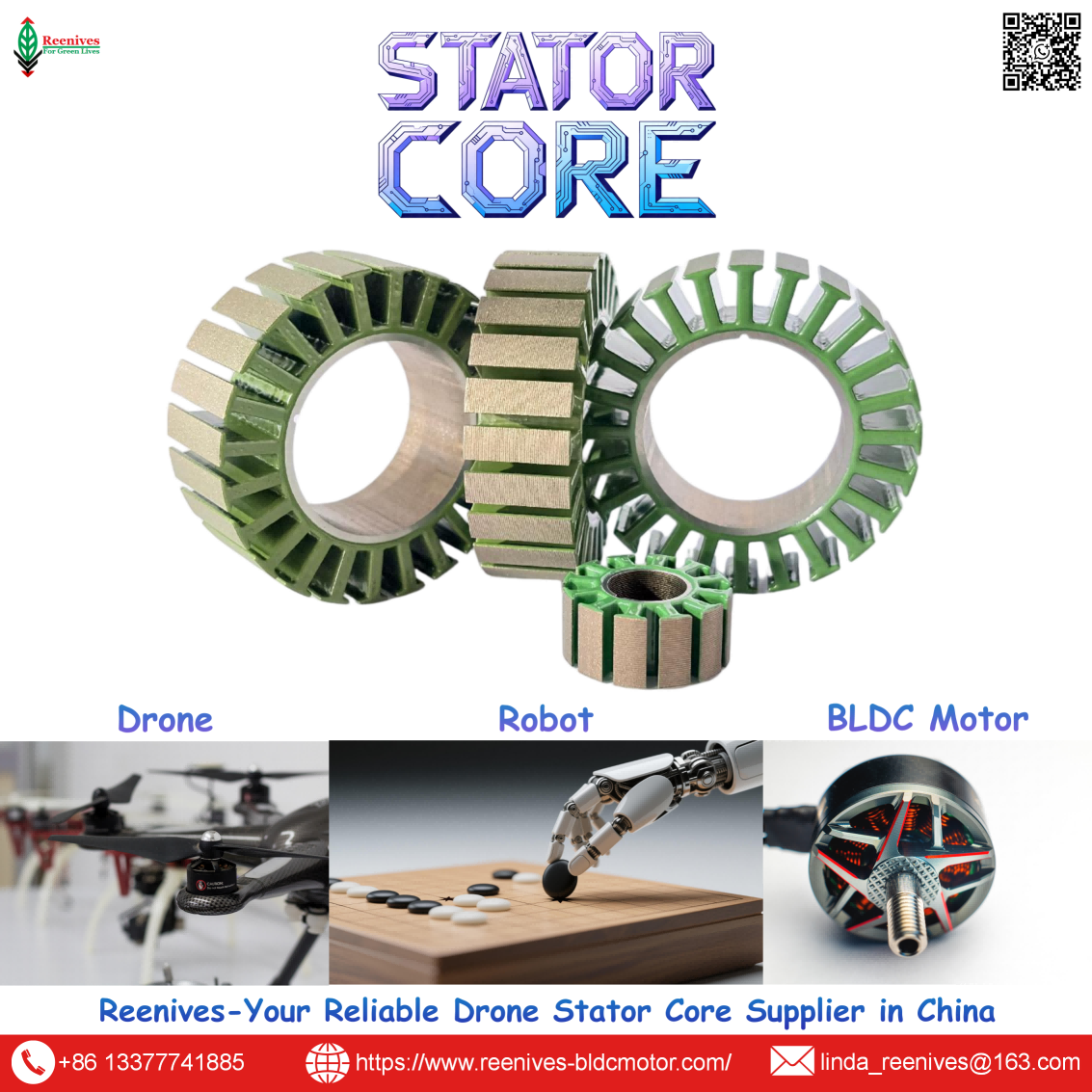
Reenives engineers matched stator and rotor cores for drone brushless motors, including rotor assemblies with specified NdFeB magnet grades (SH/UH families), Ni-Cu-Ni, epoxy, or duplex coatings, and arc-segment profiles matched to the stator bore and air gap. Send your motor’s operating temperature, required grade class, coating specification, and rotor geometry for a sample evaluation and matched-pair data.
WhatsApp: +86-13377741885
Email: linda_reenives@163.com
Official website: www.reenives-bldcmotor.com
Dongguan Runlu Motor Technology Co., Ltd.
Reenives — Drone Motor One-Stop Solution Supplier
Reenives is a professional drone stator core manufacturer, founded in 2022. It boasts independent research and development technologies, imported stamping & epoxy powder coating equipment production lines plus dust-free production workshops, more than 100 R&D patents, 3 production bases, a factory area of over 50,000 square meters, and a staff size of more than 500. From production to sales, we support bulk purchasing, private mould development, and sample making, and can provide tailor-made perfect solutions for your production and usage scenarios. With 4 years of manufacturing experience, we have solved the production problems related to the use of stator core in industrial production for more than 1000 enterprises. We can ship globally (with complete export qualifications). Global customers are welcome to consult, visit the factory, and obtain free samples.
Matched stator + rotor pairsSH / UH NdFeB gradesNi-Cu-Ni / epoxy / duplex coatingsArc-segment rotor magnetsAir-gap matched pairsGlobal export qualifications
How to Do Drone Motor Winding?
Core Workflows of a Drone Motor Production Line
Related Article