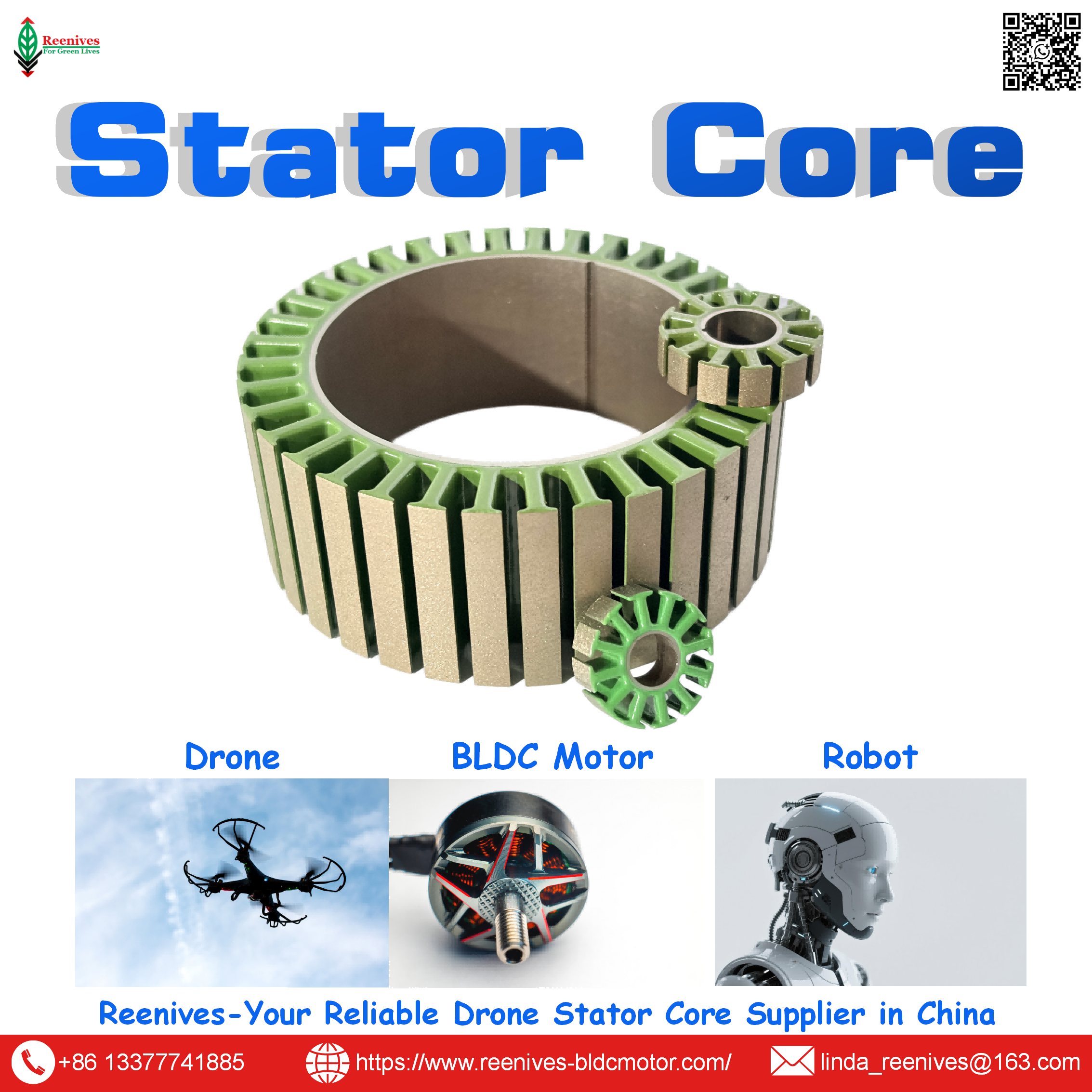
What is Outrunner Stator?

What Is an Outrunner Stator? A Complete Engineering Guide for UAV and Brushless Motor Manufacturers
Your outrunner motor produces the rated thrust on the bench, but on the aircraft it develops vibration at mid-throttle, runs 15°C hotter than the datasheet suggests, and develops cogging that the flight controller cannot fully compensate. The magnets, bearings, and windings may all be within specification. The variable is often the Outrunner Stator — specifically, how it was designed, segmented, stacked, and toleranced.
Outrunner stators are fundamentally different from inrunner stators. The rotor rotates on the outside, which means the stator's outer diameter and slot geometry directly define the air gap that the motor depends on. Any concentricity error, segment joint looseness, or lamination burr shows up immediately as vibration, cogging, or thermal drift. If you source outrunner stators as if they were generic stator cores, you are accepting performance losses that only appear in the field.
This guide explains the outrunner stator from the inside out: definition, classification, key parameters with test data, UAV application requirements, and a practical supplier selection workflow. It is written for procurement managers and R&D engineers who need verifiable facts, not marketing copy.
Table of Contents
- What Is an Outrunner Stator?
- Outrunner Stator Classification
- Key Outrunner Stator Parameters & Test Data
- Application Scenarios & Outrunner Stator Requirements
- Outrunner Stator Selection Steps
- FAQ: Outrunner Stator Parameters Engineers Ask About
- Summary & Get in Touch
- About Dongguan Runlu Motor Technology Co., Ltd.
What Is an Outrunner Stator?
An Outrunner Stator is the stationary magnetic core used in an external-rotor brushless DC (BLDC) motor, where the permanent-magnet rotor surrounds the stator and rotates on the outside. This is the opposite configuration from an inrunner motor, where the rotor spins inside a hollow stator. In an outrunner motor, the stator core faces outward: the stator teeth point radially outward toward the rotating rotor bell, and the air gap is formed at the outer circumference of the stator.
The outrunner stator performs three critical functions:
- Guides magnetic flux from the outward-facing rotor magnets through the winding slots
- Holds the windings in precise geometric position relative to the rotating rotor
- Dissipates heat generated by copper loss and core loss through the mounting base
Because the rotor rotates on the outside, the stator's outer diameter and outer circumference define the air gap. Any concentricity error between the stator outer profile and the rotor bell manifests as uneven magnetic pull, producing vibration, cogging, and accelerated bearing wear. In a typical 14-pole drone outrunner spinning at 6,000 RPM, the magnetic field inside the stator reverses direction hundreds of times per second. At this frequency, lamination thickness, segment joint precision, burr height, and stack height consistency determine whether the motor runs cool and efficient or overheats and loses thrust.

Precision-stamped outrunner stator core with radially oriented teeth for drone brushless motors. Source: Reenives
Outrunner Stator Classification
Outrunner stators are classified by structure (segmented vs. one-piece), slot count, and the lamination material grade they are built from. The table below maps the main types to their characteristics and typical drone motor applications.
| Outrunner Stator Type | Structure | Typical Slots | Typical Application |
|---|---|---|---|
| Segmented Outrunner | Individual tooth segments, assembled into ring | 9 / 12 / 18 | Industrial UAV, heavy-lift multi-rotor |
| One-Piece Outrunner | Single stamped lamination stack, interconnected | 12 / 14 / 24 | FPV, racing, surveying drones |
| Ultra-Thin High-Frequency Outrunner | 0.10–0.20mm laminations, high slot count | 12 / 18 | High-KV FPV motors, high-RPM BLDC |
| Large-Diameter Low-KV Outrunner | Oversized stator, thick lamination, large slot area | 24 / 36 | Heavy-lift logistics, agricultural spraying |
Engineering note: Industrial multi-rotors commonly use segmented outrunner stators with 12 or 18 slots paired with 14- or 16-pole rotors. Segmented construction reduces punching waste and allows tighter winding tolerances, but demands high precision in the segment joint — a loose joint increases reluctance and core loss, which is particularly damaging in an outrunner because the magnetic path is already longer than in an inrunner.
Key Outrunner Stator Parameters & Test Data
The table below summarizes the parameters most commonly specified when qualifying an outrunner stator, together with the performance characteristic each parameter influences.
Outrunner Stator Parameters vs. Motor Performance
| Stator Parameter | Influences | Reference Value |
|---|---|---|
| Lamination thickness | Eddy current loss, efficiency, heat | 0.20mm for high-performance UAV |
| Core loss (P1.5/50) | Motor efficiency, thermal rise | ≤ 1.5 W/kg for industrial UAV |
| Outer diameter concentricity | Air-gap uniformity, vibration, cogging | < 0.03mm preferred |
| Segment joint tolerance | Reluctance increase, cogging, noise | < 0.02mm for low-cogging UAV |
| Burr height | Interlaminar short circuits, hot spots | < 0.02mm for low-loss stacks |
| Insulation coating class | Interlaminar resistance, temperature rating | C5 / C6 for industrial UAV |
| Stack height consistency | Torque output, vibration | ±0.05mm or tighter |
| Max flux density | Torque capability under load | ≥ 1.9 T for heavy-lift motors |
Source: Reenives outrunner stator specifications and internal lab test data, 2025.
Lamination Thickness vs. Core Loss — Controlled Test Data
Reenives conducted a controlled bench test on a standard 14-pole outrunner drone motor, keeping all other components constant and swapping only the outrunner stator lamination material from 0.35mm standard silicon steel to 0.2mm low-loss steel.
| Parameter | 0.35mm Standard Silicon Steel | 0.2mm Low-Loss Steel | Delta |
|---|---|---|---|
| Motor efficiency | Baseline | +1–2% | Longer flight time |
| Core + winding temperature rise | Baseline | −10°C+ | Slower insulation aging |
| Eddy current loss reduction | Baseline | Up to 40% lower | Less heat at high RPM |
Data source: Reenives internal lab tests, 2025. Test conditions: standard 14-pole outrunner drone BLDC motor, 6S LiPo, 5,000–7,000 RPM. Actual results may vary depending on motor design and assembly quality.
Outrunner Stator Specification Reference
| Specification | Standard Range | High-Performance Range |
|---|---|---|
| Lamination thickness | 0.35mm / 0.50mm | 0.20mm / 0.10mm |
| Core loss | ≤ 3.0 W/kg | ≤ 1.5 W/kg (50Hz/1.5T) |
| Concentricity tolerance | ±0.05mm | ±0.02mm |
| Segment joint tolerance | ±0.05mm | ±0.02mm |
| Insulation coating | C3 / C4 | C5 / C6 |
| Burr height | < 0.05mm | < 0.02mm |
| Outer diameter range | 28xx–100xx series | Custom geometry available |
Source: Reenives outrunner stator specifications. Tested per IEC 60404-2 for specific core loss at 50 Hz / 1.5 T.
Manufacturing Tolerances That Matter
Two motors can use the exact same 0.2mm low-loss electrical steel and still perform differently on the thrust stand. The finished outrunner stator — after punching, segmenting, stacking, and assembly — determines the actual magnetic performance. Key variables include:
- Segment joint tolerance: In segmented outrunner stators, the joint between adjacent teeth is a potential source of additional reluctance. A joint gap of 0.05mm vs. 0.02mm can measurably increase core loss and cogging torque.
- Burr height: Large burrs pierce the interlamination insulating coating, creating local short circuits that increase eddy current loss and cause hot spots.
- Punching stress: Mechanical stress near the stator teeth alters local magnetic permeability, increasing hysteresis loss. Outrunner teeth are often narrow, so the affected area represents a significant portion of total tooth width.
- Outer diameter concentricity: Because the outrunner air gap is formed at the stator's outer circumference, concentricity directly controls air-gap uniformity and therefore vibration and cogging.
- Stack height variation: Inconsistent stack height changes the effective magnetic circuit area, reducing torque output and introducing vibration.
Application Scenarios & Outrunner Stator Requirements
Different UAV mission profiles place different demands on the outrunner stator. The table below maps four common industrial applications to their stator requirements.
| Application | Motor Type | Outrunner Stator Priority | Key Metric |
|---|---|---|---|
| Agricultural spraying UAV | Low-KV outrunner (90–120 KV) | Thermal stability, coating durability | Continuous duty at high ambient temp |
| Industrial inspection UAV | Medium-KV outrunner (100–150 KV) | Concentricity, low vibration, low cogging | Concentricity < 0.03mm |
| Logistics / heavy-lift UAV | Low-KV outrunner (< 90 KV) | High flux density capacity, large slot area | Max flux density ≥ 1.9 T |
| FPV / surveying UAV | High-KV outrunner (1700–2700 KV) | Eddy current loss minimization | 0.2mm or 0.1mm laminations |

Outrunner stators for UAV, robotics, and industrial brushless motor applications. Source: Reenives
For agricultural drones operating in high-temperature environments, the outrunner stator coating must maintain its insulating properties even as ambient temperature approaches the motor's thermal limit. A core loss reduction of even 1% translates to extended operation cycles and slower insulation aging — directly impacting total cost of ownership for fleet operators.
Outrunner Stator Selection Steps
The workflow below follows the standard approach used by industrial drone motor manufacturers. Each step includes the outrunner stator specifications you should verify with your supplier.
- Define the motor's operating point.
Establish rated voltage, continuous current, target RPM, and duty cycle. The outrunner stator must be sized so that magnetic flux density stays below saturation at the highest expected load. - Select the slot and pole configuration.
Common combinations in outrunner drone motors: 12-slot/14-pole, 18-slot/16-pole, 24-slot/22-pole. Slot-pole combination determines cogging torque, winding factor, and harmonic content — all of which affect noise and vibration. - Choose segmented vs. one-piece construction.
Segmented outrunner stators reduce punching waste and enable tighter winding, but require high-precision joint assembly. One-piece construction eliminates joint reluctance but produces more stamping scrap and limits winding access. - Choose lamination thickness and material grade.
0.35mm standard silicon steel for cost-sensitive applications; 0.20mm low-loss steel for high-efficiency industrial UAV; 0.10mm for high-frequency or extreme-efficiency designs. - Audit outrunner stator tolerances with your supplier.
Ask these specific questions:- What is the outer diameter concentricity tolerance? (<0.03mm for low-vibration UAV)
- What is the segment joint tolerance for segmented stators? (<0.02mm preferred)
- What is the burr height limit on the finished lamination?
- What insulation coating class is applied? (C3, C4, C5, or C6)
- What is the stack height tolerance after interlocking or welding?
- Can you provide interlamination resistance test results on the finished stack?
- Validate thermal and vibration performance.
Target motor temperature rise below 80°C under continuous duty. For industrial drones, verify that the outrunner stator maintains dimensional stability across the full operating temperature range and that the finished motor's vibration signature meets your platform's requirements.
Procurement tip: When evaluating outrunner stator suppliers, request test data from the finished stack, not just the raw material datasheet. Segment joint quality, processing stress, and burr height can reduce magnetic performance by 5–15% compared to the material's original specification.
FAQ: Outrunner Stator Parameters Engineers Ask About
Summary: Specify the Outrunner Stator, Control the Motor
An outrunner motor is only as reliable as its Outrunner Stator. Lamination thickness, segment joint precision, burr control, and outer diameter concentricity determine whether your motor delivers consistent thrust or battles vibration and thermal degradation. For industrial drone manufacturers — whether producing agricultural sprayers, inspection platforms, or heavy-lift logistics drones — the outrunner stator is the component that quietly defines the performance ceiling.
The numbers speak for themselves:
- 0.2mm laminations vs. 0.35mm: +1–2% efficiency, −10°C+ temperature rise
- Outer diameter concentricity < 0.03mm: smoother torque, lower vibration, quieter operation
- Segment joint tolerance < 0.02mm: lower cogging, lower core loss
- Core loss ≤ 1.5 W/kg: longer flight time, slower insulation aging
Whether you are qualifying a new outrunner motor design or looking to reduce field failures, the conversation should start with the stator. Reenives Outrunner Stator Supplier provides matched stator and rotor cores, custom tooth geometry, and full test documentation for UAV and brushless motor manufacturers worldwide.
Ready to Discuss Your Outrunner Stator Requirements?
Website: www.reenives-bldcmotor.com
WhatsApp: +86-13377741885
Email: linda_reenives@163.com
Free samples available for qualified engineering evaluations. Global shipping with complete export qualifications.
Dongguan Runlu Motor Technology Co., Ltd.
Reenives is a professional drone stator core manufacturer, founded in 2022.
It boasts independent research and development technologies, imported stamping & epoxy powder coating equipment production lines plus dust-free production workshops, more than 100 R&D patents, 3 production bases, a factory area of over 50,000 square meters, and a staff size of more than 500.
From production to sales, we support bulk purchasing, private mould development, and sample making, and can provide tailor-made perfect solutions for your production and usage scenarios.
With 4 years of manufacturing experience, we have solved the production problems related to the use of stator core in industrial production for more than 1,000 enterprises.
We can ship globally (with complete export qualifications). Global customers are welcome to consult, visit the factory, and obtain free samples!
© 2026 Dongguan Runlu Motor Technology Co., Ltd. (Reenives). All rights reserved. Outrunner Stator manufacturer serving the UAV, robotics, and brushless motor industries worldwide. Search for "Reenives Outrunner Stator Supplier" to learn more.
What is 3115 Drone Motor Stator Core?
What is Gimbal BLDC Motor Stator?
Related Article