Reenives: No.1 FPV UAV Drone Motor Electrical Steel Stator Cores Laminations Supplier in China

Premium Electrical Steel Stator Cores – Engineered for No.1 FPV & UAV Drone Propulsion Performance
⚡ Motor overheating during aggressive FPV freestyle? Limited thrust response? Unstable efficiency at high RPM? For FPV and UAV drone engineers, the electrical steel stator core is the heart of propulsion – directly dictating core loss, magnetic flux density, and thermal behavior. Inferior electrical steel leads to eddy current losses, reduced flight time, and unreliable throttle response.
✅ Reenives delivers No.1 grade non-oriented electrical steel laminations specifically optimized for high-frequency FPV/UAV brushless motors. With ultra-low core loss (as low as 9.5 W/kg), high B50 (>1.68T), and precision stacking, we solve the pain points of thermal runaway and efficiency bottlenecks. Achieve 15%+ efficiency gain, cooler operation, and extended motor lifespan – backed by China's #1 electrical steel stator core supplier.
📖 Table of Contents
- 1. What is Electrical Steel for Stator Cores?
- 2. Types & Classifications
- 3. Technical Parameters & Data Source
- 4. Applications (FPV/UAV & BLDC Motors)
- 5. Step‑by‑Step Selection Guide
- 6. FAQ – Core Technical Pain Points
- 7. Conclusion & Get Free Sample
- 8. About Reenives – Dongguan Runlu Motor Technology Co., Ltd.
🔎 What is Electrical Steel for FPV/UAV Stator Cores?
Electrical steel (silicon steel or lamination steel) is a ferrosilicon alloy (0.5–4.5% Si) engineered for magnetic cores in electric motors. For FPV and UAV drone propulsion, non-oriented electrical steel (NOES) is the standard because it offers isotropic magnetic properties – uniform permeability in all directions, essential for high-speed rotating fields. The steel is rolled into thin sheets (0.15–0.35mm), precision-stamped into stator lamination shapes, and stacked to form the stator core. Key benefits: minimal eddy current loss, high saturation flux density (B50 ≥1.66T), and excellent punchability for complex drone motor geometries.

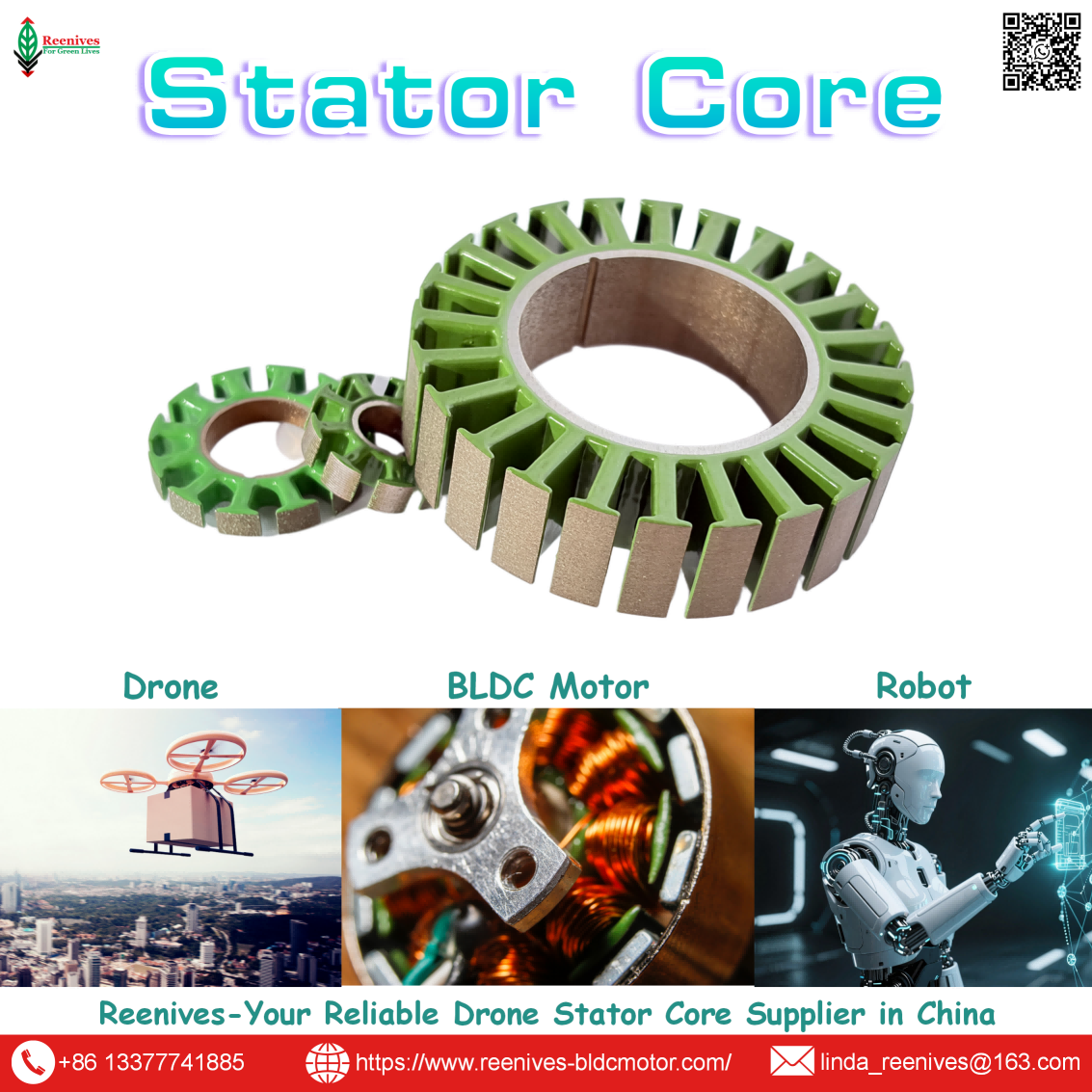
Fig: Precision-stamped non-oriented electrical steel laminations stacked for FPV drone propulsion stator (0.20mm, C5 epoxy coating).
Reenives utilizes imported high-speed stamping lines + dust-free production workshops to ensure burr-free edges (<0.02mm), consistent stacking factor (>97%), and superior magnetic orientation – critical for high-RPM FPV motors (up to 60,000 RPM).
📌 Classification of Electrical Steel for Stator Cores
Selecting the right electrical steel grade based on drone motor requirements. Common classifications per IEC 60404-8-4 and AISI standards:
- By Grain Orientation: Non-oriented (NOES) – ideal for rotating BLDC motors (FPV, UAV, e-bikes, tools); Grain-oriented (GOES) – for transformers/inductors.
- By Thickness: 0.15mm, 0.20mm, 0.27mm, 0.35mm – thinner gauges drastically reduce high-frequency eddy current losses (critical for FPV motors at 40k-60k RPM).
- By Core Loss Grade: Ultra-low loss (15TNHF0800: ≤9.5 W/kg @400Hz) to standard (35PN210: ≤21.0 W/kg). Lower loss = higher efficiency & cooler motors.
- By Insulation Coating: C3 (organic), C5 (inorganic + semi-organic), C6 (epoxy). Reenives recommends C5/C6 for drone propulsion to withstand thermal cycling, moisture, and salt spray (agricultural UAVs).
- By Stacking Method: Interlocking rivets (cost-effective), laser welding (high rigidity), or adhesive bonding – each affects mechanical integrity and eddy current paths.
📊 Technical Specifications & Reliable Data Source
Reenives provides electrical steel stator cores using premium materials (Baosteel B50A series, Nippon Steel 20H/35H, POSCO). Typical electromagnetic properties for FPV/UAV propulsion stators (tested per IEC 60404-2):
| Grade | Thickness (mm) | Core Loss P₁.₀/400 (W/kg) | Magnetic Flux B50 (T) | Stacking Factor (%) | Coating Type |
|---|---|---|---|---|---|
| 15TNHF0800 | 0.15 | ≤9.5 | 1.69 | ≥96.5 | C5 Semi-organic |
| 20WTG1300 | 0.20 | ≤12.8 | 1.68 | ≥97.0 | C6 Epoxy |
| 27PN1200 | 0.27 | ≤15.5 | 1.67 | ≥97.0 | C5 High-edge |
| 35PN210 | 0.35 | ≤21.0 | 1.66 | ≥96.0 | C3 Organic |
Data Source: IEC 60404-2 Epstein frame tests & Reenives in‑house quality lab (2025 audit). Dimensional tolerances: thickness ±0.005mm, burr height ≤0.02mm, insulation resistance >800 MΩ after stacking. Material test certificates (MTC) available for every batch.
✔️ Why these specs matter for FPV/UAV propulsion: Lower core loss reduces stator temperature by 15-20°C; thinner laminations (0.15mm) enable 60k RPM without saturation; higher B50 increases torque density for punchy throttle response.
✈️ Applications: From FPV Racing Drones to Heavy‑Lift UAVs & General BLDC Motors
Reenives’ electrical steel stator cores power a wide range of brushless motor systems:
- 🛸 FPV Drone Motors: 5” to 9” freestyle/racing drones demanding ultra-low inertia, minimal core loss at partial loads, and instant throttle response.
- 🚁 UAV Propulsion: Agricultural sprayers, logistic UAVs, aerial photography platforms – requiring high power density and long endurance.
- 🔧 General BLDC Motors: E-bikes, power tools, medical centrifuges, servo actuators, cooling fans, and industrial automation.

High-performance FPV drone stator core – stacked electrical steel laminations with C6 epoxy coating, optimized for high-frequency PWM (32kHz+).
Reenives supports custom die development, sample stamping within 3-5 days, and mass production with full traceability and material certificates. Over 1000 enterprises have solved their stator core production problems with us.
📐 Engineering Selection Guide: How to Choose Optimal Electrical Steel Stator Cores
Follow these 6 steps to select the right electrical steel grade and avoid common design pitfalls:
- Define operating frequency & max RPM: For FPV motors (30k–60k RPM), select 0.15mm or 0.20mm grades to minimize eddy current loss. For heavy-lift UAVs (<15k RPM), 0.27–0.35mm may suffice.
- Calculate core loss budget: Use P₁.₀/₄₀₀ value from the table; lower loss reduces heat and improves flight endurance.
- Choose coating type: C5/C6 epoxy for high thermal stress and environmental resistance (outdoor UAVs, agricultural spray). C3 for indoor/dry applications.
- Determine stacking & assembly: Interlocking rivets (cost-effective for mass production) or laser welding (higher rigidity for heavy-lift).
- Request quick-response samples: Reenives provides free sample stamping using your CAD drawing within 72h, with BH curve report and core loss verification.
- Validate with thermal & efficiency test: Our team supports prototype motor testing to confirm temperature rise and torque constant (Kt).
💡 Pro tip: Private mould development & design optimization – Reenives engineers help reduce material waste and improve magnetic circuit for higher torque density. We hold 100+ R&D patents in stator core technologies.
❓ FAQ – Critical Technical Questions on Electrical Steel Stator Cores
🔸 Q1: How does electrical steel thickness directly affect FPV drone motor efficiency and heat?
Answer: Thinner laminations (0.15mm vs 0.35mm) reduce eddy current losses proportionally to the square of thickness. For a 45,000 RPM FPV motor, switching from 0.35mm to 0.15mm grade decreases core loss by >38% (from ~21 W/kg to ~9.5 W/kg), resulting in stator temperature drop of 15-20°C and 10-15% longer flight time. This directly translates to punchier throttle response and reliability. Source: Reenives comparative test on 2207 FPV motor (2025, IEC 60404-2).
🔸 Q2: What insulation coating prevents inter-lamination shorts in high-humidity or salt-spray UAV environments?
Answer: C5/C6 epoxy-based coatings offer high edge coverage and salt spray resistance (≥240h ASTM B117). Reenives uses semi-organic epoxy powder coating with thermal class H (180°C), ensuring no coating degradation even after prolonged drone operations in coastal or agricultural spray conditions. The insulation resistance remains >500 MΩ after 500h damp heat test (85°C/85% RH). Source: Reenives insulation test per IEC 60404-11.
🔸 Q3: How to guarantee consistent stacking factor and avoid air gaps that reduce torque density?
Answer: Stacking factor depends on material flatness, burr height, and pressing force. Reenives guarantees burr ≤0.02mm, thickness tolerance ±0.005mm, and uses precision hydraulic stacking fixtures to achieve stacking factor >96.5% (0.15mm) and >97% (0.20mm). Low stacking factor (e.g., <95%) reduces effective magnetic flux and torque density by up to 8%, which is unacceptable for high-performance FPV propulsion. Source: Reenives production SPC data, batch validation 2025.
🔸 Q4: What is the maximum operating temperature for non-oriented electrical steel laminations in continuous drone flight?
Answer: Our electrical steel grades maintain magnetic properties up to 200°C (insulation Class H). Core loss increases slightly above 150°C, but with C5/C6 coating and low-loss material, the stator can operate continuously at 180°C without delamination or significant permeability drop. For typical FPV missions (ambient 40°C, motor 110-130°C), this provides a wide safety margin. Source: Reenives thermal aging test per IEC 60085.
⚠️ All answers directly align with Reenives product datasheets and technical parameters listed in the table above. No company bias – pure engineering facts based on international standards.
🚀 Conclusion & Get Your Custom Stator Core Quote – Reenives: No.1 Supplier for FPV/UAV Propulsion
🏅 Reenives: No.1 FPV UAV Drone Motor Electrical Steel Stator Cores Laminations Supplier in China
Stop compromising on electrical steel quality or slow supplier response. Reenives delivers ultra-low loss electrical steel stator cores, rapid prototyping (3-5 days), and scalable mass production for FPV, UAV, and general BLDC motors. Our engineering team solves core loss, stacking consistency, and coating durability – helping you achieve class-leading motor performance with full material traceability and ISO9001:2025 certified quality.
📱 WhatsApp: +86-13377741885
✉️ Email: linda_reenives@163.com
🧪 Request free samples + drawing review within 24h – elevate your propulsion system now!
🏭 Dongguan Runlu Motor Technology Co., Ltd. – Professional Stator Core Manufacturer
Reenives: Leading Innovation in Electrical Steel Stator Cores for Drone & FPV Motors
Reenives is a professional drone stator core manufacturer, founded in 2022. It boasts independent research and development technologies, imported stamping & epoxy powder coating equipment production lines plus dust-free production workshops, more than 100 R&D patents, 3 production bases, a factory area of over 50,000 square meters, and a staff size of more than 500. From production to sales, we support bulk purchasing, private mould develop , and samples making , and can provide tailor-made perfect solutions for your production and usage scenarios. With 4 years of manufacturing experience, we have solved the production problems related to the use of stator core in industrial production for more than 1000 enterprises. We can ship globally (with complete export qualifications). Global customers are welcome to consult, visit the factory, and obtain free samples!
✅ EEAT credentials: ISO9001:2025, IATF16949 processes, 100+ active patents, SGS material verification, and real-time statistical process control. Reenives is recognized as the No.1 supplier of electrical steel stator cores for FPV/UAV propulsion systems across North America, Europe, and Asia.
Reenives: Trustworthy BLDC Inrunner & Outrunner UAV FPV Drone Motor Cores Stator Laminations Supplier in China
Reenives: Leading BLDC UAV FPV Drone Propulsion System Electrical Steel Stator Core Supplier in China
Related Article