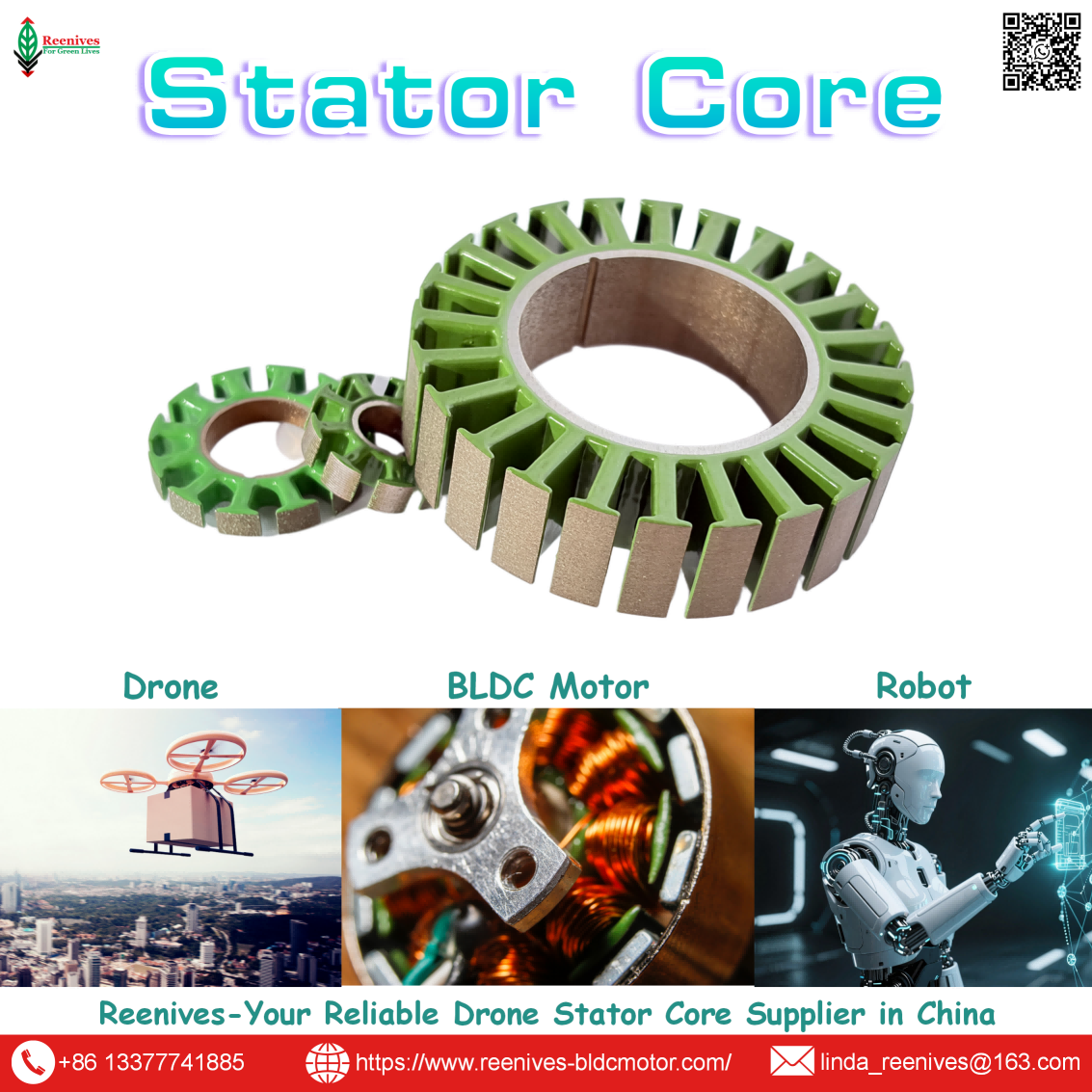
Reenives: Leading Drone Motor Stator Core Supplier in Turkey

Reenives: Leading Drone Motor Stator Core Supplier in Turkey
Table of Contents
-
Introduction: Turkey’s Drone Revolution and the Need for World-Class Components
-
The Stator Core: The Hidden Heart of Drone Performance
-
Why Turkey’s Drone Industry Demands Superior Stator Cores
-
The Competitive Landscape: How Reenives Stands Apart
-
Three Key Advantages of Reenives Stator Cores
-
Advantage 1: Ultra-Thin Silicon Steel for Minimal High-Speed Iron Loss
-
Advantage 2: Burr-Free Precision Lamination for Maximum Efficiency
-
Advantage 3: Vacuum Pressure Impregnation (VPI) for Unmatched Durability
-
-
Comprehensive Quality Control and Customization Capabilities
-
Serving Turkey’s Leading Drone Manufacturers
-
Conclusion: Partner with Reenives for Mission-Critical Performance
1. Introduction: Turkey’s Drone Revolution and the Need for World-Class Components
Turkey has emerged as a global leader in drone technology. By 2025, the country controlled over 65% of the global drone market, driven by the success of Baykar’s Bayraktar TB2 and a deliberate national strategy of technological independence following past arms embargoes-8. The Turkish defense and aerospace industry has seen extraordinary growth, with defense exports reaching USD 7.1 billion in 2024 and 80% of production resources provided by domestic companies-8.
Turkey’s commercial drone market is expanding at a remarkable CAGR of 23.6% from 2025 to 2033, projected to grow from USD 100.42 million in 2024 to USD 677.75 million by 2033-1. Globally, the drone motor market—of which stator cores are a critical subcomponent—was valued at USD 6.73 billion in 2025 and is projected to reach USD 16.30 billion by 2034, growing at a CAGR of 10.6%-23. The BLDC motors for drones segment alone is expected to grow from US$ 2.23 billion in 2025 to US$ 4.86 billion by 2031-20.
As Turkish drone manufacturers—including Baykar Technologies, Turkish Aerospace Industries (TUSAŞ), Zyrone Dynamics, Titra Technology, DASAL, and KARAKAMLAR—continue to expand their global footprint, the demand for precision-engineered domestic components has never been greater-11-. At Reenives, we are proud to serve as Turkey’s leading supplier of high-performance drone motor stator cores, providing the electromagnetic foundation that powers the nation’s unmanned aerial vehicles (UAVs).
2. The Stator Core: The Hidden Heart of Drone Performance
A brushless DC (BLDC) motor consists of two primary components: the stator (the fixed part mounted to the drone frame) and the rotor (the spinning bell containing permanent magnets)-59. The stator core—also called a lamination stack—is a precisely assembled bundle of hundreds of thin, insulated silicon steel sheets around which copper wires are wound to generate the electromagnetic field that drives the motor-59.
Why use laminated steel rather than a solid iron block? A changing magnetic field induces currents in conductive materials. In a solid core, these “eddy currents” swirl around and convert useful energy into wasted heat. Each lamination in a Reenives stator core is coated with a high-resistance insulating layer that disrupts the path of these currents, confining them to tiny loops and drastically reducing heat generation-59.
The stator core is not merely a component—it is the electromagnetic foundation of a drone’s endurance, power output, and reliability-58. For fixed-wing UAVs operating in high-RPM steady-state environments, core loss minimization is paramount: every watt lost to hysteresis or eddy currents directly shortens flight time-58. For mini FPV drones, the stator core determines throttle response, peak power, and durability during high-stress maneuvers-59.
At Reenives, we have dedicated our engineering expertise to perfecting stator core manufacturing for the unique demands of drone propulsion—from ultra-light FPV racers to long-endurance fixed-wing surveillance platforms and heavy-lift cargo UAVs.
3. Why Turkey’s Drone Industry Demands Superior Stator Cores
Turkey’s drone industry operates at the forefront of global aerospace technology, with applications spanning military defense, agriculture, logistics, surveillance, disaster response, and beyond. Turkish manufacturers are producing high-capacity cargo drones for humanitarian missions, unmanned helicopters for mountainous terrain, and loitering munition systems for precision strikes-11-12.
These demanding applications impose stringent requirements on every component—especially the motor stator core:
-
Military-grade reliability requires cores that maintain structural integrity under sustained high-G maneuvers, vibration, and thermal cycling.
-
Long-endurance missions demand minimal core losses to maximize flight time on limited battery capacity.
-
High-speed operation necessitates ultra-thin laminations to suppress eddy current losses at elevated frequencies.
-
Heavy-lift capability requires high magnetic flux density to generate sufficient torque without excessive weight.
Generic stator core solutions—often imported from overseas suppliers with variable quality control—cannot consistently meet these demands. Turkish drone manufacturers require a domestic partner that understands their unique operational requirements and can deliver precision-engineered cores with rapid turnaround and technical support.
That partner is Reenives.
4. The Competitive Landscape: How Reenives Stands Apart
The global drone motor market features a diverse array of suppliers. Major international players include T-MOTOR, Maxon, Nidec, DJI (vertically integrated), KDE Direct, Scorpion Power Systems, Brotherhobby, and Hobbywing-30-27. Chinese suppliers such as T-MOTOR, Sunray (三瑞智能—the world’s second-largest civil drone power system supplier with 7.1% global market share), and various others dominate the mass-market segment-30.
However, the competitive landscape for high-precision stator cores specifically reveals a significant gap: while global players offer complete motors, few specialize in standalone stator cores manufactured with the precision tolerances and mission-specific optimization that Turkish drone manufacturers require. Many overseas suppliers rely on standardized processes, use thicker laminations (0.35mm or above) that introduce unacceptable iron losses at high speeds, and lack the flexibility to accommodate custom geometries.
Turkey’s domestic motor component sector remains nascent. While companies like MOTA Motor Teknolojileri have contributed to UAV motor development projects, the supply chain for precision stator cores has historically relied on imports-. Reenives fills this critical gap by offering world-class, domestically manufactured stator cores that rival or exceed the quality of international competitors, with the added benefits of local support, shorter lead times, and customization tailored to Turkish OEM requirements.
Below, we detail the three key advantages that set Reenives stator cores apart from the competition.
5. Three Key Advantages of Reenives Stator Cores
Advantage 1: Ultra-Thin Silicon Steel for Minimal High-Speed Iron Loss
The single most important factor determining stator core efficiency at high rotational speeds is lamination thickness. Eddy current losses are proportional to the square of lamination thickness—meaning thinner laminations exponentially reduce energy waste.
Most mass-market stator cores use 0.35mm or 0.50mm silicon steel laminations, which produce significant iron losses when drone motors spin at tens of thousands of RPM. At high frequencies, these losses manifest as heat, reducing efficiency, shortening flight times, and potentially damaging adjacent electronics.
Reenives uses premium ultra-thin silicon steel grades (0.20mm, 0.15mm, and even 0.10mm where mission-critical), sourced from top-tier electrical steel mills. Our fixed-wing UAV cores, for example, prioritize ultra-thin, high-silicon steel grades such as M250-35A or better to minimize eddy current loss at high operational frequencies-58. For FPV and mini drone applications, 0.15mm–0.20mm laminations are standard, with 0.10mm available for the most demanding racing and cinewhoop builds-59.
The performance difference is substantial: 0.20mm laminations reduce iron loss by approximately 30% compared to 0.35mm laminations-59. For a long-endurance surveillance drone operating at high cruise speeds, this efficiency gain translates directly into additional flight minutes—often the difference between mission success and premature return.
By contrast, many competitors continue to use thicker laminations to reduce manufacturing costs, sacrificing performance for price. Reenives refuses to compromise. We believe that drone manufacturers seeking the highest possible efficiency and reliability deserve nothing less than the thinnest, highest-grade silicon steel available.
Advantage 2: Burr-Free Precision Lamination for Maximum Efficiency
Precision lamination stamping is an art as much as a science. The quality of the stamped edge—specifically, the presence or absence of burrs—has a direct impact on core efficiency and reliability.
When laminations are stamped with suboptimal die clearances or worn tooling, microscopic burrs form along the cut edges. These burrs can pierce the insulating coating between adjacent laminations, creating unintended electrical contact paths. Inter-lamination short circuits allow eddy currents to flow between sheets rather than being confined within each lamination, bypassing the very mechanism that makes laminated cores efficient. The result is increased core losses, localized heating, and reduced motor lifespan.
Reenives employs progressive die technology in our clean, controlled manufacturing facilities. Every lamination is stamped with precisely maintained die clearances, producing burr-free edges and perfect geometric accuracy-58. After stamping, each lamination receives a uniform, high-resistance insulation coating (C5 class or higher), further ensuring that inter-laminar leakage currents are prevented-58.
Our commitment to burr-free precision extends to stacking as well. Laminations are stacked to exact height with meticulous alignment, using a combination of interlocking features and controlled epoxy bonding to create a rigid, unitary stack that prevents vibration-induced micro-movements-58. These micro-movements, if allowed to occur, can degrade performance over hundreds of flight hours—an unacceptable risk for mission-critical UAVs.
Many overseas competitors, particularly those focused on high-volume low-cost production, tolerate minor burrs and less precise stacking to increase throughput. Reenives does not. Every core that leaves our facility meets our rigorous internal standards for edge quality, coating integrity, and stack rigidity.
Advantage 3: Vacuum Pressure Impregnation (VPI) for Unmatched Durability
A stator core must survive harsh operating environments: high temperatures from sustained power output, moisture from outdoor operations, vibration from unbalanced propellers or turbulent flight conditions, and contaminants such as dust, salt spray, or agricultural chemicals. Without proper sealing and consolidation, core performance degrades over time as interlaminar insulation breaks down, corrosion sets in, and mechanical looseness develops.
Reenives solves this durability challenge through Vacuum Pressure Impregnation (VPI) —a process that sets our cores apart from standard offerings-58.
The VPI process at Reenives works as follows:
-
Vacuum evacuation: The stacked core is placed in a vacuum chamber, and all air is removed from within the lamination stack, including microscopic voids between laminations and within the insulation coatings.
-
Varnish impregnation: While still under vacuum, a high-thermal-class varnish is introduced. The vacuum draws the varnish deep into every void and crevice within the core structure.
-
Pressure saturation: The chamber is pressurized, forcing the varnish even deeper into the core and ensuring complete, uniform saturation.
-
Curing: The impregnated core is cured, transforming the varnish into a solid, thermally conductive, chemically resistant matrix that permanently seals and consolidates the lamination stack.
The benefits of VPI treatment are substantial:
-
Enhanced thermal conductivity: The varnish fills air gaps, creating continuous thermal pathways that draw heat away from windings and into the core for dissipation.
-
Superior mechanical strength: The consolidated stack resists vibration-induced delamination and maintains geometric stability over thousands of flight hours.
-
Environmental protection: Sealed laminations are protected against moisture, salt, dust, and chemical contaminants—critical for drones operating in agricultural, maritime, or desert environments.
While some competitors offer basic dip-and-bake varnishing (which leaves internal voids unsealed), Reenives’ VPI process ensures complete, void-free impregnation. This is the same technology used in aerospace-grade motors and high-reliability industrial applications—now available to Turkish drone manufacturers through Reenives.
After VPI, critical surfaces such as the bore and mounting faces are machined to tight tolerances, ensuring perfect concentricity and alignment with the rotor, minimizing magnetic asymmetry and mechanical vibration-58.
6. Comprehensive Quality Control and Customization Capabilities
At Reenives, quality is not an afterthought—it is embedded into every stage of our manufacturing process. Our 8-step precision manufacturing methodology includes:
-
Mission-specific electromagnetic and thermal simulation
-
Precision lamination stamping with progressive die technology
-
High-resistance insulation coating application
-
Precision stacking and controlled epoxy bonding
-
Vacuum Pressure Impregnation (VPI)
-
Precision machining of critical surfaces
-
100% dimensional and magnetic inspection
-
Final certification and packaging-58
Our quality control protocols include rigorous dimensional verification using precision measurement equipment, magnetic flux density testing to confirm material performance, and visual inspection for coating integrity and burr-free edges.
Customization is another core competency of Reenives. Unlike many overseas suppliers who offer only standard geometries, Reenives supports full OEM custom designs. We work directly with drone manufacturers to develop stator cores optimized for specific motor dimensions, power targets, and operational profiles. Whether you need a mini 0702 core for an ultralight FPV racer, a medium 2207 core for a freestyle drone, or a large-format core for a heavy-lift cargo UAV, Reenives can deliver.
Our team provides technical support throughout the design and prototyping phases, helping customers select optimal lamination thicknesses, slot geometries, and material grades for their specific applications.
7. Serving Turkey’s Leading Drone Manufacturers
Reenives is proud to support Turkey’s growing ecosystem of drone manufacturers. Our stator cores are used in:
-
Fixed-wing surveillance UAVs requiring long-endurance cruise efficiency
-
FPV racing and freestyle drones demanding instantaneous throttle response and thermal resilience
-
Agricultural drones operating in dusty, humid environments requiring environmental sealing
-
Industrial inspection drones needing reliable performance across wide temperature ranges
-
Cargo and logistics UAVs requiring high torque density for heavy payloads
We serve both established defense contractors and emerging startups, offering the flexibility to scale from prototype quantities to production volumes. As a Turkey-based supplier, we provide shorter lead times, reduced shipping costs, and direct technical support compared to overseas alternatives.
Our commitment to local manufacturing aligns with Turkey’s national strategy of technological independence. By sourcing high-precision stator cores from Reenives, Turkish drone manufacturers reduce their reliance on imported components, strengthen domestic supply chain resilience, and contribute to the continued growth of Turkey’s aerospace industry.
8. Conclusion: Partner with Reenives for Mission-Critical Performance
The stator core is the hidden heart of every drone motor—and for drone manufacturers seeking the highest levels of efficiency, reliability, and performance, the choice of stator core supplier matters immensely.
Reenives brings together world-class engineering, precision manufacturing, and deep expertise in drone propulsion requirements. Our three key advantages—ultra-thin silicon steel for minimal high-speed iron loss, burr-free precision lamination for maximum efficiency, and Vacuum Pressure Impregnation for unmatched durability—deliver tangible performance benefits that extend flight times, increase payload capacity, and enhance reliability.
As Turkey’s leading drone motor stator core supplier, we invite UAV manufacturers, motor designers, and system integrators to partner with Reenives. Whether you are developing a next-generation military UAV, a high-performance FPV racing motor, or an industrial inspection platform, we have the expertise and capabilities to deliver stator cores that exceed your expectations.
Contact Reenives today to discuss your stator core requirements. Let us power your flight—with precision, reliability, and Turkish engineering excellence.
Reenives: Precision Engineered. Mission Ready. Made in Turkey.
Reenives: Leading Drone FPV UAV Motor Stator Core Supplier in Poland
Reenives:Pioneer Drone Stator Supplier in Turkey
Related Article