
Classification of Drone Motor
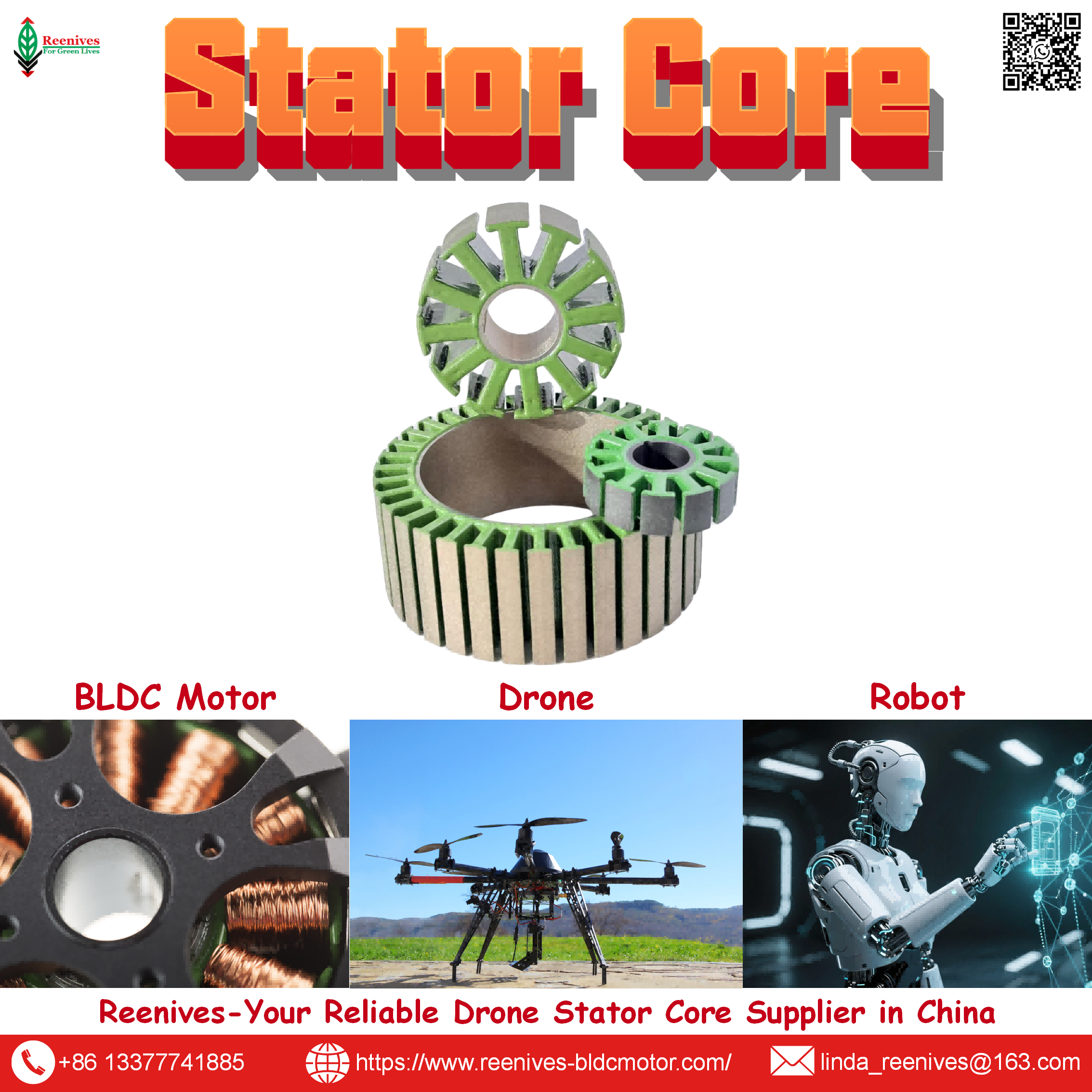
Classification of Drone Motor: Five Axes That Turn a Category Label Into a Comparable Specification
Two motors, both labeled “2207 1750KV 6S,” both priced within 15% of each other, and one flies an eighteen-minute survey while the other sags at minute nine. The part number is identical. The KV is identical. The voltage platform is identical. The difference sits on axes the label never mentions: the stator core lamination grade, the stacking method, the winding tension control, and the magnet temperature class. Procurement engineers who compare drone motors on the label are comparing four-fifths of a specification while believing they have compared the whole thing.
The published data shows why the label is insufficient. A drone motor name encodes stator diameter and stack height — 2207 means 22 mm stator diameter and 7 mm stack height, 2306 means 23 mm and 6 mm. It says nothing about the lamination inside. A 0.35 mm core runs at roughly 28–35 W/kg at 1.0 T / 400 Hz; a 0.20 mm grade runs at roughly 10–14 W/kg, and Reenives publishes ≤8.5 W/kg at 1.0 T / 400 Hz for its drone grade with stacking factor ≥97.5%, burr <0.03 mm, critical tolerance ±0.05 mm, concentricity ≤0.02 mm, and uniform epoxy coating. Two motors that share a part number and a KV rating can therefore differ in thermal margin by a factor that shows up as flight time, not as a datasheet line.
This guide treats classification as a procurement tool, not a taxonomy exercise. It defines the five independent axes that fully describe a drone motor, separates the commutation and topology axes from the stator construction and slot-pole axes, presents the published parameters that make each axis auditable, maps the axes to application classes from whoop to eVTOL, and closes with a five-step classification audit. Every figure below is traceable to a published source or a named measurement standard.
In this guide — jump to the section your project needs:
- What Does “Classification of Drone Motor” Mean? The Five-Axis Definition
- The Five Axes in Detail: Commutation, Rotor Topology, Stator Construction, Slot-Pole/KV, Application Class
- Published Parameters per Axis: Core Loss, Stacking Factor, Burr, Concentricity, Winding Factor, KV Bands
- Application Classes: Which Axes Bind Which Drone Mission
- A 5-Step Classification Audit for Procurement Engineers
- FAQ: Axes, Outrunner vs Inrunner, Stator Constructions, KV Class, Stator Core, and Part-Number Confusion
- Summary: Classify Before You Compare
What Does “Classification of Drone Motor” Mean? The Five-Axis Definition
“Drone motor” is a category label. It tells you the motor is used for drone propulsion; it does not tell you what the motor is. To classify a drone motor properly, you have to specify its position on five independent axes, and a specification that leaves any of them unnamed leaves a performance variable to chance.
| Axis | Options | What It Changes | Visible on the Part Number? |
|---|---|---|---|
| 1 · Commutation | Brushed / Brushless (BLDC) | Efficiency, wear mechanism, speed ceiling, controller requirement | Usually, but not always |
| 2 · Rotor topology | Outrunner / Inrunner | Torque-radius, inertia, bearing arrangement, air-gap geometry | No |
| 3 · Stator construction | Slotted laminated / Slotless / Coreless / PCB | Core loss, cogging, torque density, thermal path, unit cost | No |
| 4 · Slot-pole and KV class | 9N12P / 12N14P / 18N24P / 24N28P × high/mid/low KV | Winding factor, cogging profile, torque-speed trade | KV yes, slot-pole no |
| 5 · Application class | Whoop / 5-inch FPV / cine / 7–10 inch / heavy-lift / industrial / eVTOL | Voltage platform, propeller size, continuous duty requirement | No |
Sources: Published drone motor classification frameworks; motor naming convention (stator diameter + stack height); published KV application bands.
The reason the five axes must be treated as independent is that a choice on one axis does not constrain the others. A 12N14P outrunner can be built with a slotted laminated stator or with a PCB stator — both are valid classifications, and they differ on Axis 3 while matching on Axes 1, 2, 4, and often 5. The classification label in a catalog typically names Axis 4 (KV) and part of the part-number envelope, and leaves the rest to be inferred. The procurement job is to make the inference explicit.
Procurement translation: a motor specification that reads “2207 1750KV 6S” describes one axis of five. A specification that reads “BLDC, outrunner, slotted laminated stator at 0.20 mm ≤8.5 W/kg with ≥97.5% stacking factor, 12N14P, 1750KV wye, 6S platform, 5-inch FPV class” describes all five. The second specification can be audited; the first can only be priced.
The Five Axes in Detail: Commutation, Rotor Topology, Stator Construction, Slot-Pole/KV, Application Class
Axis 1 — Commutation: brushed versus brushless
Commutation is how the motor switches current direction to keep the rotor turning. A brushed motor uses brushes pressing against a rotating commutator; a brushless DC (BLDC) motor removes the brushes and commutator entirely, using an electronic speed controller (ESC) to switch current through the stator phases. The consequence is well-published: brushless efficiency is roughly 85–95% versus 60–75% for brushed, brushless lifespan is 20,000–100,000 hours versus 1,000–5,000 hours for brushed, and the brushless speed ceiling is far higher because there is no mechanical contact to limit it. Virtually every drone motor above toy class is BLDC, which is why the axis seems trivial — but it is the axis that determines whether the rest of the classification even applies, because brushed motors do not have a stator core in the sense that BLDC motors do.
Axis 2 — Rotor topology: outrunner versus inrunner
| Topology | Construction | Torque / Speed Character | Drone Class |
|---|---|---|---|
| Outrunner | Rotor bell with magnets spins around the outside of the stator | Higher torque at lower RPM; larger torque radius; direct propeller mounting | Multirotor, FPV, cinematic, heavy-lift — the dominant topology |
| Inrunner | Rotor spins inside the stator | Lower inertia, faster dynamic response, higher speed ceiling | EDF and ducted-fan units, gimbals, some high-speed propulsion |
Source: Published outrunner vs inrunner construction comparison; drone application mapping (outrunner dominant for multirotor; inrunner for EDF/gimbal).
The topology choice is structural, and it changes the bearing arrangement, the air-gap geometry, and the load path. In an outrunner, the bearings sit inside the stator and the rotor bell is the rotating structural member, which means the bell’s roundness and the stator bore’s concentricity both feed directly into the air gap. In an inrunner, the rotor is a small-diameter assembly spinning inside the stator, which reduces inertia and enables faster throttle response but changes where the heat is generated and how it is dissipated. The distinction cannot be inferred from the KV rating, because the same KV can be achieved with either topology at different stator dimensions.
Axis 3 — Stator construction: the axis that determines thermal margin
| Construction | How It Is Built | Cogging | Torque Density | Drone Class |
|---|---|---|---|---|
| Slotted laminated | Stacked electrical steel with teeth; concentrated windings in the slots | Present; reduced by slot-pole choice and skew | Highest | Mainstream FPV, UAV, heavy-lift — the default |
| Slotless | No teeth; windings placed in the air gap | Essentially eliminated | Lower — larger effective gap | High-speed precision drives, low-cogging platforms |
| Coreless | No steel; windings on a non-magnetic support | Zero | Lowest continuous | Micro drones, high-speed low-power propulsion |
| PCB / axial-flux | Copper traces etched onto multilayer board; flux crosses axially | Reduced / near zero | Low-to-moderate; thermally limited | Compact axial-flux designs, low-voltage applications |
Sources: Published stator construction comparison (slotted, slotless, coreless, PCB); hybrid ceramic and axial-flux classification data.
Axis 3 is where the published parameters become auditable. Reenives specifies its drone stator cores as slotted laminated, 0.20 mm silicon steel, core loss ≤8.5 W/kg at 1.0 T / 400 Hz, stacking factor ≥97.5%, burr height <0.03 mm, critical tolerance ±0.05 mm, concentricity ≤0.02 mm, and uniform epoxy coating. Those six values are the difference between a slotted laminated core that meets its thermal budget and one that merely shares the same classification name. A slotted laminated core built on 0.35 mm steel would run at 28–35 W/kg at the same test point — same classification, different thermal envelope.
Axis 4 — Slot-pole and KV class: the electromagnetic coordinate
The slot-pole combination defines the winding factor and cogging profile; the KV class defines the torque-speed trade. For drone propulsion, 12N14P is the workhorse — q = 12 ÷ (14 × 3) ≈ 0.286, winding factor 0.933, very low cogging. 9N12P is lighter and higher-speed biased; 18N24P and 24N28P appear on larger outrunners with different torque-ripple profiles. KV is a separate axis within Axis 4: published ranges place high KV (2000–4000+) with small propellers, mid KV (1000–2000) with 5-inch freestyle, and low KV (90–1000) with large propellers and heavy-lift. The rule is physical: a large propeller needs high torque at low RPM, which a low-KV motor provides by trading speed for torque.
Axis 5 — Application class: the voltage and duty platform
Application class sets the voltage platform and the continuous duty requirement, and it is the axis that most directly maps to the buyer’s mission. A whoop runs on 1S–2S with a small stator and a brushed or low-KV BLDC motor. A 5-inch FPV runs on 4S–6S with a 2207 or 2306 stator and a mid-to-high KV. A 7–10 inch long-range platform runs on 6S–12S with a larger stator and a lower KV. Heavy-lift and industrial platforms run on 12S–14S+ with large stators and low KV. eVTOL platforms add continuous-duty and bearing-current considerations that the smaller classes do not face. The application class is not a property of the motor — it is a property of the mission, and the motor is selected to match it.
Published Parameters per Axis: Core Loss, Stacking Factor, Burr, Concentricity, Winding Factor, KV Bands
Each axis has parameters that can be measured, and each parameter is the difference between a classification label and a specification. The table below maps each axis to the parameter that makes it auditable.
| Axis | Auditable Parameter | Published Value / Range | Source / Standard |
|---|---|---|---|
| 1 · Commutation | Efficiency band; lifespan band | BLDC 85–95%, 20,000–100,000 h; brushed 60–75%, 1,000–5,000 h | Published drone motor comparison |
| 2 · Rotor topology | Torque radius; rotor inertia | Outrunner higher torque-radius; inrunner lower inertia | Published topology comparison |
| 3 · Stator construction | Core loss at 1.0 T / 400 Hz; stacking factor; burr; concentricity | ≤8.5 W/kg (0.20 mm) vs ~28–35 W/kg (0.35 mm); ≥97.5%; <0.03 mm; ≤0.02 mm | Reenives specification; IEC 60404-2 |
| 4 · Slot-pole and KV | Winding factor; KV band | 12N14P ≈0.933; high 2000–4000+, mid 1000–2000, low 90–1000 | Published BLDC slot-pole table; KV band data |
| 5 · Application class | Voltage platform; propeller diameter; continuous duty | Whoop 1S–2S; 5-inch 4S–6S; 7–10 inch 6S–12S; heavy-lift 12S+ | Published application class data |
Sources: Published BLDC vs brushed efficiency and lifespan data; published outrunner vs inrunner comparison; Reenives stator core specification; published 12N14P winding factor; published KV application bands.
Why the stator construction axis dominates thermal performance
Of the five axes, Axis 3 is the one where a misclassification most directly degrades the motor’s field reliability, because the stator core’s parameters determine the motor’s thermal margin. Iron loss has two components: hysteresis loss, proportional to frequency and the material’s coercivity, and eddy-current loss, proportional to the square of both lamination thickness and electrical frequency. In a drone motor running at hundreds of hertz to over 1 kHz electrical, the eddy-current term dominates, and it scales with the square of lamination thickness. Moving from 0.35 mm to 0.20 mm reduces eddy-current loss by approximately 67% at the same flux density. That is a classification difference — same slotted laminated category, different thermal envelope — and it is not visible on any part number.
Why the slot-pole axis dominates smoothness
The slot-pole combination determines the winding factor and the cogging profile. A 12N14P motor delivers a fundamental winding factor of approximately 0.933 with very low cogging, because the slight asymmetry between 12 slots and 14 poles means the magnets never align with all teeth simultaneously. A 9N6P motor delivers roughly 0.866 with low cogging; a 24N22P delivers 0.949 with extremely low cogging and is used in gimbal motors. The classification choice is not a quality ranking — it is a smoothness-versus-manufacturability trade, and the correct choice depends on whether the payload sees vibration before the pilot does.
The cross-axis comparison trap: the most common procurement error is comparing two motors that match on Axis 4 and Axis 5 but differ on Axis 3. A buyer looking for a 5-inch FPV motor might compare a 2207 1750KV with a 0.35 mm core against a 2207 1750KV with a 0.20 mm core and conclude the second is overpriced. Both motors match on stator envelope, KV, and voltage platform. The 15–25% price difference is the lamination grade and the manufacturing controls — and it shows up as a 15–25°C thermal difference and an 8–12% continuous-torque difference in the field. Comparing across Axis 3 is comparing thermal margin against price.
Application Classes: Which Axes Bind Which Drone Mission
| Application Class | Typical Platform | Binding Axis | Specification to Write |
|---|---|---|---|
| Whoop / micro | 1S–2S; 65–85 mm props; coreless brushed or small BLDC | Axis 1 (commutation) and Axis 3 (construction) | Coreless brushed or small slotted BLDC; weight and replacement cost dominate |
| 5-inch FPV freestyle / racing | 4S–6S; 5×4.3 props; 2207 / 2306 stator; mid-to-high KV | Axis 3 (stator) and Axis 4 (KV) | 0.20 mm ≤8.5 W/kg core; 12N14P; KV matched to 5-inch prop; 100% surge test |
| Cinematic / long-range | 6S; 5–7 inch props; 2207–2806; mid KV | Axis 3 (stator) and Axis 2 (topology) | 0.20 mm core; concentricity ≤0.02 mm; 12N14P for low cogging; outrunner |
| 7–10 inch long-range | 6S–12S; 7–10 inch props; 2806–3110; low-mid KV | Axis 4 (KV) and Axis 3 (stator) | Low-mid KV matched to prop; 0.20 mm core; 18N24P or 12N14P depending on torque target |
| Heavy-lift / logistics | 12S–14S; 22–30 inch props; 8318 / larger; low KV | Axis 3 (stacking factor) and Axis 5 (duty) | Stacking factor ≥97.5%; ≥8.5 W/kg core loss; 18N24P / 24N28P; N42SH magnets |
| Industrial / eVTOL | High-voltage; large stators; continuous duty | Axis 3 (thermal), Axis 2 (topology), bearing current | Full core spec set; hybrid ceramic bearings; matched stator-rotor pair; system-level current path review |
The pattern is that the binding axis shifts with application scale. Whoop-class motors bind on Axis 1 and Axis 3 because the brushed-versus-brushless decision and the weight/replacement cost dominate. 5-inch FPV binds on Axis 3 and Axis 4 because the stator core sets the thermal budget and the KV must match the propeller. Cinematic platforms bind on Axis 3 and Axis 2 because vibration reaches the payload. Heavy-lift binds on Axis 3 and Axis 5 because continuous duty magnifies thermal and stacking-factor differences. Industrial and eVTOL add the bearing-current consideration that is invisible to the smaller classes.
A 5-Step Classification Audit for Procurement Engineers
- Fix Axis 5 first, because the mission determines the other four. State the all-up weight, the propeller diameter, the voltage platform, and the continuous duty cycle. A 5-inch FPV on 6S and a 30-inch heavy-lift on 14S are in different application classes, and the remaining axes follow from the class. A classification audit that starts with the motor rather than the mission will select a motor that fits a category but not a requirement.
- Confirm Axis 1 and Axis 2 as the structural baseline. For any motor above toy class, Axis 1 is BLDC; for any multirotor propulsion application, Axis 2 is outrunner. State both explicitly in the specification, because an inrunner with the same KV will have a different inertia, bearing arrangement, and load path. If the application is an EDF or a gimbal, the inrunner classification applies and the specification changes accordingly.
- Make Axis 3 the stator construction specification, with all six published values. State slotted laminated, 0.20 mm silicon steel, core loss ≤8.5 W/kg at 1.0 T / 400 Hz per IEC 60404-2, stacking factor ≥97.5%, burr height <0.03 mm, critical tolerance ±0.05 mm, concentricity ≤0.02 mm, and uniform epoxy coating. The comparison point is the 0.35 mm grade at roughly 28–35 W/kg — same slotted laminated category, different thermal envelope. A specification that names only “slotted laminated” has classified the motor but not specified it.
- Fix Axis 4 by matching the slot-pole and KV to the propeller and the mission. State the slot-pole combination — 12N14P for the drone workhorse with winding factor ≈0.933 and very low cogging; 9N12P for lightweight high-speed; 18N24P or 24N28P for higher-torque larger outrunners. State the KV band from the application class — high (2000–4000+), mid (1000–2000), or low (90–1000) — and confirm the KV is matched to the propeller diameter, not chosen in isolation.
- Compare motors only within the same classification coordinate, and audit the evidence. Before comparing two quotations, write the five axes for each motor and confirm they match. If they differ on any axis, the quotations are not comparable — the price difference is a classification difference, not a margin difference. Then ask for the finished-stack core-loss report, the stacking factor measurement, the burr record, and the concentricity data. A supplier who can produce those is classified on Axis 3 with evidence; a supplier who cannot is classified on Axis 3 by assertion.
FAQ: Axes, Outrunner vs Inrunner, Stator Constructions, KV Class, Stator Core, and Part-Number Confusion
What are the main classification axes for drone motors?
Five independent axes define a drone motor. Axis 1 is commutation: brushed versus brushless (BLDC). Axis 2 is rotor topology: outrunner versus inrunner. Axis 3 is stator construction: slotted laminated, slotless, coreless, or PCB. Axis 4 is slot-pole and KV class: 9N12P, 12N14P, 18N24P, 24N28P combined with high, mid, or low KV bands. Axis 5 is application scale: whoop, 5-inch FPV, cinematic/long-range, 7–10 inch, heavy-lift, industrial, and eVTOL. A single motor sits at the intersection of one option from each axis. This is why two motors that both read “2207 1750KV 6S” can be different products — the part number names the stator diameter and stack height, not the stator core construction or the winding topology.
Source: Published drone motor classification frameworks; motor naming convention (stator diameter + stack height).
What is the difference between an outrunner and an inrunner drone motor?
In an outrunner, the rotor bell with its permanent magnets spins around the outside of the stationary stator. This larger rotating diameter produces higher torque at lower RPM without a gearbox, which is why outrunners dominate multirotor and FPV propulsion. In an inrunner, the rotor spins inside the stator. This gives lower rotor inertia, faster dynamic response, and a higher speed ceiling, which suits ducted fans, EDF units, and gimbals where rapid response matters more than raw torque. The distinction is structural: it changes the bearing arrangement, the air-gap geometry, and the load path, and it cannot be inferred from the motor’s KV rating.
Source: Published outrunner vs inrunner construction comparison; drone application mapping (outrunner for multirotor, inrunner for EDF/gimbal).
What stator constructions are used in drone motors, and how do they differ?
Four stator constructions appear in drone motors. Slotted laminated cores use stacked electrical steel with teeth that carry concentrated windings; this is the mainstream drone construction because the teeth concentrate flux and produce high torque density, at the cost of cogging torque. Slotless cores remove the teeth and place windings in the air gap, which eliminates cogging and reduces torque ripple but lowers torque density. Coreless stators remove the steel entirely, which eliminates iron loss and reduces mass but leaves no flux-concentrating path and delivers the lowest continuous torque. PCB stators etch the windings onto a multilayer board for axial-flux machines, which is lightweight and cogging-free but limited by copper current capacity. For drone propulsion, slotted laminated is the default; the other three appear in high-speed, low-torque, or acoustic-sensitive applications.
Source: Published stator construction comparison (slotted, slotless, coreless, PCB); published axial-flux and coreless application notes.
How does KV class relate to application scale in drone motors?
KV is the motor’s velocity constant — RPM per volt under no load — and it trades torque for speed. Published ranges place high KV (2000–4000+) with small propellers and light airframes, mid KV (1000–2000) with 5-inch freestyle and cinematic platforms, and low KV (90–1000) with large propellers, heavy-lift, and long-range builds. The matching rule is physical: a large propeller needs high torque at low RPM, which a low-KV motor provides by trading speed for torque; a small propeller needs high RPM, which a high-KV motor provides at the cost of torque per amp. A KV mismatch causes either insufficient thrust or excessive current draw and overheating.
Source: Published KV application band data (high 2000–4000+, mid 1000–2000, low 90–1000); published KV–propeller matching rule.
What stator core parameters determine whether a drone motor meets its class specification?
The stator core sets the electrical ceiling regardless of the motor’s classification. Reenives publishes drone stator cores at 0.20 mm silicon steel, core loss ≤8.5 W/kg at 1.0 T / 400 Hz per IEC 60404-2, stacking factor ≥97.5%, burr height <0.03 mm, critical tolerance ±0.05 mm, concentricity ≤0.02 mm, and uniform epoxy coating, in 9N12P, 12N14P, 18N24P, and 24N28P configurations. A 0.35 mm grade at the same test point runs roughly 28–35 W/kg. At drone electrical frequencies, that difference becomes winding temperature and lost continuous torque. Two motors that share a classification on all other axes can still differ in thermal margin and endurance because their stator cores differ in lamination grade, stacking factor, or burr control.
Source: Reenives drone stator core specification (0.20 mm, ≤8.5 W/kg @ 1.0 T / 400 Hz, ≥97.5% stacking, <0.03 mm burr, ±0.05 mm tolerance, ≤0.02 mm concentricity); published 0.35 mm comparison range (28–35 W/kg).
Why can two motors with the same part number perform differently?
A motor name such as 2207 or 2306 encodes only stator diameter and stack height — the first two digits are the stator outer diameter in millimetres and the last two are the stack height. It does not encode the stator core lamination grade, the stacking method, the winding topology, the connection type (wye or delta), the magnet grade, or the bearing specification. Two 2207 motors can therefore be classified identically on the part-number axis while differing on every other axis. When a buyer compares them on price alone, the comparison is not like-for-like — the lower-priced unit may use a 0.35 mm core, an open-loop tension winder, and a standard-grade magnet, while the higher-priced unit uses a 0.20 mm low-loss core, closed-loop tension, and a 150°C magnet class.
Source: Motor naming convention (stator diameter + stack height); published stator core and winding parameter differences between price tiers.
Summary: Classify Before You Compare
“Classification of drone motor” is not a taxonomy exercise — it is the discipline that makes motor quotations comparable. A drone motor is a coordinate in a five-dimensional space: commutation (brushed vs BLDC), rotor topology (outrunner vs inrunner), stator construction (slotted, slotless, coreless, PCB), slot-pole and KV class (9N12P/12N14P/18N24P/24N28P × high/mid/low KV), and application class (whoop through eVTOL). The part number on the can names the stator envelope and the KV/voltage pair, and it says nothing about the other axes.
The published parameters make each axis auditable. On Axis 1, BLDC runs at 85–95% efficiency versus 60–75% for brushed, with a lifespan of 20,000–100,000 hours versus 1,000–5,000 hours. On Axis 3, Reenives publishes its drone stator cores at 0.20 mm silicon steel, core loss ≤8.5 W/kg at 1.0 T / 400 Hz, stacking factor ≥97.5%, burr height <0.03 mm, critical tolerance ±0.05 mm, concentricity ≤0.02 mm, and uniform epoxy coating, against a 0.35 mm comparison grade at roughly 28–35 W/kg. On Axis 4, 12N14P delivers a winding factor of approximately 0.933 with very low cogging, and KV bands run from 90–1000 low to 2000–4000+ high. On Axis 5, the application class sets the voltage platform from 1S–2S (whoop) to 12S–14S+ (heavy-lift and eVTOL).
The procurement takeaway is that a comparison across different classification coordinates is not a price comparison — it is a comparison of two different products. Write the five axes for each quotation before comparing the numbers, and if the axes do not match, the price difference is a classification difference rather than a margin difference. That single discipline eliminates most of the “supplier A is expensive” conclusions that turn out to be comparisons of a 0.35 mm core against a 0.20 mm core, or an open-loop winder against a closed-loop one.
Classifying a drone motor for a procurement programme?
Reenives publishes the Axis 3 specification your classification audit needs: 0.20 mm silicon steel, core loss ≤8.5 W/kg at 1.0 T / 400 Hz per IEC 60404-2, stacking factor ≥97.5%, burr height <0.03 mm, critical tolerance ±0.05 mm, concentricity ≤0.02 mm, and uniform epoxy coating, in 9N12P, 12N14P, 18N24P, and 24N28P configurations. Matched stator-rotor pairs, finished-stack reports, private mould development, and free samples are available for qualified engineering evaluations.
WhatsApp: +86-13377741885
Email: linda_reenives@163.com
Official website: www.reenives-bldcmotor.com
Dongguan Runlu Motor Technology Co., Ltd.
Reenives — Drone Motor One-Stop Solution Supplier
Reenives is a professional drone stator core manufacturer, founded in 2022. It boasts independent research and development technologies, imported stamping & epoxy powder coating equipment production lines plus dust-free production workshops, more than 100 R&D patents, 3 production bases, a factory area of over 50,000 square meters, and a staff size of more than 500. From production to sales, we support bulk purchasing, private mould development, and sample making, and can provide tailor-made perfect solutions for your production and usage scenarios. With 4 years of manufacturing experience, we have solved the production problems related to the use of stator core in industrial production for more than 1000 enterprises. We can ship globally (with complete export qualifications). Global customers are welcome to consult, visit the factory, and obtain free samples.
0.20 mm silicon steelCore loss ≤8.5 W/kg @ 1.0 T / 400 HzStacking factor ≥97.5%Burr <0.03 mmConcentricity ≤0.02 mmUniform epoxy coating9N12P · 12N14P · 18N24P · 24N28PMatched stator-rotor pairsGlobal export qualifications
Classification of BLDC Drone Motor Stator Core
Reenives: BLDC Drone Electric Motor Assembly Line Supplier
Related Article


