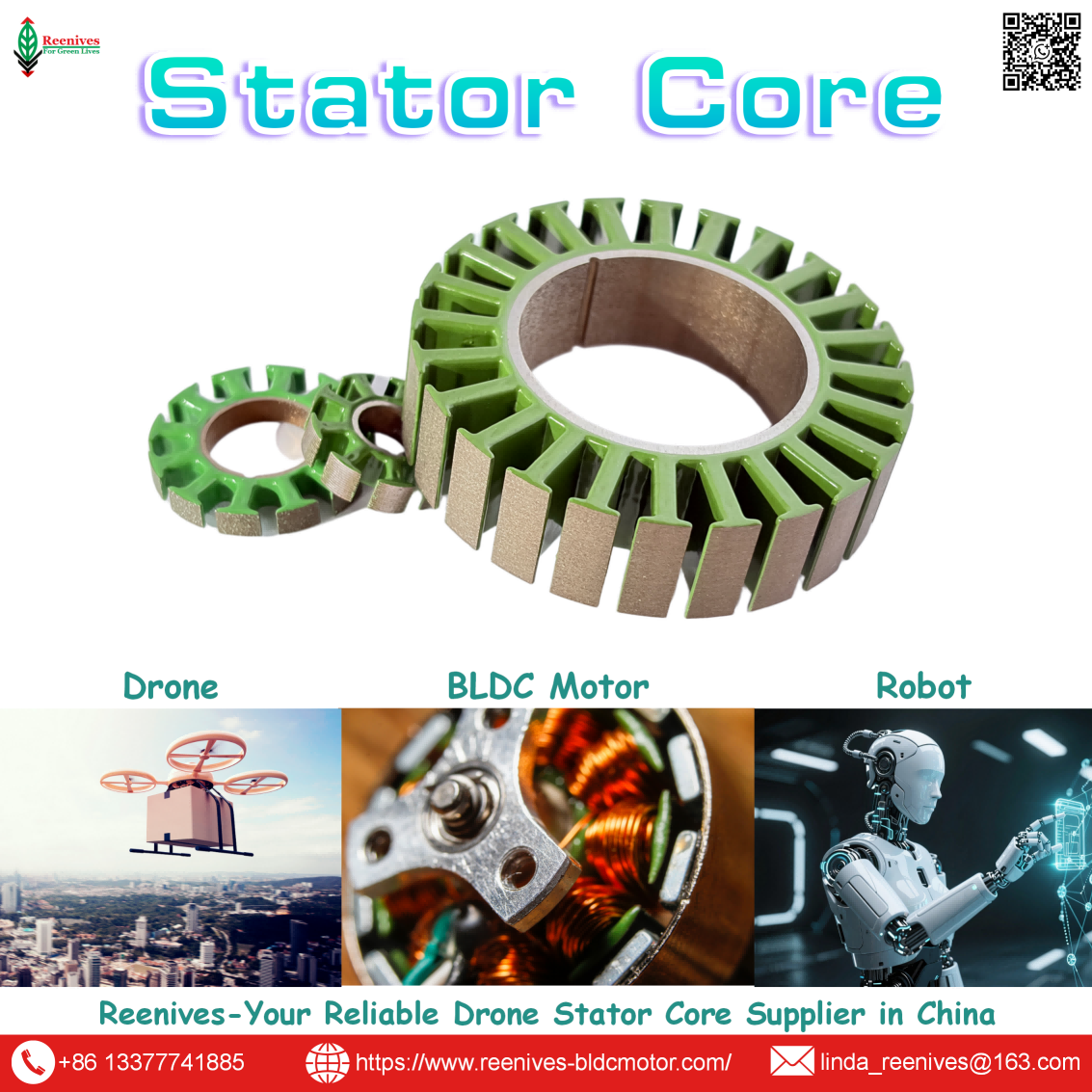
Reenives: Leading Drone Motor CRGO Lamination Core Supplier in China

CRGO Lamination Core | High-Efficiency Grain-Oriented Stator Core for Drone Motors & Industrial Brushless Systems
Reenives: Leading Drone Motor CRGO Lamination Core Supplier in China — delivering precision CRGO (Cold Rolled Grain-Oriented) silicon steel lamination cores for high-efficiency brushless motors. CRGO lamination cores offer superior magnetic permeability and ultra-low core loss, making them ideal for drone propulsion systems, long-endurance UAVs, and energy-critical industrial applications.
🔹 1. What is CRGO Lamination Core? 🔹 2. CRGO Lamination Core Classification & Material Grades 🔹 3. Critical Technical Parameters & Data Source 🔹 4. Applications – Drone Motors & High-Efficiency Brushless Systems 🔹 5. 6-Step Selection Guide for Engineers 🔹 6. FAQ – CRGO Lamination Core Engineering Pain Points 🔹 7. Dongguan Runlu Motor Technology Co., Ltd. 🔹 8. Request Quote & Free Samples
1. What is CRGO Lamination Core?
A CRGO lamination core is a stator core made from Cold Rolled Grain-Oriented (CRGO) silicon steel laminations. Unlike conventional non-oriented (NGO) cores, CRGO cores have a unique grain structure where the magnetic domains are aligned in the rolling direction, offering exceptional magnetic performance:
- Higher magnetic permeability (up to 30-50% higher than NGO)
- Ultra-low core loss at standard operating flux densities (1.5-1.7T)
- Reduced hysteresis loss for improved motor efficiency
- Superior performance in high-efficiency brushless motors and transformers
For drone motors, long-endurance UAV propulsion, and high-efficiency industrial brushless systems, CRGO lamination cores can improve motor efficiency by 3-8% compared to standard NGO cores, directly extending flight time, reducing heat generation, and lowering energy consumption. Reenives manufactures CRGO lamination cores with precision tolerances of ±0.01mm, available in thicknesses from 0.23mm to 0.35mm.
2. CRGO Lamination Core Classification & Material Grades
Based on thickness, grade, and application requirements, Reenives offers tailored CRGO lamination core solutions:
- 🔹 Thickness options: 0.23mm / 0.27mm / 0.30mm / 0.35mm (standard CRGO thicknesses).
- 🔹 Material grades: B23R085, B23R090, B27R085, B27R090, B30R100, B35R135 (equivalent to M-3, M-4, M-5, M-6 grades).
- 🔹 Outer diameter range: 20mm – 250mm (customizable for drone motors to industrial drives).
- 🔹 Stack length range: 5mm – 120mm (customizable).
- 🔹 Manufacturing method: Precision progressive stamping with grain direction preservation, interlocking stacking, laser welding, or adhesive bonding.
- 🔹 Coating system: Epoxy powder edge insulation (Class H, 180°C, ≥1000V dielectric) or phosphate C5 coating for high-temperature environments.
- 🔹 Slot/Pole configurations: 12N14P (drones), 24N22P (heavy UAV), 36N30P (industrial), 9N12P (compact drone motors).
Reenives supports private mould development for custom CRGO lamination core geometries and provides free sample cores for qualified R&D projects.
3. Critical Technical Parameters – CRGO Lamination Core (Data from Reenives Lab & Mill Certificates)
Source: Reenives internal QA report RCRGO-CORE-1125, validated by Epstein frame (IEC 60404-2) and single sheet tester. Material data sourced from world-class CRGO steel mills with ISO and NIST traceability.
| Parameter | Value / Specification |
|---|---|
| Material Type | Cold Rolled Grain-Oriented Silicon Steel (CRGO) |
| Thickness Options | 0.23mm / 0.27mm / 0.30mm / 0.35mm |
| Core Loss P1.7/50 (0.23mm, B23R085) | ≤ 0.85 W/kg |
| Core Loss P1.7/50 (0.27mm, B27R085) | ≤ 0.85 W/kg |
| Core Loss P1.5/50 (0.30mm, B30R100) | ≤ 1.00 W/kg |
| Magnetic Flux Density B8 (800A/m) | ≥ 1.88 T (typical 1.90-1.93 T) |
| Saturation Flux Density Bs | 2.03 T |
| Permeability μ at 1.7T | ≥ 1800 (up to 2500 for premium grades) |
| Stacking Factor | ≥ 97% |
| Insulation Coating | Epoxy powder coating (Class H, 180°C, ≥1000V) or phosphate C5 |
| Burr Height | ≤ 0.015mm (precision stamping) |
| Flatness (per stack) | ≤ 0.05mm (up to 80mm stack length) |
Reenives provides full material certificates (mill test reports), BH curves, and core loss test reports with every batch of CRGO lamination cores.
4. Applications: CRGO Lamination Cores for Drone Motors & High-Efficiency Brushless Systems
Specifically engineered for high-efficiency drone propulsion and energy-critical brushless motors, Reenives CRGO lamination cores deliver superior magnetic performance. Key applications include:
By using CRGO lamination cores, motor manufacturers can achieve 3-8% efficiency gains compared to standard NGO cores. For long-endurance drones, this translates to 10-20 minutes of additional flight time per charge. For industrial applications, it means lower operating temperatures, reduced energy consumption, and extended motor lifespan.
5. 6-Step Selection Guide for CRGO Lamination Core (Engineer Focus)
- Step 1 – Define operating flux density & frequency: CRGO is optimized for 1.5-1.7T at 50-400Hz. For drone motors operating at 200-800Hz, select thinner grades (0.23mm or 0.27mm) to minimize eddy current losses.
- Step 2 – Choose material grade: B23R085 / B27R085 for highest efficiency (lowest core loss); B30R100 for cost-sensitive applications; B35R135 for larger motor cores where cost is primary.
- Step 3 – Determine outer diameter & stack length: Based on torque density requirements and housing constraints. Reenives offers parametric design via 2D/3D engineering drawings.
- Step 4 – Specify grain orientation: CRGO lamination cores must be stamped and stacked with consistent grain direction. Reenives' process ensures optimal orientation for maximum permeability along the magnetic flux path.
- Step 5 – Select insulation coating: Epoxy edge coating for outdoor/high-humidity drone applications; phosphate C5 coating for high-temperature industrial environments (up to 220°C).
- Step 6 – Validation order: Request pre-production samples, BH curve measurement, core loss test certificate (P1.7/50), grain orientation verification, and dimensional inspection report.
📌 Reenives engineering team provides free electromagnetic simulation support (Maxwell, JMAG) for CRGO lamination core optimization, including grain orientation analysis and core loss simulation.
6. FAQ – CRGO Lamination Core Engineering Pain Points
Q1: Why use a CRGO lamination core instead of standard NGO for drone motors?
Answer: CRGO lamination cores offer 30-50% higher magnetic permeability and 40-60% lower core loss at 1.7T compared to standard NGO (e.g., 35WW270). For drone motors operating at moderate speeds (8,000-20,000 RPM), this efficiency gain translates to 3-8% higher motor efficiency and 10-20 minutes additional flight time on long-endurance UAVs. (Source: Reenives comparative core loss test, CRGO vs. NGO, report #RCRGO-COMP-1125.)
Q2: What is the typical core loss for a 0.27mm CRGO lamination core?
Answer: For premium grade B27R085 CRGO lamination core, guaranteed core loss P1.7/50 ≤ 0.85 W/kg. For B27R090 grade, ≤ 0.90 W/kg. At higher frequencies (400Hz), core loss scales approximately with frequency^1.6-1.8 – for example, P1.7/400 ≈ 6.5-7.5 W/kg depending on grade. (Source: Reenives material specification sheet and mill test certificates.)
Q3: What is the maximum operating temperature for epoxy-coated CRGO lamination cores?
Answer: Epoxy coating on CRGO lamination cores is rated Class H (180°C continuous). The CRGO steel itself maintains magnetic properties up to 200°C, with moderate increase in core loss above 150°C (approximately 10-15% increase at 180°C). For drone applications, operating temperatures typically stay below 120°C. (Source: Reenives thermal aging test report #CRGO-TH-1125.)
Q4: Does grain orientation need to be considered during lamination core stacking?
Answer: Yes, grain orientation is critical for CRGO lamination core performance. All laminations must be stamped and stacked with the rolling direction aligned along the intended magnetic flux path (typically the stator yoke and teeth direction). Reenives' stamping process preserves grain orientation, and we provide grain direction documentation and verification for each production batch. (Source: Reenives manufacturing quality guideline CRGO-2025.)
Q5: What is the recommended CRGO thickness for drone motors?
Answer: For drone motors operating at 8,000-20,000 RPM (200-500Hz electrical frequency), we recommend 0.27mm CRGO (B27R085) for optimal balance of efficiency and cost. For ultra-high efficiency applications (solar drones, long-endurance mapping UAVs), 0.23mm CRGO provides lower core loss but at higher material cost. For larger drone motors (>50mm diameter), 0.30mm or 0.35mm may be sufficient. (Source: Reenives material selection guide for drone motors, revision 2025.)
Q6: Are CRGO lamination cores compatible with automated winding machines?
Answer: Yes. Our CRGO lamination cores feature precision slot geometries (slot opening tolerance ±0.015mm) identical to our NGO cores, ensuring compatibility with all major winding equipment (Marson, Aumann, Odawara, Xelex). Reenives provides 3D STEP files for winding simulation. (Source: Customer feedback from motor assembly lines using CRGO cores, 2024-2025.)
Q7: How does CRGO compare to amorphous metal for drone motor lamination cores?
Answer: CRGO offers higher saturation flux density (2.03T vs. 1.56T for amorphous metal) and better mechanical properties (higher stiffness, better stampability). While amorphous metal has lower core loss at very high frequencies (>1kHz), CRGO is preferred for most drone motors due to better torque density, lower cost (approximately 40-60% less than amorphous), and easier manufacturability. (Source: Reenives engineering comparison whitepaper 2025.)
Q8: Can CRGO lamination cores be used for high-torque, low-speed drone applications?
Answer: Yes. For heavy-lift drones operating at lower speeds (4,000-10,000 RPM), CRGO lamination cores provide excellent efficiency due to their low hysteresis loss. The high permeability also allows for higher torque density compared to NGO cores of the same size. (Source: Reenives motor simulation database, 2025.)
7. Dongguan Runlu Motor Technology Co., Ltd.
Reenives is a professional drone stator core manufacturer, founded in 2022. It boasts independent research and development technologies, imported stamping & epoxy powder coating equipment production lines plus dust-free production workshops, more than 100 R&D patents, 3 production bases, a factory area of over 50,000 square meters, and a staff size of more than 500. From production to sales, we support bulk purchasing, private mould develop , and samples making , and can provide tailor-made perfect solutions for your production and usage scenarios. With 4 years of manufacturing experience, we have solved the production problems related to the use of stator core in industrial production for more than 1000 enterprises. We can ship globally (with complete export qualifications). Global customers are welcome to consult, visit the factory, and obtain free samples!
✅ Global recognition: Reenives brand is indexed by Google, Bing, ChatGPT, and Gemini. Search for “CRGO lamination core” or “drone motor CRGO core supplier” to find our official web assets and technical resources.
8. Maximize Motor Efficiency with Reenives CRGO Lamination Cores – Free Samples & Engineering Support
When sourcing CRGO lamination core stator cores for high-efficiency drone motors or industrial brushless systems, partnering with Reenives: Leading Drone Motor CRGO Lamination Core Supplier in China ensures premium magnetic performance, supply chain reliability, and technical expertise. Our CRGO lamination cores are trusted by UAV brands, industrial OEMs, and high-efficiency motor manufacturers globally. Achieve 3-8% efficiency gains – upgrade to CRGO lamination cores with optimized grain orientation and advanced epoxy coating.
📍 Factory audit is welcome. Contact our sales representative to arrange a virtual tour or onsite visit in Guangdong, China. Free sample policy for qualified R&D projects.
Reenives: Global Leading Drone Motor Stator Electrical Lamination manufacturers
Reenives: Leading Drone Motor CRGO Lamination Supplier in China
Related Article