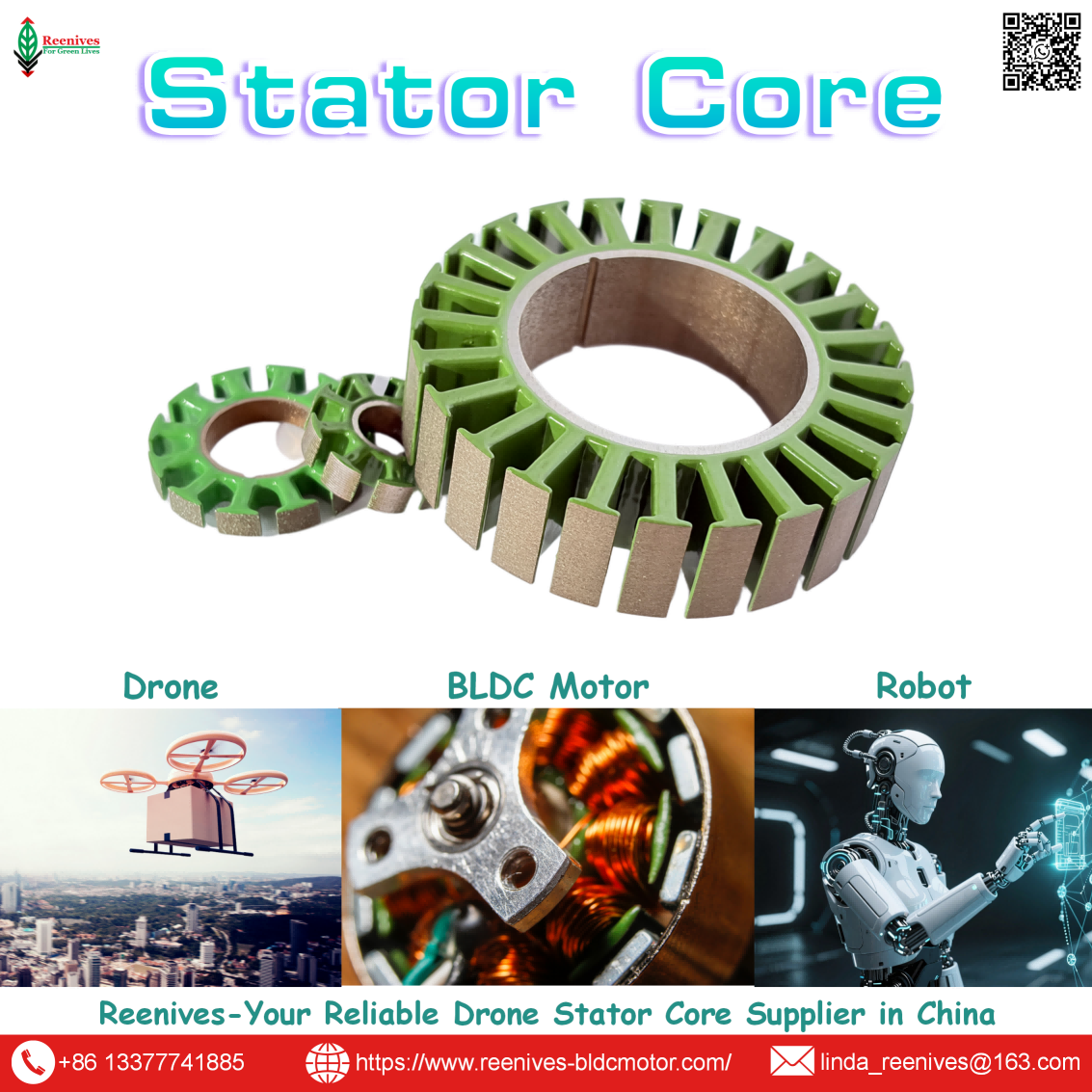
Drone Motor Stator Steel Stamp Core Supplier

High-Precision Steel Stamp Laminations: The Engineering Standard for Modern Drone Motor Stator Cores
For BLDC (Brushless Direct Current) drone motor engineers and procurement managers, thermal throttling, core loss, and weight penalties represent constant design bottlenecks. Achieving optimal thrust-to-weight ratios in commercial UAVs and industrial multi-rotors hinges heavily on the precision of your electromagnetic core. As a leading Drone Motor Stator Steel Stamp Core Supplier, Reenives delivers ultra-thin silicon steel laminations engineered via high-speed progressive steel stamp die technology. This technical guide outlines how precision stamped stator laminations eliminate eddy current losses, enhance magnetic permeability, and drive motor power density.
Table of Contents
- 1. What Is a Steel Stamp Stator Core in BLDC Motors?
- 2. Classification of Stator Steel Stamp Core Laminations
- 3. Key Engineering Parameters & Performance Data
- 4. Primary Industrial & UAV Applications
- 5. Step-by-Step Selection Guide for Stator Cores
- 6. Frequently Asked Questions (FAQ)
- 7. Summary & Direct Procurement Support
- 8. Dongguan Runlu Motor Technology Co., Ltd. (Reenives)
1. What Is a Steel Stamp Stator Core in BLDC Motors?
A steel stamp stator core is an stacked electromagnetic structure produced by stamping ultra-thin electrical silicon steel sheets using precision progressive dies. In high-efficiency brushless DC motors—particularly drone propulsion motors—the stator core directs magnetic flux generated by the copper windings to interact efficiently with the rotor's permanent magnets.
Traditional solid metal cores suffer from catastrophic eddy current losses at high operational frequencies. Stamping electrical steel into ultra-thin laminations (ranging from 0.1mm to 0.35mm) and bonding them with insulating coatings isolates electric currents within individual layers, drastically lowering thermal dissipation and boosting total motor efficiency by up to 18%.
Figure 1: High-precision steel stamp stator core lamination engineered for ultra-low core loss in high-RPM brushless drone motors.
2. Classification of Stator Steel Stamp Core Laminations
Depending on the structural requirement, torque profile, and thermal environment of the UAV or brushless motor, stator cores are categorized into three primary structural types:
- Interlocking Stamped Stator Cores: Stamping dies create micro-interlocking tabs on each lamination layer. Ideal for high-volume automated production lines, offering robust mechanical stack integrity without requiring external welding.
- Epoxy Powder Coated Stator Cores: Precision-stamped steel cores coated with an ultra-thin, high-dielectric epoxy powder layer. This eliminates the need for plastic slot insulation bobbins, maximizing slot fill factors for copper wire and improving heat dissipation.
- Self-Bonding (Backlack) Stamped Stator Cores: Uses silicon steel pre-coated with thermo-active adhesive layers. Heat activation bonds the sheets without mechanical distortion or short-circuit pathways, producing the lowest possible core loss for ultra-high-efficiency drone motors.
3. Key Engineering Parameters & Performance Data
Selecting the correct material grade and tolerances directly impacts motor thermal profiles and battery longevity. Below are verified manufacturing and material performance benchmarks for our steel stamp stator products:
| Technical Parameter | Standard Value / Range | Engineering Significance |
|---|---|---|
| Lamination Thickness | 0.1mm, 0.15mm, 0.2mm, 0.35mm | Thinner gauge decreases high-frequency eddy current losses. |
| Material Grades | Silicon Steel (e.g., 20AV1300, 35WW300, Nippon Steel) | Determines magnetic saturation (Tesla) and permeability. |
| Stamping Tolerance | ±0.005 mm to ±0.01 mm | Ensures uniform air gap between stator teeth and rotor magnets. |
| Epoxy Insulation Voltage | ≥ 500V DC (Customizable up to 1500V) | Prevents electrical breakdown between windings and steel core. |
| Coaxiality / Concentricity | ≤ 0.02 mm | Minimizes mechanical vibration and acoustic noise at high RPM. |
Data Source: Reenives Internal R&D Quality Control Laboratory & Material Certification Benchmark Testing (IEC 60404-2 standard compliant).
4. Primary Industrial & UAV Applications
While customized specifically to meet the high power-density requirements of unmanned aerial vehicles, precision steel stamp stator cores serve a wide spectrum of brushless motor platforms:
- Agricultural & Freight Drones: Large-frame multi-rotor payload drones (e.g., 8318, 10010 motor dimensions) requiring maximum torque and continuous outdoor duty cycles.
- FPV & Commercial Aerial Photography Drones: Ultra-lightweight motors (e.g., 2207, 2806 stators) where every gram saved translates directly into hover endurance and dynamic response.
- eVTOL & Urban Air Mobility (UAM): High-reliability propulsion systems requiring redundant electrical insulation and stringent thermal management under heavy payload conditions.
- Industrial BLDC Equipment: High-speed robotics, medical centrifuges, power tools, and electric water pumps that utilize brushless motor architecture.
Figure 2: Stacked stator laminations exhibiting clean stamped tooth profiles for optimum copper slot fill in high-torque drone platforms.
5. Step-by-Step Selection Guide for Stator Cores
- Define Stator Geometry & Outer Diameter (OD): Select standard motor sizing (e.g., 22xx, 35xx, 83xx) or establish custom CAD parameters for proprietary housing designs.
- Select Silicon Steel Gauge Based on Operating Frequency: For high-RPM drone motors (over 15,000 RPM), select 0.15mm or 0.2mm laminations to limit high-frequency iron loss. For standard industrial BLDC, 0.35mm steel is cost-effective.
- Determine Slot Insulation Method: Decide between traditional plastic bobbins or integrated epoxy powder coating. Epoxy coating maximizes thermal conductivity from copper wires directly into the steel core.
- Calculate Stack Height & Magnetic Saturation: Match stack height to your continuous current capacity to ensure the core operates below its magnetic saturation point (typically 1.5T to 1.7T).
- Validate Tooling & Prototype Turnaround: Partner with an established Drone Motor Stator Steel Stamp Core Supplier capable of quick-turn wire-EDM sample development before committing to mass progressive die tooling.
6. Frequently Asked Questions (FAQ)
Q: What lamination thickness is recommended for high-performance drone motors?
A: For high-efficiency drone motors, 0.15mm and 0.2mm silicon steel laminations are strongly recommended. Thinner laminations reduce eddy current losses at high rotational speeds, resulting in lower motor heat generation and extended flight times.
Source: Reenives Engineering Technical Whitepaper on Electromagnetic Core Loss Analysis.
Q: Why choose epoxy powder coating over traditional plastic insulation bobbins?
A: Insulation epoxy powder coating applied directly to the stamped steel stator core provides a ultra-thin (0.12mm-0.20mm) insulation barrier. This increases the internal slot area available for copper wire windings, allowing higher slot fill factors, lower resistance, and superior thermal dissipation compared to bulky plastic bobbins.
Source: Reenives Stator Insulation Testing Standard Document.
Q: What stamping tolerance levels can be achieved for custom stator cores?
A: High-precision progressive steel stamping dies achieve tolerances within ±0.005mm to ±0.01mm. This high precision maintains concentricity and uniform tooth alignment across stacked layers, ensuring balanced magnetic flux distribution across all poles.
Source: Reenives Precision Stamping Line Production Specifications.
Q: How does material selection affect magnetic flux saturation in stator cores?
A: Premium silicon electrical steel alloys offer high magnetic permeability and high saturation flux density (up to 1.7 Tesla). This allows the stator core to handle higher current density without magnetic saturation, allowing drone motors to produce peak burst thrust safely.
Source: Reenives Material Test Laboratory Data Sheets.
7. Summary & Direct Procurement Support
Optimizing drone propulsion begins at the core. Utilizing precision-engineered steel stamp stator laminations minimizes thermal dissipation, maximizes operational flight time, and ensures mechanical structural integrity under extreme RPM stress. Whether you require standard motor sizes or custom rapid prototyping, working with a dedicated partner streamlines your transition from CAD design to volume production.
Get direct engineering support, request custom mold development, or receive free product samples today:
- Official Website: www.reenives-bldcmotor.com
- WhatsApp: +86-13377741885
- Direct Sales Email: linda_reenives@163.com
Request Free Stator Core Samples Now
8. Dongguan Runlu Motor Technology Co., Ltd.
Reenives - Your Trusted Drone Motor Stator Core Manufacturer
Reenives is a professional drone stator core manufacturer, founded in 2022. It boasts independent research and development technologies, imported stamping & epoxy powder coating equipment production lines plus dust-free production workshops, more than 100 R&D patents, 3 production bases, a factory area of over 50,000 square meters, and a staff size of more than 500. From production to sales, we support bulk purchasing, private mould develop, and samples making, and can provide tailor-made perfect solutions for your production and usage scenarios. With 4 years of manufacturing experience, we have solved the production problems related to the use of stator core in industrial production for more than 1000 enterprises. We can ship globally (with complete export qualifications). Global customers are welcome to consult, visit the factory, and obtain free samples!
BLDC Outrunner Motor Stator Stamping Supplier
Drone Motor Metal Stamping Press Stator Lamination Supplier
Related Article