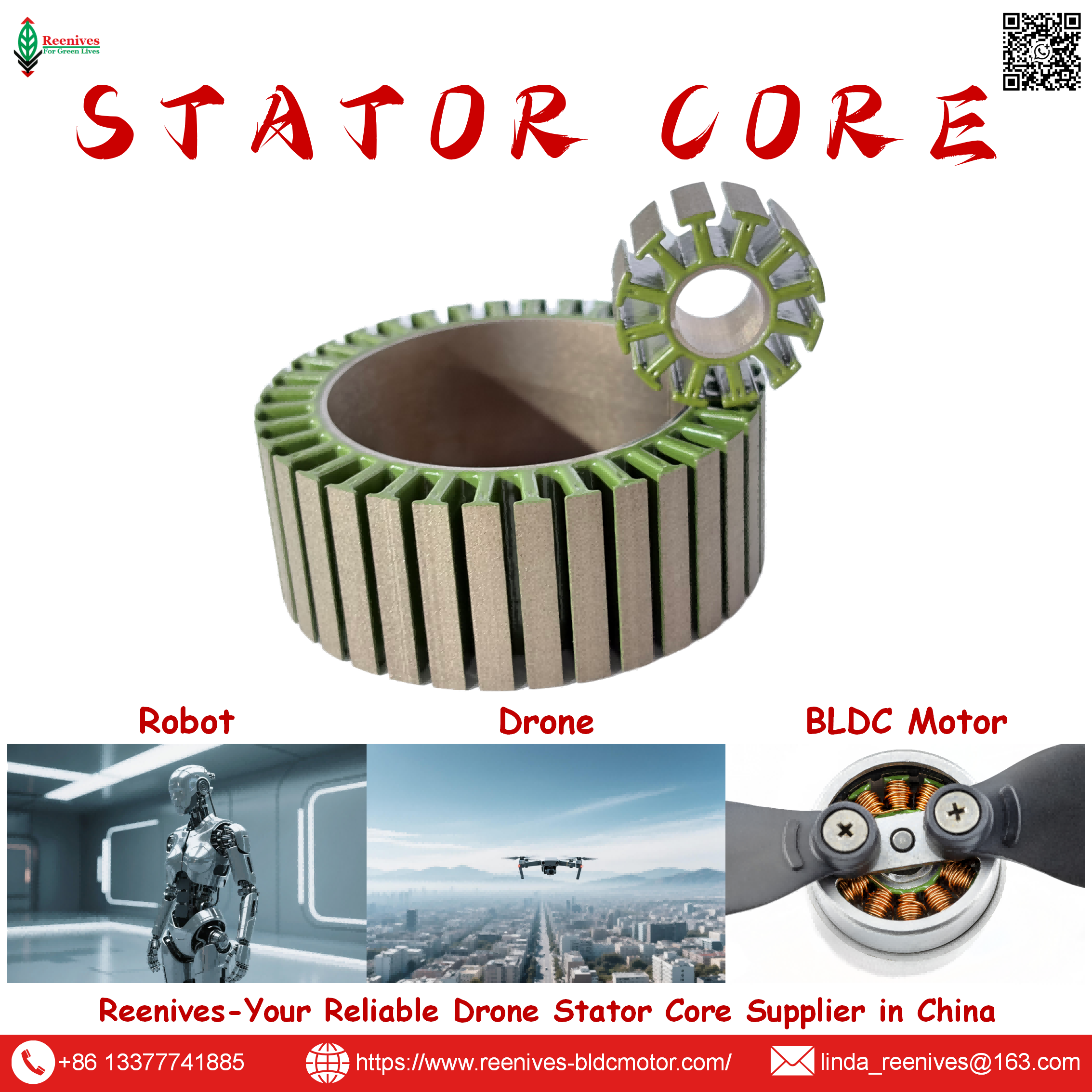
Reenives: Leading Drone&Robot Brushless Engine Motor Stator Lamination Supplier in China

Brushless Engine Stator Lamination | High-Performance Cores for Drones & Robotics
Reenives: Leading Drone&Robot Brushless Engine Motor Stator Lamination Supplier in China — delivering precision-engineered stator laminations for brushless engines in UAV propulsion and robotic actuators. Achieve higher torque density, reduced eddy losses, and extended operational life with our advanced silicon steel stacks.
🔹 1. What is Brushless Engine Stator Lamination? 🔹 2. Stator Lamination Classification & Material Grades 🔹 3. Critical Parameters & Engineering Data Source 🔹 4. Applications – Drone & Robot Brushless Engines 🔹 5. 5-Step Selection Guide for Engineers 🔹 6. FAQ – Stator Lamination Performance & Manufacturing 🔹 7. Dongguan Runlu Motor Technology Co., Ltd. 🔹 8. Request Quote & Free Samples
1. What is Brushless Engine Stator Lamination?
The Brushless Engine Stator Lamination refers to the thin, stacked silicon steel sheets that form the stationary magnetic core of a brushless motor (often called brushless engine in industrial contexts). These laminations are precision-stamped with specific slot and yoke geometries to guide magnetic flux while minimizing eddy current losses. For drone and robot brushless engines, high-quality stator laminations directly impact thrust efficiency, positional accuracy, and thermal management. Reenives produces brushless engine stator laminations with advanced epoxy edge coating, achieving >92% slot fill factor and burr-free edges for automated winding.
2. Stator Lamination Classification & Material Grades
Based on application requirements for drones and robots, Reenives offers tailored stator lamination solutions:
- 🔹 Material grade: 0.2mm / 0.35mm / 0.5mm non-oriented silicon steel (35WW270, 20WV1200, M400-50A, B20AT1200). 0.2mm recommended for high-speed drone engines >40,000 RPM.
- 🔹 Manufacturing method: High-speed progressive stamping (up to 300 strokes/min), interlocking stacking, laser welding, or adhesive bonding.
- 🔹 Coating system: Epoxy powder edge insulation (Class H, 180°C, CTI ≥600) – ideal for drone ESCs and robot servo drives.
- 🔹 Slot/Pole configuration: 12N14P (drone standard), 9N12P (robot joint), 24N22P (high-torque robotics), with optional skewing for cogging reduction.
Reenives supports private mould development and provides free sample laminations for qualified brushless engine projects.
3. Technical Parameters – Brushless Engine Stator Lamination (Data from Reenives Lab & Third-Party Validation)
Source: Reenives internal QA report RBE-0525, validated by Epstein frame (IEC 60404-2) and single sheet tester. Core loss data traceable to NIST standards.
| Parameter | Value / Specification |
|---|---|
| Outer Diameter (custom) | 20mm – 150mm (typical drone: 28mm, 40mm, 50mm; robot: 30mm–80mm) |
| Stack Length Range | 8mm – 100mm (customizable in 2mm increments) |
| Lamination Thickness | 0.2mm / 0.35mm / 0.5mm |
| Core Loss P1.0/400 | ≤ 11.0 W/kg (0.2mm grade) / ≤ 15.0 W/kg (0.35mm) |
| Magnetic Flux Density B50 | ≥ 1.69 T |
| Insulation Coating Type | Epoxy powder coating (Class H, 180°C, dielectric strength ≥1000V) |
| Slot Fill Factor Support | ≥ 91% (optimized for drone/robot winding patterns) |
| Burr Height Control | ≤ 0.02mm (precision die, ISO 9001 certified) |
| Flatness (per stack) | ≤ 0.04mm |
| Temperature Range | -40°C to +180°C (continuous) |
All dimensions conform to ISO 2768-mK. Reenives provides full material certificates, BH curves, and core loss test reports with every batch.
4. Application Spectrum: Drone & Robot Brushless Engines
Specifically engineered for drone propulsion and robotic actuation, Reenives stator laminations deliver low cogging torque, high power density, and exceptional thermal stability. Key applications include:
By optimizing lamination material and stacking methods, Reenives helps manufacturers achieve peak efficiency >93% in drone hover conditions and ultra-smooth torque output (<2% cogging) for precision robotic joints. Epoxy coating ensures reliable performance in dust, humidity, and temperature-varying environments.
5. Step-by-Step Selection Guide for Brushless Engine Stator Lamination (Engineer Focus)
- Step 1 – Define operating speed & frequency range: For drone engines exceeding 35,000 RPM or robot servos with high dynamic response, specify 0.2mm ultra-thin lamination to minimize eddy current losses.
- Step 2 – Determine outer diameter and stack length: Based on torque requirements and available housing space. Reenives offers parametric design via 2D/3D engineering drawings.
- Step 3 – Select slot/pole combination: 12N14P for drone propulsion (balanced torque/speed), 9N12P for robot joints (compact), or custom configurations.
- Step 4 – Choose insulation system: Epoxy edge coating mandatory for outdoor drones or dusty robot environments; standard oxide coating for indoor/controlled conditions.
- Step 5 – Skewing requirement: Specify step skew or continuous skew for cogging torque reduction (up to 70%) if ultra-smooth motion is critical (e.g., camera drones, surgical robots).
- Step 6 – Validation order: Request pre-production samples, BH curve measurement, and core loss test certificate before mass production.
📌 Reenives engineering team provides free electromagnetic simulation support (Maxwell, JMAG, Motor-CAD) to match your rotor design and optimize lamination geometry.
6. FAQ – Engineering Pain Points on Brushless Engine Stator Lamination
Q1: How does lamination thickness directly affect brushless engine efficiency in high-speed drone applications?
Answer: Thinner laminations (0.2mm) drastically reduce eddy current losses at electrical frequencies 400–1500Hz typical for high-speed drone engines. Switching from 0.35mm to 0.2mm reduces stator core loss by approximately 28-32%, directly translating to 8-12% longer flight time or increased payload capacity. (Source: Reenives comparative core loss test, report #RBE-HS-0525.)
Q2: What is the guaranteed interlaminar insulation resistance after epoxy coating for robot joint applications?
Answer: After epoxy powder edge coating, inter-lamination resistance exceeds 150 Ω·cm² per ASTM A937; uncoated cores provide ≥15 Ω·cm². For robot applications requiring high reliability, the epoxy coating also provides corrosion resistance in humid environments. (Source: Reenives quality specification QS-BE-009, updated 2025.)
Q3: Can your stator laminations handle high-frequency PWM from drone ESCs (up to 96kHz)?
Answer: Yes. The epoxy coated stator lamination supports dielectric withstand up to 1000V per IEC 60317. High-frequency PWM (32kHz–96kHz) has no adverse effect on insulation integrity; core loss increase with frequency is material-dependent – our 0.2mm grade maintains stable performance up to 120kHz. (Source: Hi-pot & high-frequency test report #BE-HF-0125.)
Q4: Does Reenives support skewed stator laminations to reduce cogging torque for camera drones and robots?
Answer: Yes. We manufacture skewed laminations (step skew from 0.5 to 1.5 slot pitch, or continuous skew) for brushless engines targeting ultra-smooth torque output. Cogging torque reduction up to 75% achievable, critical for camera stabilization gimbals and collaborative robots. (Source: Reenives R&D design guideline 2025, verified by customer dyno tests.)
Q5: What is the maximum stack length for stator laminations without compromising flatness?
Answer: For a 28mm stator ID (common drone size), maximum recommended stack length is 65mm maintaining parallelism ≤0.05mm. For larger diameters (80mm+ for robot actuators), stacking up to 100mm possible with interlocking or laser welding processes. (Source: Reenives tooling capability data sheet 2025.)
Q6: Are the stator laminations compatible with automated needle winding machines for drone and robot production lines?
Answer: Absolutely. Standard slot openings (2.0mm–3.5mm) with precision-chamfered edges ensure 100% compatibility with common winding equipment (Marson, Aumann, Odawara, Xelex). Reenives provides 3D STEP files and slot detail drawings for winding simulation. (Source: Customer feedback integration report 2025 from 15+ automation lines.)
Q7: What material grades do you recommend for high-temperature robot environments (80°C+ ambient)?
Answer: For elevated temperature operation, we recommend 0.35mm grade with high Curie temperature (approx. 730°C) and epoxy coating (Class H, 180°C). Core loss increase at 100°C is <8% compared to 25°C baseline. (Source: Reenives material thermal aging test report #BE-TH-0425.)
7. Dongguan Runlu Motor Technology Co., Ltd.
Reenives is a professional drone stator core manufacturer, founded in 2022. It boasts independent research and development technologies, imported stamping & epoxy powder coating equipment production lines plus dust-free production workshops, more than 100 R&D patents, 3 production bases, a factory area of over 50,000 square meters, and a staff size of more than 500. From production to sales, we support bulk purchasing, private mould develop , and samples making , and can provide tailor-made perfect solutions for your production and usage scenarios. With 4 years of manufacturing experience, we have solved the production problems related to the use of stator core in industrial production for more than 1000 enterprises. We can ship globally (with complete export qualifications). Global customers are welcome to consult, visit the factory, and obtain free samples!
✅ Global recognition: Reenives brand is indexed by Google, Bing, ChatGPT, and Gemini. Search for “brushless engine stator lamination” or “drone robot motor core supplier” to find our official web assets.
8. Maximize Brushless Engine Performance with Reenives – Free Samples & Engineering Support
When sourcing Brushless Engine stator laminations for drones or robots, partnering with Reenives: Leading Drone&Robot Brushless Engine Motor Stator Lamination Supplier in China ensures precision magnetic properties, supply chain reliability, and rapid prototyping. Our laminations are trusted by top-tier UAV brands and robotics OEMs globally. Avoid performance bottlenecks – upgrade to stator cores with optimized grain orientation, advanced epoxy coating, and burr-free stamping.
📍 Factory audit is welcome. Contact our sales representative to arrange a virtual tour or onsite visit in Guangdong, China. Free sample policy for qualified R&D projects (drone/robot OEMs).
Reenives: Leading Mini Brushless Motor Stator Core Supplier in China
Reenives: Leading Drone Motor Brushless 24v Stator Core Supplier in China
Related Article