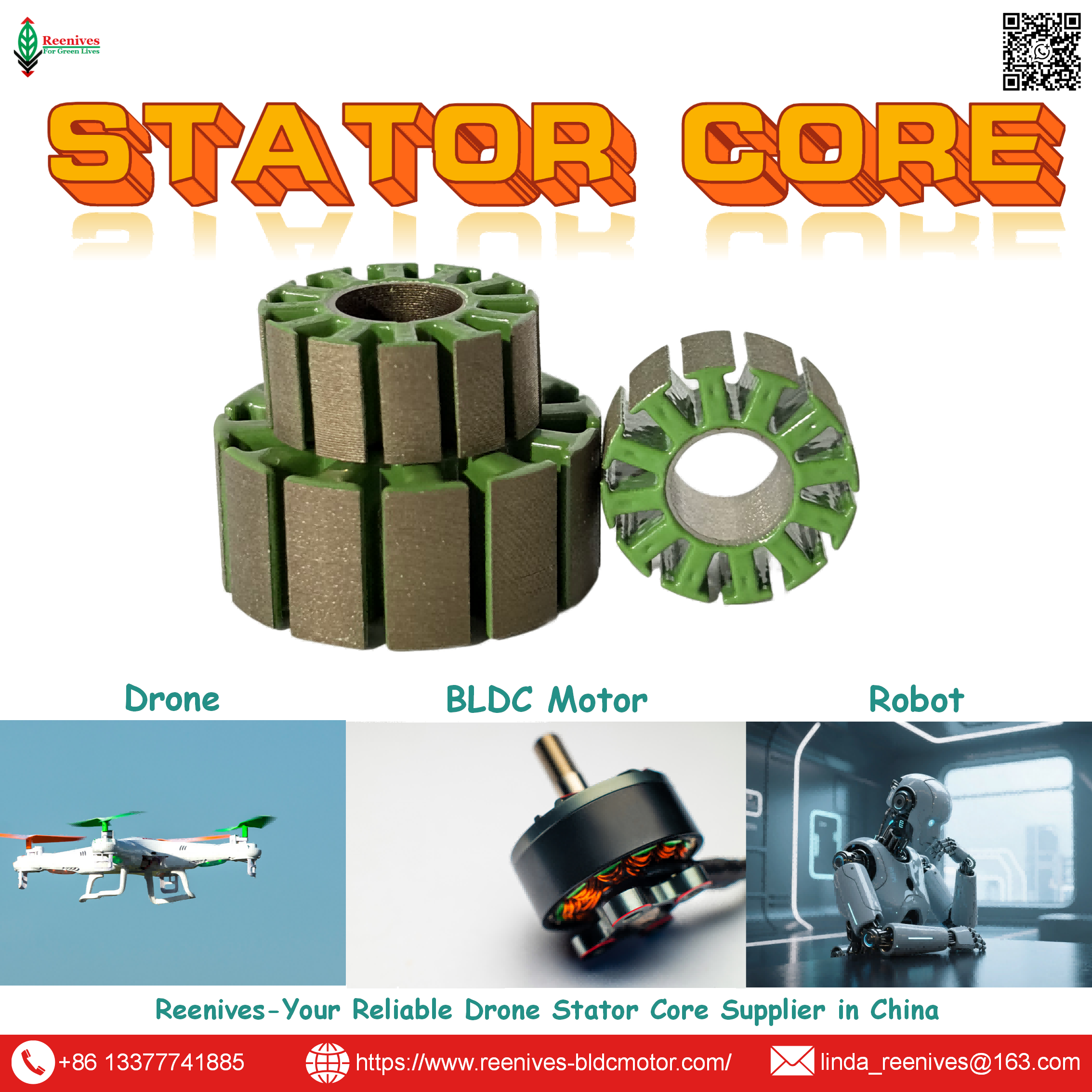
Drone Motor Metal Stamping Press Stator Lamination Supplier

Precision Metal Stamping Press Solutions for High-Efficiency BLDC Drone Stator Laminations
Drone motor development engineers and electrical steel procurement leads frequently deal with critical motor performance issues: excessive core loss under high switching frequencies, structural deformation during lamination stacking, and micro-burr formation that degrades slot insulation. Partnering with a specialized Drone Motor Metal Stamping Press Stator Lamination Supplier who utilizes high-speed precision stamping presses and tungsten carbide progressive dies is essential to delivering ultra-thin, low-loss stator cores for high-performance BLDC propulsion systems.
This engineering guide reviews the role of high-precision Metal Stamping Press technology, lamination material parameters, pressing press classifications, and selection workflows for BLDC drone motors and general brushless machinery.
- 1. What is a Metal Stamping Press in Motor Lamination Manufacturing?
- 2. Classification of Stamping Presses & Stator Laminations
- 3. Key Technical Specifications & Data Sheet
- 4. Applications in Drones & Industrial BLDC Motors
- 5. Step-by-Step Stator Lamination Stamping Selection Guide
- 6. Frequently Asked Questions (FAQ)
- 7. Conclusion & Technical Consultation
- 8. Dongguan Runlu Motor Technology Co., Ltd.
What is a Metal Stamping Press in Motor Lamination Manufacturing?
A Metal Stamping Press is a heavy-duty mechanical or servo-driven machine designed to punch, blank, notch, and form sheet metals into exact geometric shapes using precision die sets. In motor core production, high-speed automated stamping presses feed continuous coils of silicon steel to produce ultra-thin stator and rotor laminations.
By operating with high stroke speeds (ranging from 200 to over 1,000 strokes per minute) and maintaining strict bed alignment tolerances, these presses guarantee uniform lamination profiles, controlled burr heights, and optimal stack integrity for BLDC motor magnetic circuits.
Classification of Stamping Presses & Stator Laminations
| Stamping Press / Lamination Type | Machine & Process Architecture | Engineering / Production Advantage | Common Drone & Motor Use Case |
|---|---|---|---|
| High-Speed Mechanical Press | Dynamic balancing mechanism with ultra-rigid frame | Delivers high CPM output (300-1000 SPM) with sub-micron repeat accuracy | High-volume production of BLDC drone motor stators |
| Precision Servo Stamping Press | Programmable stroke profile and controlled velocity | Superior die life and zero micro-cracking on ultra-thin silicon steel (0.1mm) | Custom FPV drone stators, high-efficiency eVTOL cores |
| Compound Die Blanking Press | Single-station concentric punching process | Perfect inner-bore to outer-diameter concentricity | High-precision gimbal motors, robotic actuators |
| Interlocking Auto-Stack Press | Integrated die stroke mechanism for stack interlocking | Eliminates post-process welding or manual stacking steps | Standard industrial BLDC and induction motors |
Key Technical Specifications & Data Sheet
Below are standard industry technical parameters for high-precision motor stator core stamping on automated metal stamping presses:
| Parameter | Standard Technical Specification | Engineering Impact | Source / Standard |
|---|---|---|---|
| Lamination Thickness | 0.1mm, 0.15mm, 0.2mm, 0.35mm, 0.5mm | Thinner laminations exponentially reduce Eddy Current Loss (Pe ∝ t²) | IEC 60404-8-8 |
| Raw Material Grade | 20AV1300, 35WW300, B20AT1300, Baosteel / Nippon | High magnetic permeability (μ) and high flux saturation limits (Bs) | AISI / ASTM A677 |
| Press Bed Accuracy | ≤ 0.003 mm (Bed Parallelism) | Prevents progressive carbide die wear and guarantees uniform tooth geometry | ISO 2768-mK |
| Maximum Burr Height | ≤ 0.02 mm (Max 0.03mm) | Prevents core short circuits and preserves slot insulation integrity | DIN 9830 |
| Surface Insulation | Electrostatic Blue Epoxy Powder Coating / Varnish | Delivers >500V DC breakdown voltage without requiring plastic bobbins | ISO 2178 |
Applications in Drones & Industrial BLDC Motors
- FPV Racing & Freestyle Drones: Utilizes 0.15mm–0.2mm ultra-thin stamped laminations produced on precision presses to handle high switching frequencies without core overheating.
- Agricultural & Commercial Logistics Multirotors: Employs large-diameter stator stacks stamped from high-grade silicon steel to maintain high thermal dissipation during continuous heavy-payload operation.
- eVTOL Propulsion Motors: Relies on ultra-low-loss stamped stators with bonded stacks to eliminate vibration and ensure max torque density for extended flight duration.
- Industrial Robotics & Power Tools: Applies stamped stator cores for servo motors and high-torque actuators requiring precise dimensional consistency and mechanical reliability.
Step-by-Step Stator Lamination Stamping Selection Guide
- Identify Operating Frequency & RPM: Determine target electrical frequency to choose the optimum silicon steel thickness (e.g., 0.15mm for high-RPM BLDC, 0.35mm for standard torque motors).
- Select Electrical Steel Grade: Balance core loss requirements (W/kg) and flux density limits to pick grades such as 20AV1300 or 35WW300.
- Determine Pressing & Tooling Method:
- For rapid prototyping and sample runs: Utilize precision laser cutting or wire EDM.
- For volume production (>10,000 sets): Deploy tungsten carbide progressive dies on automated high-speed stamping presses.
- Define Core Stacking & Surface Coating: Select interlocking, laser welding, or self-bonding varnish (Backlack), combined with electrostatic epoxy powder coating for high dielectric insulation.
- Evaluate Supplier Tooling & Press Fleet: Confirm that your lamination supplier operates dust-free coating lines, high-precision automated presses, and optical CMM inspection systems.
Frequently Asked Questions (FAQ)
Q1: How does lamination thickness affect drone BLDC motor core efficiency?
A: Eddy current loss is directly proportional to the square of lamination thickness (Pe ∝ t²). Reducing lamination thickness from 0.35mm to 0.15mm through high-precision metal stamping press technology significantly lowers core loss, reducing thermal buildup and extending drone flight time. (Source: IEEE Transactions on Magnetics / IEC 60404-8-8 Standards)
Q2: What is the acceptable burr height limit for precision motor lamination stamping?
A: Standard precision stamping requires a burr height of ≤ 0.02 mm (maximum 0.03 mm). Excess burrs puncture inter-lamination insulation coatings, creating conductive paths that increase eddy current losses and motor operating temperatures. (Source: DIN 9830 Stamping Standards)
Q3: Why is electrostatic epoxy powder coating preferred over plastic bobbins for drone stator cores?
A: Electrostatic epoxy powder coating provides a thin, uniform insulating layer (0.08mm - 0.12mm) with high dielectric strength (>500V DC). This eliminates the spatial bulk of plastic bobbins, maximizing slot fill area for copper wire and enhancing heat dissipation. (Source: IEC 60034-18 Performance Benchmarks)
Conclusion & Technical Consultation
Optimizing your BLDC motor efficiency and flight performance starts with selecting high-grade electrical steel and maintaining strict stamping press precision. For custom engineering drawings, lamination samples, or volume manufacturing quotes, reach out to our team today:
- Official Website: www.reenives-bldcmotor.com
- WhatsApp: +86-13377741885
- Email: linda_reenives@163.com
Dongguan Runlu Motor Technology Co., Ltd.
Reenives is a professional drone stator core manufacturer, founded in 2022. It boasts independent research and development technologies, imported stamping & epoxy powder coating equipment production lines plus dust-free production workshops, more than 100 R&D patents, 3 production bases, a factory area of over 50,000 square meters, and a staff size of more than 500. From production to sales, we support bulk purchasing, private mould develop , and samples making , and can provide tailor-made perfect solutions for your production and usage scenarios. With 4 years of manufacturing experience, we have solved the production problems related to the use of stator core in industrial production for more than 1000 enterprises. We can ship globally (with complete export qualifications). Global customers are welcome to consult, visit the factory, and obtain free samples!
Related Article