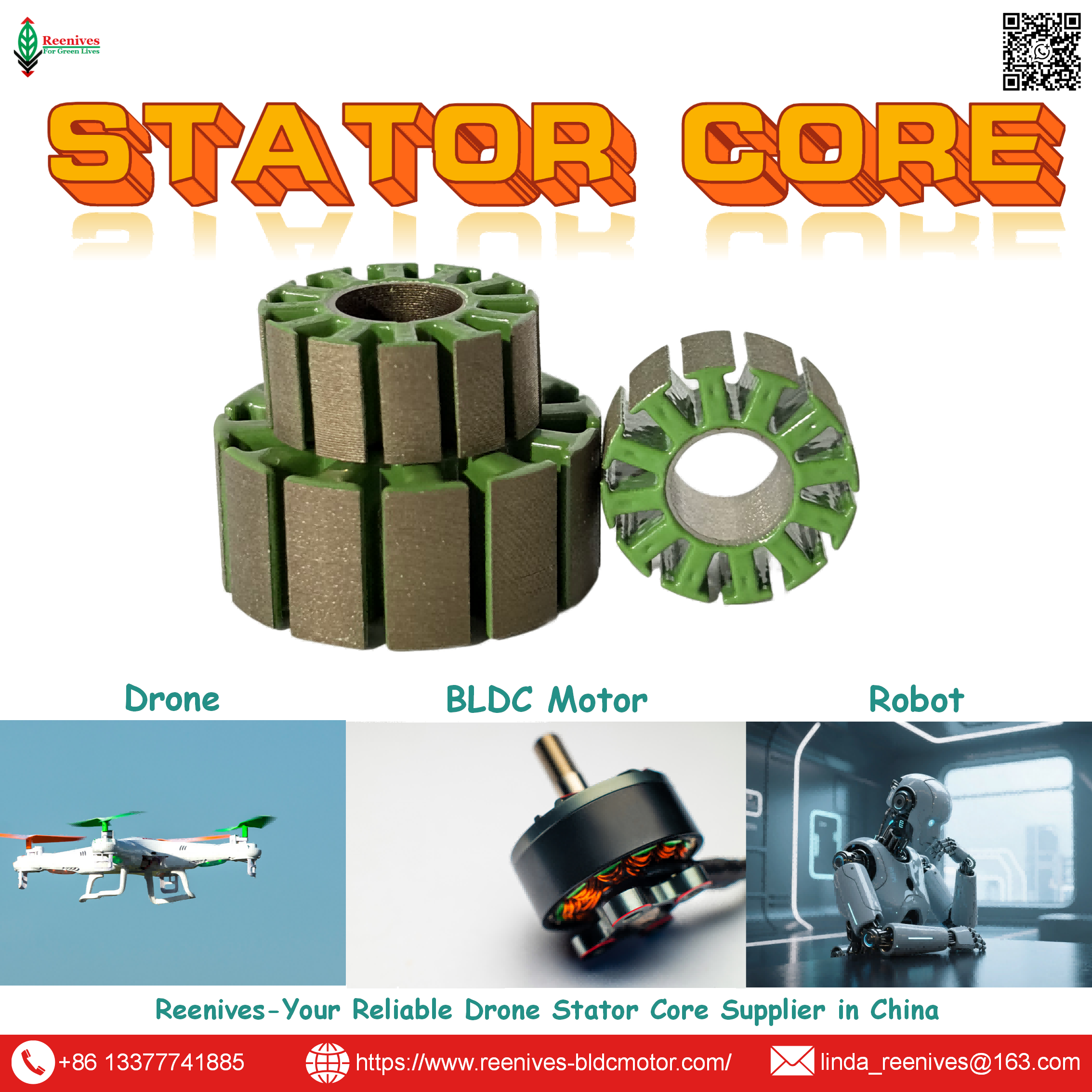
Induction Motor Stamping Supplier in China

Precision Induction Motor Stamping: The Engineering Guide for High-Efficiency BLDC Drone Motors
Electromechanical engineers and drone motor sourcing experts frequently encounter severe performance bottlenecks: excessive core heating at elevated operating frequencies, acoustic noise from loose lamination stacks, and flight time penalties caused by hysteresis and eddy current losses. Partnering with a reliable Induction Motor Stamping Supplier in China who delivers tight-tolerance silicon steel lamination stamping and ultra-thin core stacking is essential to achieving maximum power density and thermal stability.
This technical guide explores the material specifications, tooling tolerances, lamination classifications, and selection procedures for Induction Motor Stamping across high-RPM drone propulsion systems and broader BLDC motor applications.
- 1. What is Induction Motor Stamping?
- 2. Classification of Stator & Rotor Motor Laminations
- 3. Key Technical Specifications & Data Sheet
- 4. Applications in Drone BLDC & Industrial Motors
- 5. Step-by-Step Stator Stamping Selection Guide
- 6. Frequently Asked Questions (FAQ)
- 7. Conclusion & Technical Consultation
- 8. Dongguan Runlu Motor Technology Co., Ltd.
What is Induction Motor Stamping?
Induction Motor Stamping is the high-precision mechanical manufacturing process of punching thin electrical steel sheets into segmented or single-piece stator and rotor laminations. These stamped silicon steel laminations are stacked, interlocked, welded, or bonded together to form the electromagnetic core of induction motors, brushless DC (BLDC) motors, and permanent magnet synchronous motors (PMSM).
By dividing the core into ultra-thin, electrically insulated laminations, stamping minimizes internal eddy current loops generated by alternating magnetic fields, significantly improving motor efficiency and power output.
Classification of Stator & Rotor Motor Laminations
| Stamping Lamination Type | Manufacturing / Structural Feature | Primary Engineering Advantage | Common Drone & Motor Application |
|---|---|---|---|
| Progressive Die Stamping | Multi-stage continuous carbide die punching | High-speed volume production, tight tolerances (±0.005 mm) | High-volume BLDC drone motors, power tools |
| Compound Die Stamping | Single-stroke blanking of internal and external profiles | Exceptional concentricity between stator bore and rotor OD | Precision industrial servos, gimbal motors |
| Interlocked Lamination Stacks | Stamped auto-stacking tabs integrated into punching die | Eliminates external welding, reduces eddy current bridges | Standard industrial induction motors, commercial drones |
| Bonded / Glued Stacks (Backlack) | Self-bonding varnish activated under heat and pressure | Zero inter-lamination vibration, minimal acoustic noise | High-frequency FPV drones, defense propulsion |
Key Technical Specifications & Data Sheet
Below are standard industry material and engineering parameters for high-precision motor lamination stamping:
| Parameter | Technical Specification | Engineering Impact | Source / Standard |
|---|---|---|---|
| Lamination Thickness | 0.1mm, 0.15mm, 0.2mm, 0.35mm, 0.5mm | Thinner sheets exponentially decrease Eddy Current Loss (Pe ∝ t²) | IEC 60404-8-8 |
| Material Grade | 20AV1300, 35WW300, B20AT1300, Baosteel / Nippon | Delivers high magnetic permeability (μ) and high flux saturation (Bs) | AISI / ASTM A677 |
| Stamping Precision | ±0.005 mm (Progressive Carbide Tooling) | Maintains uniform air gap and precise slot dimensions for high slot fill factor | ISO 2768-mK |
| Surface Coating | C-5 Insulation, Electrostatic Blue Epoxy Coating | Prevents phase-to-phase and core-to-ground electrical short circuits | ISO 2178 |
| Burr Height Limit | ≤ 0.02 mm (Max 0.03mm) | Prevents short-circuiting between adjacent laminations and coil damage | DIN 9830 |
Applications in Drone BLDC & Industrial Motors
- FPV Racing & Aerial Cinema Drones: Utilizes ultra-thin 0.15mm–0.2mm stamped laminations to handle extreme switching frequencies without core overheating.
- Heavy Payload & Agricultural Multirotors: Requires large-outer-diameter stamped stators with optimized slot geometry to carry heavy electrical current and dissipate heat under continuous load.
- eVTOL Propulsion Systems: Leverages high-permeability silicon steel stamping with zero-slop stack bonding to ensure maximum torque density and structural reliability.
- Industrial Induction & Servo Motors: Drives automation equipment, CNC spindles, and robotics where mechanical precision and long service life are essential.
Step-by-Step Stator Stamping Selection Guide
- Define Operating Frequency & Target RPM: Calculate fundamental switching frequency to choose the correct lamination thickness (e.g., 0.15mm for high-RPM BLDC, 0.35mm for standard 50/60Hz induction motors).
- Select Electrical Steel Grade: Evaluate core loss requirements (W/kg) versus material cost to select grades like 20AV1300 or 35WW300.
- Determine Stamping Tooling Type:
- For rapid prototyping and short runs: Choose wire EDM or laser cutting.
- For mass production (>10,000 units): Invest in high-speed progressive tungsten carbide stamping dies.
- Specify Stacking & Insulation Method: Choose between auto-interlocking, laser welding, or epoxy powder coating based on voltage rating and acoustic noise targets.
- Audit Supplier Quality & Equipment: Verify that your supplier possesses high-speed automated presses, dust-free coating lines, and optical measurement equipment (CMM).
Frequently Asked Questions (FAQ)
Q1: How does lamination thickness in induction motor stamping affect motor thermal performance?
A: Eddy current loss within the motor core is directly proportional to the square of lamination thickness (Pe ∝ t²). Reducing lamination thickness from 0.35mm to 0.15mm drastically lowers core thermal generation, reducing heat buildup and extending drone motor run-time. (Source: IEEE Transactions on Magnetics / IEC 60404-8-8 Standards)
Q2: What is the acceptable burr height limit for precision motor lamination stamping?
A: Standard precision stamping requires a burr height of ≤ 0.02 mm (maximum 0.03 mm). Excess burrs puncture inter-lamination insulation coatings, creating conductive pathways that increase eddy current losses and motor operating temperatures. (Source: DIN 9830 Stamping Standards)
Q3: Why is electrostatic epoxy powder coating preferred over plastic bobbins for drone stator cores?
A: Electrostatic epoxy powder coating provides a thin, uniform insulating layer (0.08mm - 0.12mm) with high dielectric strength (>500V DC). This eliminates the spatial bulk of plastic bobbins, maximizing slot fill area for copper wire and enhancing heat dissipation. (Source: IEC 60034-18 Performance Benchmarks)
Conclusion & Technical Consultation
Enhancing BLDC and induction motor performance relies heavily on selecting high-grade silicon steel and maintaining tight stamping tolerances. For custom lamination tooling, rapid prototype samples, or mass production quotes, get in touch with our engineering team:
- Official Website: www.reenives-bldcmotor.com
- WhatsApp: +86-13377741885
- Email: linda_reenives@163.com
Dongguan Runlu Motor Technology Co., Ltd.
Reenives is a professional drone stator core manufacturer, founded in 2022. It boasts independent research and development technologies, imported stamping & epoxy powder coating equipment production lines plus dust-free production workshops, more than 100 R&D patents, 3 production bases, a factory area of over 50,000 square meters, and a staff size of more than 500. From production to sales, we support bulk purchasing, private mould develop , and samples making , and can provide tailor-made perfect solutions for your production and usage scenarios. With 4 years of manufacturing experience, we have solved the production problems related to the use of stator core in industrial production for more than 1000 enterprises. We can ship globally (with complete export qualifications). Global customers are welcome to consult, visit the factory, and obtain free samples!
Related Article