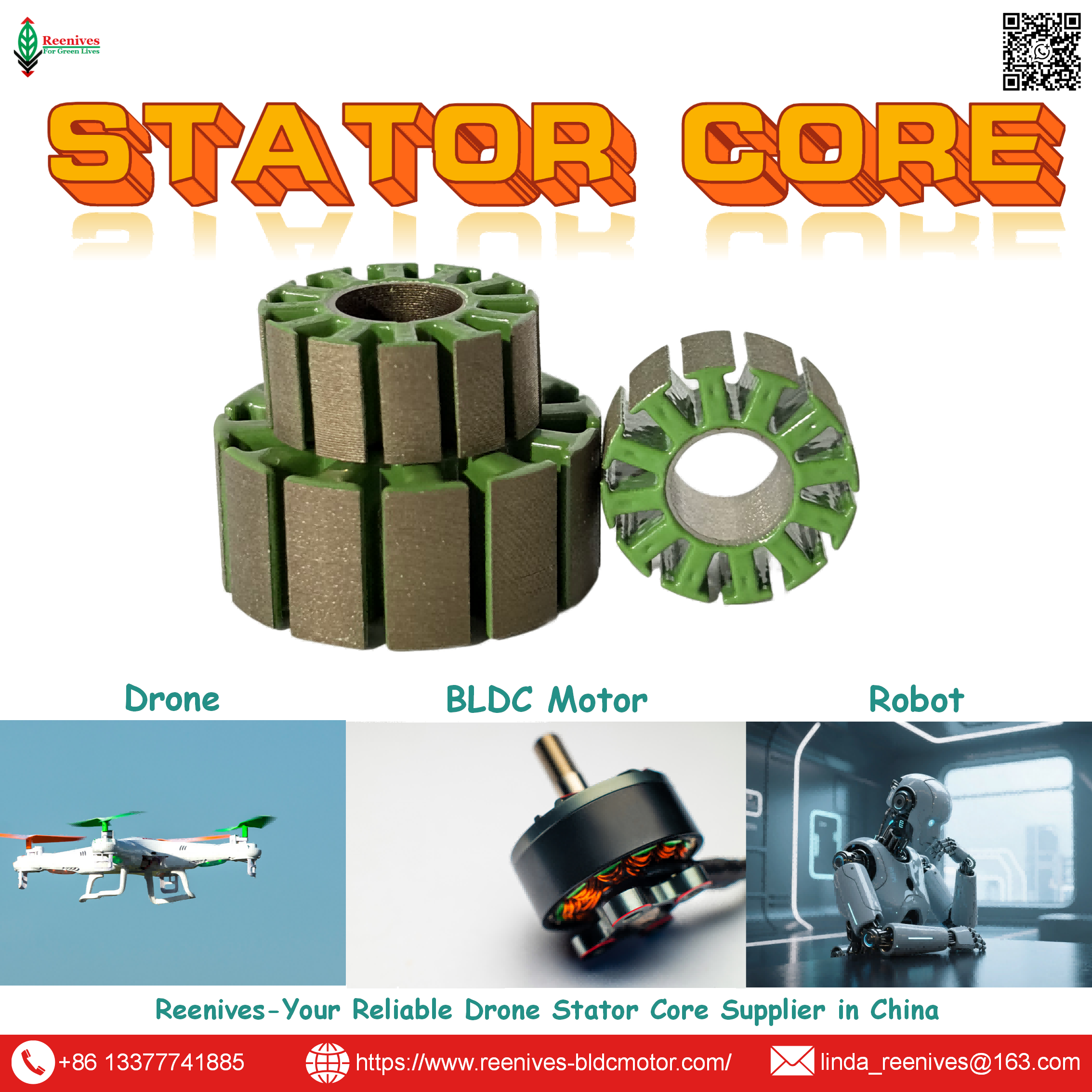
BLDC Drone Three Phase Stator Lamination Stamping Supplier

High-Performance Three Phase Stator Solutions: The Engineering Guide for BLDC Drone Motors
Drone motor engineers and thermal management procurement specialists often face severe challenges: high eddy current losses, motor overheating under peak payload, and weight penalties caused by suboptimal magnetic core designs. Finding a reliable BLDC Drone Three Phase Stator Lamination Stamping Supplier who balances ultra-thin silicon steel stamping precision with mechanical structural integrity is crucial to maximizing flight time and operational efficiency.
This technical guide dives into the architecture, material selection, stamping tolerances, and selection steps for a Three Phase Stator in high-KV and low-KV BLDC motors.
- 1. What is a Three Phase Stator?
- 2. Classification of Three Phase Stators
- 3. Key Technical Specifications & Data Sheet
- 4. Applications in Drones & Industrial Systems
- 5. Step-by-Step Stator Selection Guide
- 6. Frequently Asked Questions (FAQ)
- 7. Conclusion & Technical Consultation
- 8. About Dongguan Runlu Motor Technology Co., Ltd.
What is a Three Phase Stator?
A Three Phase Stator is the stationary electromagnetic core of a brushless DC (BLDC) motor or permanent magnet synchronous motor (PMSM). It consists of stacked electrical steel laminations featuring slots that hold three separate winding phases (Phase A, B, and C) offset by 120 electrical degrees.
When powered by an electronic speed controller (ESC), the sequential currents through these three phase windings generate a rotating magnetic field (RMF), which directly drives the outer rotor magnet assembly.
Classification of Three Phase Stators
| Stator Configuration | Architectural Feature | Primary Advantage | Typical Drone / Motor Use Case |
|---|---|---|---|
| Radial Flux (Outrunner) | Teeth extend outward toward the rotor ring | High torque density at lower RPM | FPV Drones, Heavy-Lift Multirotors, Agriculture Sprayers |
| Radial Flux (Inrunner) | Teeth project inward toward the internal rotor shaft | Superior RPM capabilities & enclosed cooling | High-Speed RC Fixed-Wings, Ducted Fans, Robotics |
| Axial Flux Stators | Planar/disc magnetic flux alignment | Ultra-compact axial depth, high power-to-weight ratio | eVTOL Propulsion, Specialty Gimbal Systems |
Key Technical Specifications & Data Sheet
Below are standard industry engineering parameters for precision BLDC drone motor stator laminations:
| Parameter | Standard Specification | Engineering Impact | Source / Standard |
|---|---|---|---|
| Lamination Thickness | 0.1mm, 0.15mm, 0.2mm, 0.35mm, 0.5mm | Thinner laminations drastically reduce Eddy Current Losses (Pe) | IEC 60404-8-8 |
| Silicon Steel Grade | 20AV1300, 35WW300, B20AT1300, Nippon Steel | Lower hysteresis loss and higher magnetic permeability (μ) | AISI / ASTM A677 |
| Coating Type | Insulation Varnish, Blue Epoxy Powder Coating | Prevents phase-to-ground short circuits and improves wire insulation | ISO 2178 |
| Stamping Tolerance | ±0.005 mm (Progressive Carbide Dies) | Minimizes air gap variance for smooth cogging torque | ISO 2768-mK |
| Stacking Method | Interlocking, Welding, Gluing/Bonding | Glued laminations reduce stray eddy paths and acoustic noise | Internal QC Benchmarks |
Applications in Drones & Industrial Systems
- FPV Racing & Freestyle Drones: Requires light 0.15mm-0.2mm stator laminations to sustain explosive throttle bursts without thermal throttling.
- Agricultural & Heavy Payload Drones: Utilizes large-diameter outrunner stators (e.g., 8120, 10015 series) with high copper slot fill factors for heat dissipation.
- eVTOL & Commercial Logistics: Relies on ultra-low-loss electrical steel stators with high magnetic saturation limits for continuous flight endurance.
- Industrial Automation & Robotics: Drives servo motors, medical pump systems, and power tools requiring high torque-to-inertia ratios.
Step-by-Step Stator Selection Guide
- Calculate Target Motor Power & Torque: Determine the required thrust and torque profile (N·m) to set the core diameter (Do) and stack height (L).
- Select Lamination Thickness Based on Operating Frequency:
- For ultra-high RPM (>20,000 RPM or high switching frequency), choose 0.1mm to 0.2mm laminations.
- For standard torque motors (<8,000 RPM), choose 0.35mm laminations for cost-effective performance.
- Determine Slot & Pole Combination: Match stator slots (S) and rotor poles (P) (e.g., 12S14P, 24S28P) to optimize cogging torque and winding layout.
- Specify Surface Insulation: Request high-voltage epoxy powder coating for thin wire slots to eliminate insulation tape thickness.
- Evaluate Supplier Tooling Capability: Ensure your manufacturer offers high-precision progressive stamping and rapid prototyping options prior to mass die production.
Frequently Asked Questions (FAQ)
Q1: How does lamination thickness affect three phase stator efficiency?
A: Eddy current loss is directly proportional to the square of lamination thickness (Pe ∝ t²). Reducing lamination thickness from 0.35mm to 0.15mm significantly lowers core thermal buildup, leading to higher BLDC motor efficiency and longer drone flight times. (Source: IEEE Transactions on Magnetics / IEC 60404-8-8 Standards)
Q2: Why is silicon steel preferred over carbon steel for stator lamination stamping?
A: Silicon steel contains 1% to 4.5% silicon, which increases electrical resistivity and decreases magnetic hysteresis loss, allowing high permeability and high flux density (B) with minimal energy loss during phase switching. (Source: ASM International Materials Handbook)
Q3: What insulation method is best for drone BLDC stator cores?
A: Electrostatic epoxy powder coating is the industry standard for drone BLDC stators. It offers uniform edge coverage (typically 0.08mm-0.12mm), withstands high insulation breakdown voltages (>500V DC), and optimizes slot fill area compared to traditional plastic bobbins. (Source: IEC 60034-18 Performance Benchmarks)
Conclusion & Technical Consultation
Optimizing your BLDC motor performance begins with selecting the right core lamination topology and stamping precision. For custom engineering drawings, prototype samples, or high-volume production quotes, contact our engineering sales team today:
- Official Website: www.reenives-bldcmotor.com
- WhatsApp: +86-13377741885
- Email: linda_reenives@163.com
Dongguan Runlu Motor Technology Co., Ltd.
Reenives - Professional Drone Stator Core Manufacturer
Reenives is a professional drone stator core manufacturer, founded in 2022. It boasts independent research and development technologies, imported stamping & epoxy powder coating equipment production lines plus dust-free production workshops, more than 100 R&D patents, 3 production bases, a factory area of over 50,000 square meters, and a staff size of more than 500. From production to sales, we support bulk purchasing, private mould develop , and samples making , and can provide tailor-made perfect solutions for your production and usage scenarios. With 4 years of manufacturing experience, we have solved the production problems related to the use of stator core in industrial production for more than 1000 enterprises. We can ship globally (with complete export qualifications). Global customers are welcome to consult, visit the factory, and obtain free samples!
Related Article