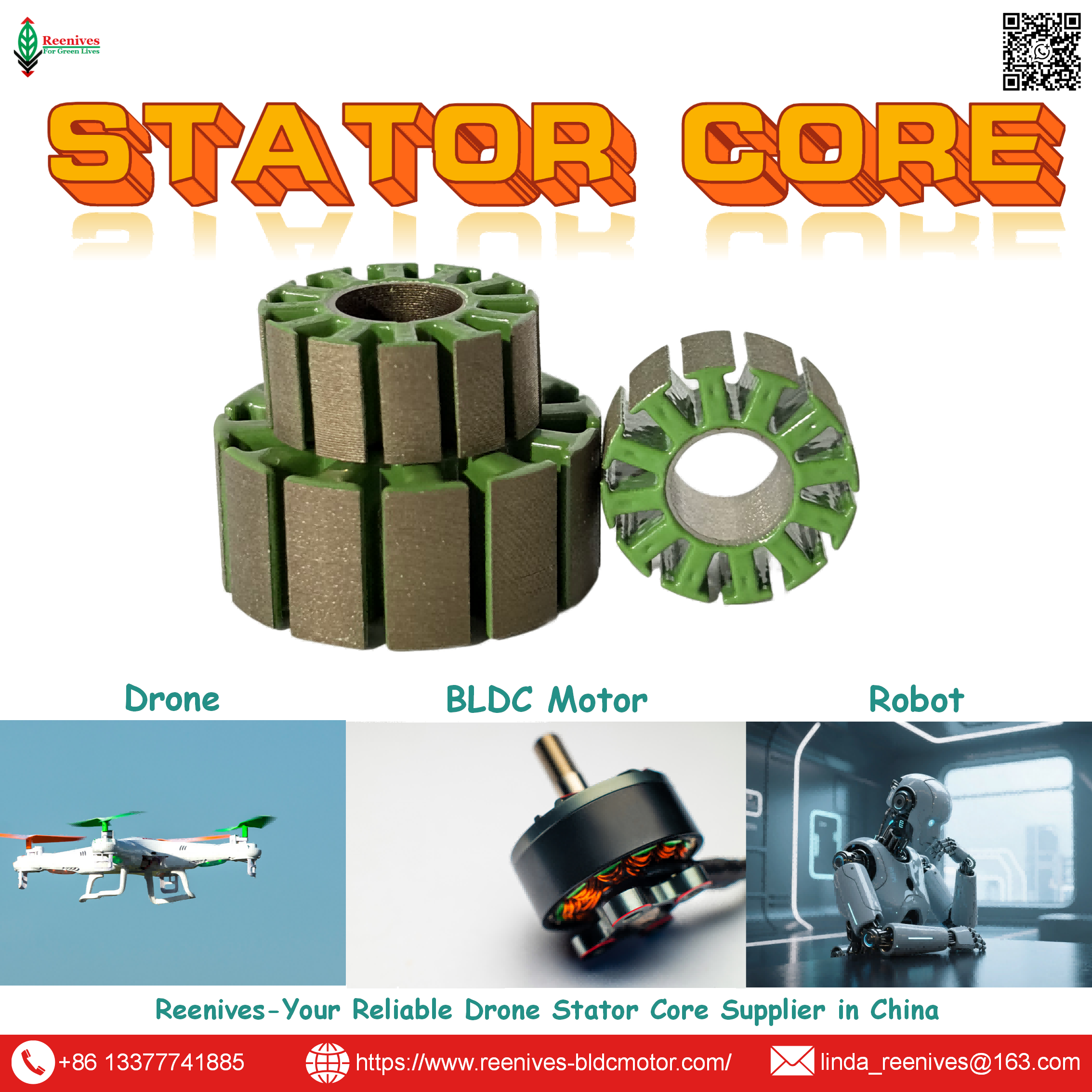
Drone Engine BLDC Outrunner Stator Stamping Lamination Supplier

Drone Engine – Precision Stator Stampings for BLDC Outrunner Propulsion Systems
Drone engine thrust limited by stator design? BLDC outrunner efficiency lagging? The drone engine in modern UAVs is almost exclusively a BLDC outrunner motor—where the stator stamping lamination stack is the critical component that determines magnetic flux, torque density, and overall propulsion efficiency. As a specialist drone engine BLDC outrunner stator stamping lamination supplier, Reenives delivers precision stator cores with 0.2mm ultra-thin silicon steel, 12N14P or 24N22P configurations, burr height < 0.03mm, and epoxy coating—reducing core loss by up to 30%, maximizing thrust-to-weight ratio, and enabling reliable, efficient propulsion for FPV racing, logistics, agriculture, and eVTOL drone engines.
- • What Is a Drone Engine (BLDC Outrunner)?
- • Classification of Drone Engine Stator Stampings
- • Technical Specifications & Verified Data
- • Applications: FPV Racing, UAV Logistics, Agriculture, eVTOL & More
- • 6-Step Engineering Selection Guide for Drone Engine Stator Stampings
- • FAQ: Drone Engine Stator Stamping Technical Questions
- • Why Reenives – Drone Engine BLDC Outrunner Stator Stamping Lamination Supplier
- • Dongguan Runlu Motor Technology Co., Ltd.
What Is a Drone Engine (BLDC Outrunner)?
A drone engine in modern UAV applications is almost exclusively a brushless DC (BLDC) outrunner motor—where the rotor spins on the outside of the stator, delivering high torque at low RPM for direct-drive propeller propulsion. The stator stamping lamination stack forms the stationary magnetic core that generates the rotating magnetic field .
Key components of a drone engine stator stamping:
- Lamination stack – Precision-stamped silicon steel sheets stacked and bonded to form the stator core
- Slot/pole geometry – 12N14P (most common) or 24N22P (heavy-lift) configurations
- Epoxy coating – Electrical insulation between laminations to minimize eddy current losses
- Burr-free edges – Critical for protecting winding insulation during assembly
ⓘ Drone engine insight: "The stator stamping lamination is the foundation of every drone engine. Its design determines thrust output, thermal stability, and flight endurance. For 12N14P drone engines, near-perfect winding factor of 0.933 delivers exceptional performance."
Reenives manufactures precision stator stampings for drone engine BLDC outrunners using imported 0.2mm silicon steel, progressive stamping dies, and automated epoxy powder coating—delivering optimal magnetic performance for demanding UAV, FPV, and eVTOL applications .
Classification of Drone Engine Stator Stampings
Reenives supplies drone engine stator stampings across four primary series, tailored to different drone classes and performance requirements :
| Series | Stator OD (mm) | Slot/Pole Configuration | Lamination Thickness | Best For |
|---|---|---|---|---|
| Series A – Micro FPV | 12–20mm | 9N12P | 0.15–0.20mm | Micro drones, tiny whoops, sub-100g FPV |
| Series B – FPV Racing | 22–30mm | 9N12P, 12N14P | 0.15–0.20mm | 3–5 inch FPV racing drones, freestyle |
| Series C – Mid-Size UAV | 30–50mm | 12N14P, 24N22P | 0.20mm | Logistics drones, camera platforms, agriculture |
| Series D – Heavy-Lift & eVTOL | 50–80mm | 24N22P, 36N30P | 0.20mm | Heavy-lift UAVs, eVTOL, cargo drones |
Drone engine stator stampings are optimized for specific propulsion requirements:
- 12N14P: The dominant standard for drone engines—winding factor 0.933, low cogging torque
- 9N12P: High RPM, responsive throttle—ideal for FPV racing
- 24N22P: High torque, low cogging—logistics and agriculture UAVs
- 36N30P: Maximum torque density—eVTOL and heavy-lift applications
Technical Specifications & Verified Data
All performance data below is derived from Reenives in-house laboratory testing (IEC 60404-2), third-party validation, and industry standards for drone engine stator stampings .
| Parameter | Value / Range (Reenives Standard) | Test Standard / Source |
|---|---|---|
| Stator Outer Diameter | 12–80mm (customizable) | CMM / optical comparator |
| Material Type | Silicon steel (CRNGO / Non-oriented) | Material certificates / IEC 60404 |
| Common Grades | 35WW270, 20WV1200, 35PN210 (Nippon Steel / Baowu) | Material certificates |
| Lamination Thickness | 0.15mm / 0.20mm / 0.35mm (customizable) | Micrometer / IEC 60404-2 |
| Core Loss @ 1.0T, 400Hz (0.20mm) | ≤ 11.0 W/kg — 30% lower than 0.35mm | IEC 60404-2 / Reenives R&D |
| Saturation Flux Density B50 | ≥ 1.69 T | Epstein frame test |
| Burr Height (max) | < 0.03mm | Optical measurement |
| Epoxy Coating Thickness | 30–60 µm, dielectric > 1000V | ASTM D149 |
| Stacking Factor | ≥ 97% | Weight method |
| Concentricity Tolerance | ±0.01mm – ±0.015mm | CMM measurement |
| Slot/Pole Configurations | 9N12P, 12N14P, 24N22P, 36N30P, custom | Reenives design standards |
| Winding Factor (12N14P) | 0.933 (near-perfect) | BLDC motor theory |
| Typical Drone Engine Efficiency | 90–95% (with optimized stator) | IEEE Xplore / FEM simulation |
| Flight Time Improvement | 8–12% (vs. standard 0.35mm stator) | Reenives R&D / field testing |
🔬 Data Source: Reenives R&D Report 2024-Q4 + IEC 60404-2 standard + Material certificates + IEEE Xplore motor studies .
Applications: FPV Racing, UAV Logistics, Agriculture, eVTOL & More
Drone engine stator stampings power the full spectrum of UAV propulsion applications. The right stator is essential for each use case :
| Application | Typical Stator Size | Stator Requirements | Performance Priorities |
|---|---|---|---|
| FPV Racing Drones | 22–30mm | Ultra-thin 0.15mm, high fill factor, low cogging | High RPM, rapid acceleration, responsiveness |
| Freestyle / Cinematic FPV | 22–30mm | 0.20mm, smooth torque, thermal stability | Smooth control, consistent power, cooling |
| UAV Logistics & Delivery | 30–50mm | 0.20mm, high efficiency, durability | Long flight time, payload capacity, reliability |
| UAV Agriculture Spraying | 40–60mm | 0.20mm, corrosion-resistant coating | Heavy payload, dust/chemical resistance, power |
| eVTOL / Air Taxi | 50–80mm | 0.20mm, high power density, reliability | Safety, redundancy, high continuous power |
| Micro / Tiny Whoop FPV | 12–20mm | 0.15mm, ultra-lightweight | Weight reduction, efficiency at low power |
"The stator stamping lamination is the foundation of every drone engine. Its design determines whether a drone can race at high speeds, carry heavy payloads, or fly for extended missions."
6-Step Engineering Selection Guide for Drone Engine Stator Stampings
For UAV motor designers and procurement engineers, selecting the optimal drone engine stator stamping requires systematic evaluation. Here is a practical 6-step framework:
- Define Drone Class & Performance Requirements – Identify your drone's mission profile:
- FPV racing: High RPM, rapid acceleration, lightweight
- FPV freestyle: Smooth control, consistent power, cooling
- UAV logistics: Long flight time, high payload, efficiency
- UAV agriculture: Heavy lift, dust/chemical resistance, durability
- eVTOL: Safety, redundancy, high continuous power
- Select Stator Outer Diameter – Match motor size to drone class:
- 12–20mm: Micro drones, tiny whoops
- 22–30mm: FPV racing, freestyle (most popular)
- 30–50mm: Logistics, agriculture, camera platforms
- 50–80mm: Heavy-lift, eVTOL, cargo drones
- Choose Lamination Thickness – Thinner laminations reduce core loss at high frequencies:
- 0.15mm: Ultimate high-RPM performance, FPV racing drones
- 0.20mm: Optimal balance—most drone applications
- 0.35mm: Not recommended for high-performance drone engines
ⓘ "0.20mm laminations reduce core loss by approximately 30% compared to 0.35mm—translating to 8–12% longer flight times for drone applications."
- Define Slot/Pole Configuration – Match to motor characteristics :
- 12N14P: Dominant standard for drone engines—winding factor 0.933
- 9N12P: High RPM, responsive—FPV racing
- 24N22P: High torque, low cogging—logistics and agriculture
- 36N30P: Maximum torque density—eVTOL
- Specify Insulation & Coating – Critical for drone engine reliability:
- Epoxy powder coating (30–60µm, Class H 180°C)
- Corrosion resistance for agriculture and outdoor operations
- Dielectric strength > 1000V for reliable insulation
- Choose a Specialist Drone Engine Stator Supplier – Evaluate UAV motor expertise:
- Experience with drone engine stator stamping for UAV applications
- Ultra-thin lamination capability (0.15–0.20mm)
- Precision stamping: burr < 0.03mm, concentricity ±0.01mm
- Epoxy coating capability for drone engine environments
- Material certificates and third-party test reports
- Proven track record with drone engine manufacturers
- Engineering support for drone engine optimization
FAQ: Drone Engine Stator Stamping Technical Questions
A drone engine stator stamping is a precision-stamped silicon steel lamination stack that forms the stationary magnetic core of a BLDC outrunner motor. It is critical because: (1) it minimizes eddy current losses through thin laminations (0.15–0.20mm), (2) consistent geometry ensures optimal magnetic flux distribution for thrust generation, (3) burr-free edges protect winding insulation, and (4) high stacking factor maximizes magnetic material density—all of which directly impact drone engine efficiency, thrust, and flight time .
For drone engines operating at high frequencies (up to 40 kHz PWM), 0.15–0.20mm laminations are optimal. 0.20mm achieves core loss ≤ 11.0 W/kg at 400Hz—approximately 30% lower than conventional 0.35mm material—delivering longer flight times and cooler operation. For FPV racing drones operating at extreme RPM, 0.15mm laminations provide ultimate performance .
12N14P (12-slot stator, 14-pole rotor) is the dominant standard for drone engine stators, offering a near-perfect winding factor of 0.933 and exceptionally low cogging torque. It is widely used across FPV racing, logistics, agriculture, and eVTOL applications. Reenives supports 12N14P as the standard drone engine configuration .
The stator stamping directly impacts drone engine flight time through core loss. Lower core loss means less energy wasted as heat and more power available for thrust. Using 0.20mm silicon steel instead of 0.35mm reduces core loss by approximately 30%, which translates to 8–12% longer flight times for the same battery capacity—a significant advantage for UAV logistics and surveying applications .
Burr height is the raised edge left on stamped metal after the punching process. In drone engine stators, burr height must be maintained below 0.03mm because excessive burrs can: (1) damage enamel insulation on copper windings during assembly, causing short circuits, (2) create localized magnetic saturation points that reduce efficiency, (3) increase core loss through eddy current concentration, and (4) reduce motor reliability—critical for UAV applications where motor failure means crashing. Reenives maintains burr height < 0.03mm through precision progressive stamping dies .
Epoxy powder coating provides three critical functions for drone engine stator stampings: (1) electrical insulation between laminations to minimize eddy currents and prevent interlaminar shorts, (2) corrosion resistance for operation in humid environments, outdoor conditions, and agriculture applications, and (3) thermal durability up to 180°C (Class H) to withstand the heat generated during high-power drone operation. The coating thickness (30–60µm) is optimized for tight slot geometries common in drone engines .
Yes. Reenives supports full customization of drone engine stator stampings including: stator outer diameter (12–80mm), lamination thickness (0.15–0.20mm), slot/pole configurations (9N12P, 12N14P, 24N22P, 36N30P, custom), stacking height, material grade, and epoxy coating specifications. Private mould development is available for high-volume OEM projects with exclusive design rights—from micro FPV motors to heavy-lift eVTOL propulsion systems .
Why Reenives – Drone Engine BLDC Outrunner Stator Stamping Lamination Supplier
Reenives has earned its reputation as a specialist Drone Engine BLDC Outrunner Stator Stamping Lamination Supplier by combining advanced manufacturing technology with deep expertise in UAV propulsion systems .
Our Advantages — Drone Engine Stator Specialists
- ✅ Ultra-Thin Silicon Steel: 0.15–0.20mm laminations reduce core loss by up to 30%—extending drone engine flight times by 8–12%
- ✅ Precision Progressive Stamping: Burr height < 0.03mm, concentricity ±0.01mm, stacking factor ≥ 97%
- ✅ Drone-Optimized Configurations: 12N14P (dominant standard), 9N12P, 24N22P, 36N30P—any drone engine application
- ✅ Full Customization: Private mould development, tailored stator diameters, and custom stack heights
- ✅ Trusted Quality Control: IEC 60404-2 testing, third-party verification, and material certificates
- ✅ Drone Engine Expertise: 4 years of experience with 1,000+ enterprise clients—specializing in UAV propulsion
- ✅ Global Export Capability: Complete export qualifications with worldwide shipping to drone engine manufacturers
- ✅ 100+ R&D Patents: Continuous innovation in stator stamping technology for drone engine applications
🚁 Our drone engine promise: Stator stampings that deliver longer flight times, higher thrust, and cooler operation. Consistent quality that eliminates rework. Technical support that understands UAV propulsion. That's why Reenives is the trusted drone engine BLDC outrunner stator stamping lamination supplier.
🚁 Ready to power your drone engines with precision stator stampings?
Contact Reenives today for engineering consultation, OEM samples, and competitive global pricing.
📱 WhatsApp: +86-13377741885
Dongguan Runlu Motor Technology Co., Ltd.
Reenives — Professional Drone Stator Core Manufacturer
Founded in 2022, Reenives has rapidly grown into a trusted drone engine stator stamping supplier for the worldwide UAV, FPV, and eVTOL markets .
Independent R&D Technology · Imported stamping & epoxy powder coating production lines · Dust-free workshops · 4 years of manufacturing experience · Solved drone engine stator challenges for 1,000+ enterprises worldwide—including leading UAV manufacturers .
From production to sales, we support bulk purchasing, private mould development, and sample making. We provide tailor-made solutions for your specific drone engine production scenarios—with competitive global pricing, consistent quality, and reliable on-time delivery .
🌐 www.reenives-bldcmotor.com | 📧 linda_reenives@163.com | 📱 +86-13377741885
✈️ Global drone engine manufacturers welcome — consult, visit the factory, or request free samples today!
Reenives — Drone Engine BLDC Outrunner Stator Stamping Lamination Supplier
© 2026 Dongguan Runlu Motor Technology Co., Ltd. All rights reserved.
Related Article