Brushless DC Motor Rotor and Stator Stamping Supplier

DC Motor Rotor and Stator — Precision Stamping for Brushed & Brushless DC Motors | Reenives Stator Core Supplier
⚠️ Are your DC motor rotor and stator mismatched, causing torque ripple, vibration, or overheating? Poor lamination stamping quality — excessive burrs, inconsistent stacking, or a mismatched stator-rotor air gap — reduces DC motor efficiency, causes vibration, and leads to premature brush or bearing failure. Especially in high-RPM brushless DC (BLDC) drone motors, where reliability is mission-critical.
✅ Reenives is a brushless DC motor rotor and stator stamping supplier producing matched cores for DC motors. With imported high-speed progressive die stamping lines, epoxy powder coating, and dust-free workshops, we deliver DC motor rotor and stator laminations with low burrs, tight tolerances, and long die life. We help 1000+ enterprises worldwide improve motor performance and reduce production costs.
📋 Table of Contents
What Are DC Motor Rotor and Stator?
A DC motor rotor and stator are the two core magnetic components of a direct current (DC) motor. The stator is the stationary part that holds field poles (permanent magnets or field windings) or, in brushless DC (BLDC) motors, the windings. The rotor is the rotating part that carries either windings (in traditional brushed DC motors) or permanent magnets (in BLDC motors).
In brushless DC drone motors, the rotor and stator must be designed and stamped as a matched pair. Their material grade, lamination thickness, pole count, and air gap directly affect:
- Motor efficiency & flight endurance
- Cogging torque & vibration levels
- Heat generation & thermal management
- Power density & thrust-to-weight ratio
Stamping is the most common and cost-effective method for producing DC motor rotor and stator laminations at volume. High-speed progressive die stamping with precision carbide tooling ensures consistent lamination geometry, minimal burrs, and long tool life — critical for high-volume brushless DC motor production.

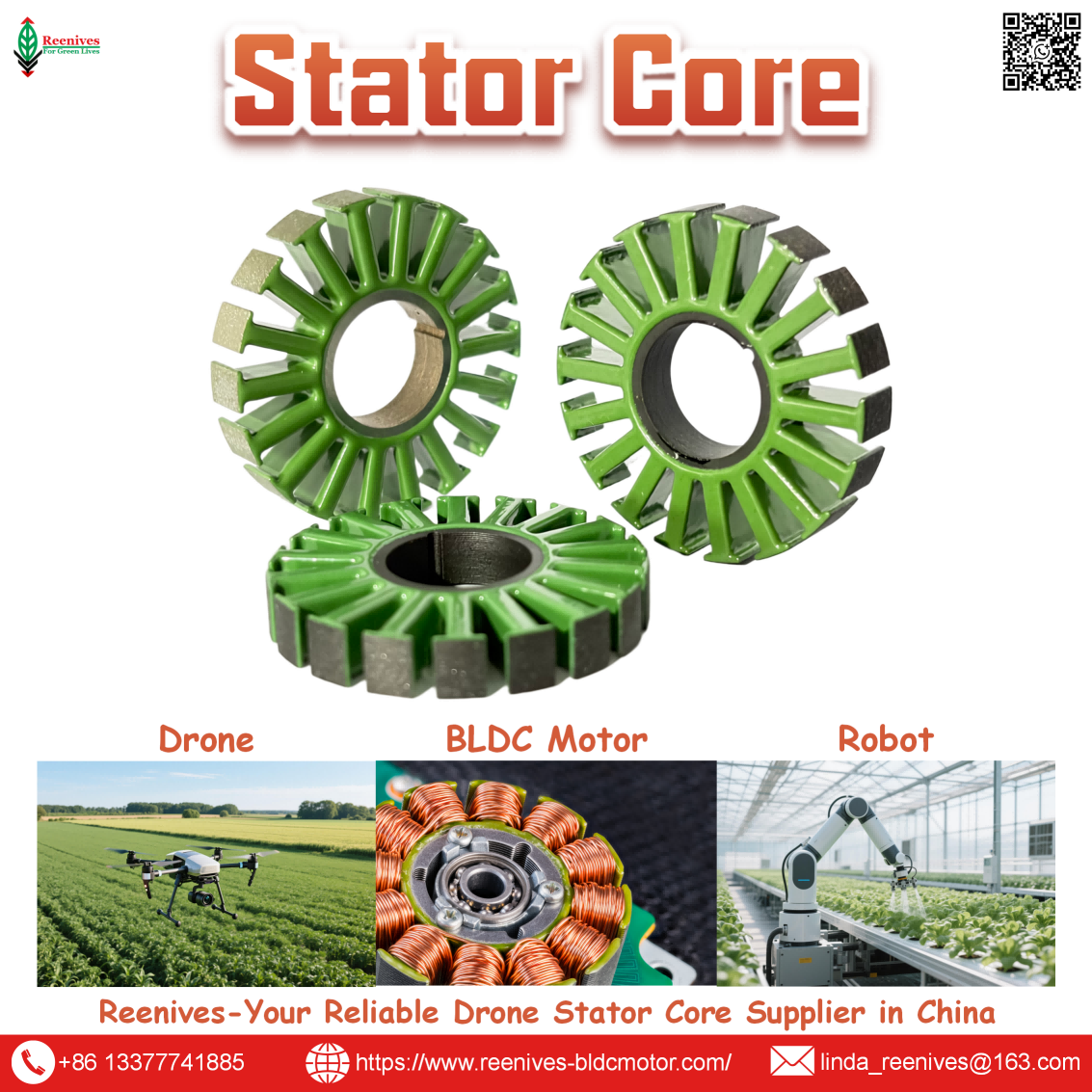
Precision DC motor rotor and stator stamping — manufactured by Reenives with imported high-speed stamping & epoxy powder coating lines.
Types of DC Motor Rotor & Stator Stamping
DC motor rotor and stator stamping can be performed using several methods, each suited to different production volumes, precision requirements, and cost targets. Reenives offers the following:
- High-Speed Progressive Die Stamping — Continuous coil feeding through a multi-station die. Highest efficiency for high-volume brushless DC motor production. Low cost per piece, excellent consistency.
- Compound Die Stamping — Single-stroke die that cuts the entire lamination profile in one hit. Good for medium volumes, high precision.
- Segmented Stator Stamping — Individual teeth stamped separately for separate winding, then assembled into a full core. Higher slot fill factor.
- Rotor Stamping with Magnet Pockets — Rotor laminations stamped with surface-mount or interior magnet slots for IPM designs.
- Interlocked Stamping Stacks — Stamped laminations with integral dimples or dovetails for mechanical assembly. Cost-effective for high volume.
- Bonded Stamping Stacks — Stamped laminations bonded with adhesive instead of interlocking, reducing eddy current losses and vibration.
- Epoxy-Coated Stamping Stacks — Stamped laminations individually coated with epoxy powder for superior insulation and corrosion resistance.
- Custom Stamping Stacks — Private mould development for unique slot counts, outer diameters, and tooth profiles.
Whether you need high-volume progressive die stamping or low-volume prototype stamping, Reenives can supply the right solution.
Key Specifications & Data
Below are typical specifications for Reenives DC motor rotor and stator stamping. Custom values are available upon request.
| Parameter | Typical Range / Value | Notes |
|---|---|---|
| Lamination Material | Silicon steel (e.g., 35WW250, 50WW470) | Low core loss grades |
| Lamination Thickness | 0.20 mm – 0.50 mm | Thinner = lower eddy current loss |
| Stator Outer Diameter | 20 mm – 200 mm | Customizable |
| Stator Bore (Inner Diameter) | 10 mm – 180 mm | Depends on rotor design |
| Rotor Outer Diameter | 10 mm – 180 mm | Matched to stator bore |
| Stack Length | 5 mm – 80 mm | Affects torque & power |
| Slot / Pole Number | 6S/4P, 12S/14P, 24S/28P, etc. | Matched pairs |
| Stamping Method | High-speed progressive die | For high volume |
| Stamping Tolerance | ±0.05 mm (critical dimensions) | High-precision dies |
| Burr Height | ≤ 0.03 mm | Optimized die clearance |
| Insulation Coating | Epoxy powder coating | Uniform, pinhole-free |
| Core Loss (at 400Hz, 1T) | ≤ 25 W/kg | Material dependent |
| Die Life | 1–5 million strokes (typical) | Depends on material & maintenance |
Data source: Reenives internal testing & supplier material datasheets, 2024. Actual values may vary by design.
Applications of DC Motor Rotor & Stator Stamping
Reenives DC motor rotor and stator stamping is used across a wide range of motor and drone applications:
- FPV Racing Drones — High RPM, lightweight BLDC stator-rotor stampings with low cogging torque.
- Cinematic & Photography Drones — Smooth, vibration-free stampings for stable aerial footage.
- Agricultural Spraying Drones — Corrosion-resistant epoxy-coated stampings for harsh chemical environments.
- Industrial Inspection Drones — High-torque stampings for long endurance and heavy payloads.
- eVTOL & UAV Propulsion — Custom high-power stampings for next-generation air mobility.
- Industrial DC Motors — Laminated armature and BLDC stator-rotor cores for industrial drives.
- Automotive Auxiliary Motors — Stators and rotors for window, seat, and pump motors.
- Power Tools — High-torque laminated cores for cordless drills, saws, and grinders.

Reenives DC motor rotor and stator stamping powers FPV drones, industrial DC motors, and power tools worldwide.
How to Select the Right DC Motor Rotor & Stator Stamping Process
Choosing the right stamping process for your DC motor rotor and stator involves several engineering and commercial decisions. Follow these steps:
- Determine Motor Type — Traditional brushed DC motor or brushless DC (BLDC)? Each has different lamination requirements.
- Determine Production Volume — High volume favors progressive die stamping; low volume or prototypes favor laser cutting or compound dies.
- Specify Lamination Material & Thickness — For high-RPM BLDC drone motors, use 0.20–0.25 mm low-loss silicon steel. For lower RPM, 0.35–0.50 mm is cost-effective.
- Define Critical Tolerances — Inner diameter, outer diameter, and slot dimensions typically require ±0.05 mm. Burr height should be ≤ 0.03 mm.
- Match Stator and Rotor — Ensure the stator bore and rotor outer diameter are designed as a matched pair with a controlled air gap (0.2–1.0 mm).
- Evaluate Die Design & Maintenance — Progressive dies with high-quality carbide inserts last longer and maintain precision. Ask about die maintenance schedules.
- Check Coating Capabilities — Epoxy powder coating for insulation and corrosion resistance. Ensure uniform, pinhole-free coverage.
- Request Sample Laminations — Test for burr height, dimensional accuracy, and magnetic performance before committing to production.
- Request Samples & Test — Reenives provides free samples for qualified projects. Test core loss, cogging torque, temperature rise, and mechanical fit.
FAQ — DC Motor Rotor & Stator Parameters
Q1: What is the difference between progressive die stamping and compound die stamping for DC motor laminations?
A: Progressive die stamping uses a multi-station die that performs cutting, notching, and forming operations sequentially as the coil feeds through. It offers the lowest cost per piece at high volumes and excellent consistency. Compound die stamping completes the entire lamination profile in a single press stroke, which is suitable for medium volumes and offers high precision with simpler tooling. For brushless DC motor production above a few thousand pieces, progressive die stamping is usually more economical.
Source: Reenives engineering team, based on production experience.
Q2: What burr height can you achieve with your DC motor rotor and stator stamping process?
A: Our high-speed progressive die stamping process typically achieves a burr height of ≤ 0.03 mm with optimized die clearance and regular maintenance. This ensures clean stacking, reduces inter-lamination shorts, and minimizes vibration. Tighter burr control can be achieved for specific applications upon request.
Source: Reenives quality control standards, 2024.
Q3: What lamination thickness do you recommend for high-RPM brushless DC drone motors?
A: For high-RPM brushless DC drone motors (above 10,000 RPM), we recommend 0.20 mm or 0.25 mm silicon steel laminations for both rotor and stator. Thinner laminations significantly reduce eddy current losses, which helps keep the motor cool and improves efficiency. For lower RPM applications, 0.35 mm or 0.50 mm can be more cost-effective.
Source: Reenives engineering team, based on motor design guidelines and material datasheets.
Q4: What is the typical die life for progressive stamping of DC motor rotor and stator laminations?
A: Die life depends on the material grade, thickness, and maintenance schedule. For standard silicon steel (e.g., 35WW250) at 0.20–0.50 mm thickness, a high-quality carbide progressive die typically achieves 1–5 million strokes before major refurbishment. Regular maintenance and sharpening extend die life and maintain precision.
Source: Reenives tooling engineering data, 2024.
Q5: Why must the DC motor rotor and stator be stamped as a matched pair?
A: The rotor and stator form a single magnetic circuit. In brushless DC motors, any mismatch in air gap, slot/pole count, or thermal expansion causes cogging torque, vibration, and efficiency loss. Stamping both cores from the same material and to the same tolerance ensures the air gap is consistent around the circumference. Our high-precision stamping ensures stator bore and rotor outer diameter tolerances of ±0.05 mm, allowing reliable small air gaps.
Source: Reenives engineering team, based on motor design principles.
Q6: Can you develop custom DC motor rotor and stator stamping for my specific motor design?
A: Absolutely. We support private mould development. Provide us with your required stator outer diameter, stator bore, rotor outer diameter, stack length, slot/pole combination, motor type (brushed or brushless), and magnet or winding configuration. Our R&D team will design and produce custom stamping dies and matched stator/rotor cores tailored to your motor. Tooling lead time is typically 15–25 days.
Source: Reenives custom development process.
Summary — Get Your DC Motor Rotor & Stator Stamping Quote Today
Ready to Improve Your DC Motor Performance with Precision Stator & Rotor Stamping?
Reenives is a reliable brushless DC motor rotor and stator stamping supplier with 4 years of manufacturing experience, 100+ R&D patents, and 3 production bases. We serve 1000+ enterprises worldwide with high-precision rotor and stator stamping for UAV and BLDC motors.
📦 Bulk purchasing · 🔧 Private mould development · 🧪 Free samples
🌐 Official Website: www.reenives-bldcmotor.com
📧 Email: linda_reenives@163.com
Contact us now for a free sample and tailored solution for your production scenario.
Dongguan Runlu Motor Technology Co., Ltd.
Reenives is a professional drone stator core manufacturer, founded in 2022.
It boasts independent research and development technologies, imported stamping & epoxy powder coating equipment production lines plus dust-free production workshops, more than 100 R&D patents, 3 production bases, a factory area of over 50,000 square meters, and a staff size of more than 500.
From production to sales, we support bulk purchasing, private mould develop, and samples making, and can provide tailor-made perfect solutions for your production and usage scenarios. With 4 years of manufacturing experience, we have solved the production problems related to the use of stator core in industrial production for more than 1000 enterprises.
We can ship globally (with complete export qualifications). Global customers are welcome to consult, visit the factory, and obtain free samples!
Reenives Runlu Motor DC Motor Rotor and Stator
Related Article